 Add to Chrome
 Add to Firefox
 Add to Edge
ERBench: A Benchmark and Testsuite for Equation Discovery Algorithms
Jun 08, 2026
Equation discovery aims to automate the discovery of scientific models in the form of mathematical equations from data. Technically, equation discovery is implemented by symbolic regression algorithms. Performance of symbolic regression for equation discovery is measured along two dimensions: Prediction accuracy on test data, and recovery of known groundtruth formulas. For standard regression, accuracy is typically measured on in-domain test data, for instance, by splitting a data set randomly into training and test data. While this makes sense for in-domain interpolation, which is the common goal in ordinary regression, it can be a misleading proxy for true model discovery and generalization. The obvious alternative is to measure out-of-domain accuracy. However, obtaining challenging out-of-domain test data is a non-trivial problem. Therefore, we focus on equation recovery for evaluating symbolic regression algorithms for equation discovery. The rationale is that symbolic regression algorithms that perform well in recovering known groundtruth formulas are good candidates to perform well in unknown equation discovery. Existing benchmarks for symbolic regression include equation recovery tasks, however, with only a small number of groundtruth formulas that are publicly known. Moreover, these benchmarks place less emphasis on evaluating the robustness of algorithms in terms of their behavior under changing dimensionality, sampling size, sampling distribution and sampling domain. This, however, is of central importance to practitioners wanting to discover equations for modeling natural phenomena, since data is almost certainly noisy and comes from diverse domains, distributions, and sample sizes. To fill this gap, we introduce the Equation Recovery Benchmark (ERBench), a new evaluation framework designed to rigorously assess algorithms explicitly targeting the task of equation discovery.

Scaling Up Unbiased Search-based Symbolic Regression
Jun 24, 2025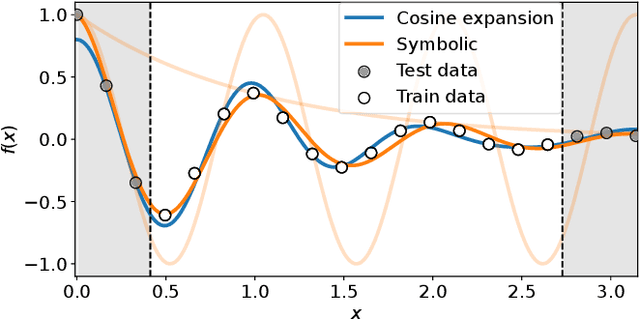
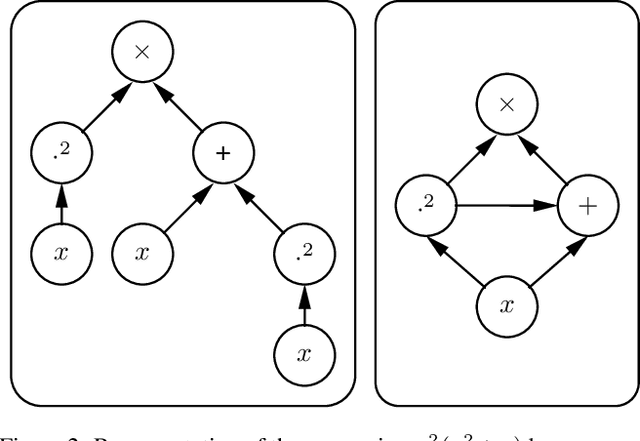
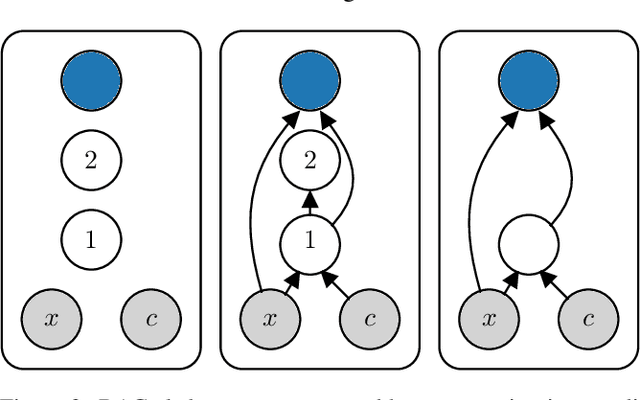
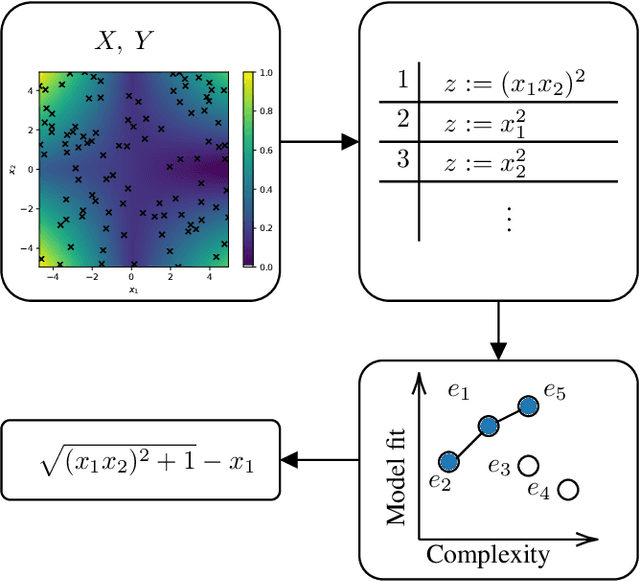
In a regression task, a function is learned from labeled data to predict the labels at new data points. The goal is to achieve small prediction errors. In symbolic regression, the goal is more ambitious, namely, to learn an interpretable function that makes small prediction errors. This additional goal largely rules out the standard approach used in regression, that is, reducing the learning problem to learning parameters of an expansion of basis functions by optimization. Instead, symbolic regression methods search for a good solution in a space of symbolic expressions. To cope with the typically vast search space, most symbolic regression methods make implicit, or sometimes even explicit, assumptions about its structure. Here, we argue that the only obvious structure of the search space is that it contains small expressions, that is, expressions that can be decomposed into a few subexpressions. We show that systematically searching spaces of small expressions finds solutions that are more accurate and more robust against noise than those obtained by state-of-the-art symbolic regression methods. In particular, systematic search outperforms state-of-the-art symbolic regressors in terms of its ability to recover the true underlying symbolic expressions on established benchmark data sets.
Paparazzi: A Deep Dive into the Capabilities of Language and Vision Models for Grounding Viewpoint Descriptions
Feb 13, 2023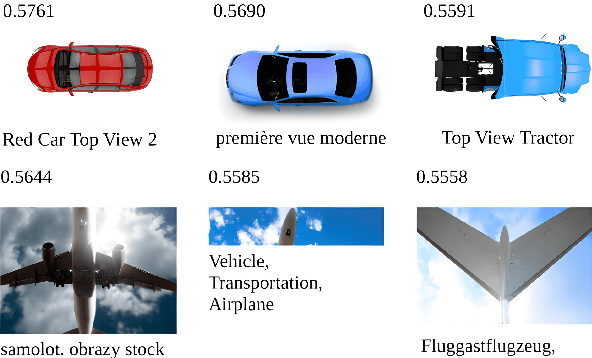

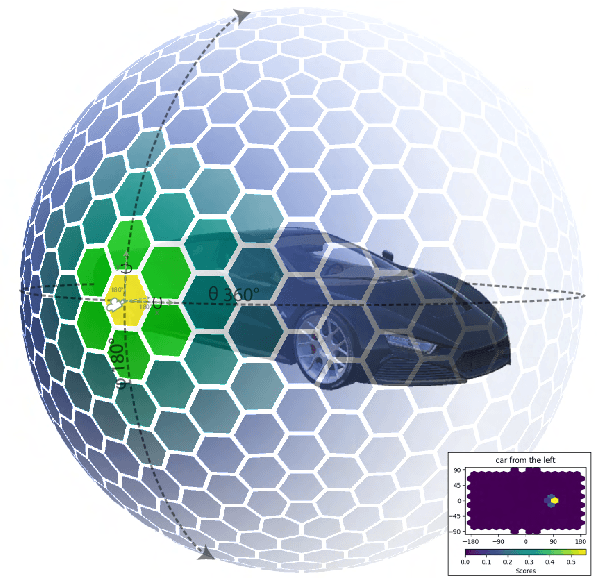
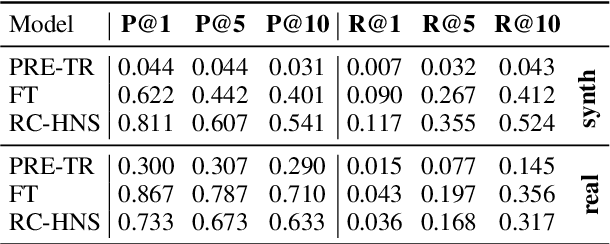
Existing language and vision models achieve impressive performance in image-text understanding. Yet, it is an open question to what extent they can be used for language understanding in 3D environments and whether they implicitly acquire 3D object knowledge, e.g. about different views of an object. In this paper, we investigate whether a state-of-the-art language and vision model, CLIP, is able to ground perspective descriptions of a 3D object and identify canonical views of common objects based on text queries. We present an evaluation framework that uses a circling camera around a 3D object to generate images from different viewpoints and evaluate them in terms of their similarity to natural language descriptions. We find that a pre-trained CLIP model performs poorly on most canonical views and that fine-tuning using hard negative sampling and random contrasting yields good results even under conditions with little available training data.