 Add to Chrome
 Add to Firefox
 Add to Edge
Probabilistic Deep Learning for Drought Forecasting: Role of Internal Climate Variability
Aug 03, 2026
Predicting drought risk is essential for anticipating impacts on water resources, agriculture, ecosystems, and climate adaptation planning. Yet drought forecasts remain uncertain because variability can substantially alter regional precipitation and evaporative demand. Treating this variability as unstructured noise ignores the fact that internal variability has spatial, seasonal, and temporal structure and thus contains information that can be used to improve drought forecasting. We propose a deep-learning-based forecasting framework for European drought prediction and extend it with an uncertainty-aware drought bound that explicitly incorporates internal forecast variability from a large climate model ensemble. This bound represents a physically plausible lower-tail trajectory of future drought conditions and marks how severe drought could plausibly become under an unfavourable realisation of internal variability, giving adaptation planning a conservative, risk-averse reference. We compare the proposed bound with a lower bound derived from reanalysis data only and show that our proposed ensemble-informed bound is better calibrated across most regions and seasons. This is specifically true during anomalously dry conditions, when historical reanalysis alone underestimates lower-tail drought risk. Our results show that internal variability should be treated as a forecast quantity in its own right. More broadly, large ensembles provide a practical way to transfer physically plausible climate variability into machine-learning drought forecasts, yielding risk-aware bounds that are more informative for drought assessment under shifting climate conditions.

Algorithm-Agnostic Interpretations for Clustering
Sep 21, 2022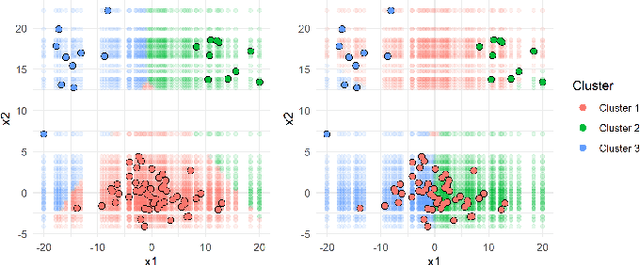
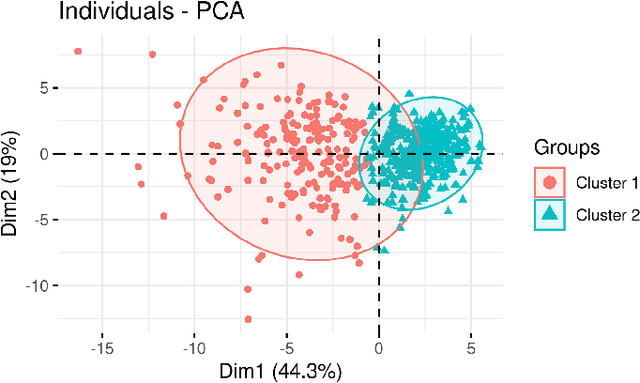
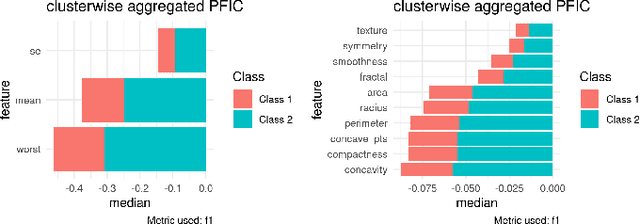
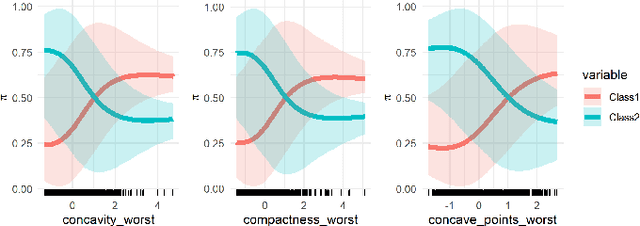
A clustering outcome for high-dimensional data is typically interpreted via post-processing, involving dimension reduction and subsequent visualization. This destroys the meaning of the data and obfuscates interpretations. We propose algorithm-agnostic interpretation methods to explain clustering outcomes in reduced dimensions while preserving the integrity of the data. The permutation feature importance for clustering represents a general framework based on shuffling feature values and measuring changes in cluster assignments through custom score functions. The individual conditional expectation for clustering indicates observation-wise changes in the cluster assignment due to changes in the data. The partial dependence for clustering evaluates average changes in cluster assignments for the entire feature space. All methods can be used with any clustering algorithm able to reassign instances through soft or hard labels. In contrast to common post-processing methods such as principal component analysis, the introduced methods maintain the original structure of the features.