 Add to Chrome
 Add to Firefox
 Add to Edge
A Mathematical Optimization Approach for Expert-Informed Bayesian Best Subset Selection
Jun 28, 2026
A central challenge in statistical modeling is identifying the subset of features that belong in the true regression model. The classical best subset selection problem, recently made tractable via mixed-integer optimization (MIO), finds the globally optimal sparse solution. It does not, however, make use of any information beyond the observed data. In many applied settings, domain experts can meaningfully rank or score the relevance of candidate predictors, yet no existing framework integrates such probabilistic expert assessments directly into the best-subsets objective. This paper presents Expert-Implied Bayesian Best Subsets (EBBS), a method that incorporates domain-expert probability estimates of feature relevance into the MIO best-subsets problem through a maximum a posteriori (MAP) framework. Expert views from multiple respondents are aggregated into a single prior probability per feature using the Poisson binomial distribution for marginal probability estimates, the pairwise win rate for pairwise comparisons, or the normalized mean rank for ordinal rankings. This probability enters the objective function as a log-odds penalty term that smoothly encourages or discourages the selection of each feature consistent with the expert consensus. This paper provides analytic derivations of the MAP formulation and characterizes its theoretical properties. The proposed model reduces to Best Subsets when experts all have no views. Empirical results on synthetic and real datasets are forthcoming.

High-resolution synthetic residential energy use profiles for the United States
Oct 14, 2022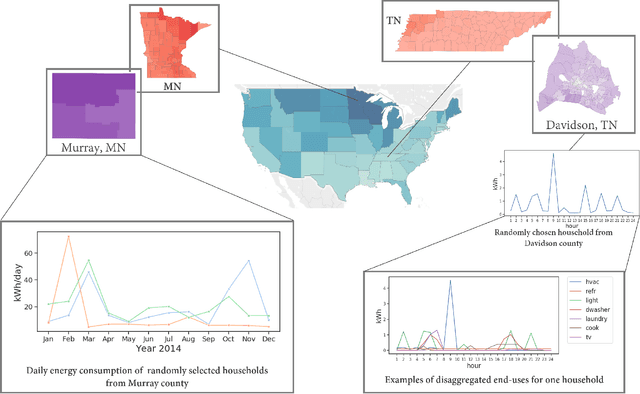
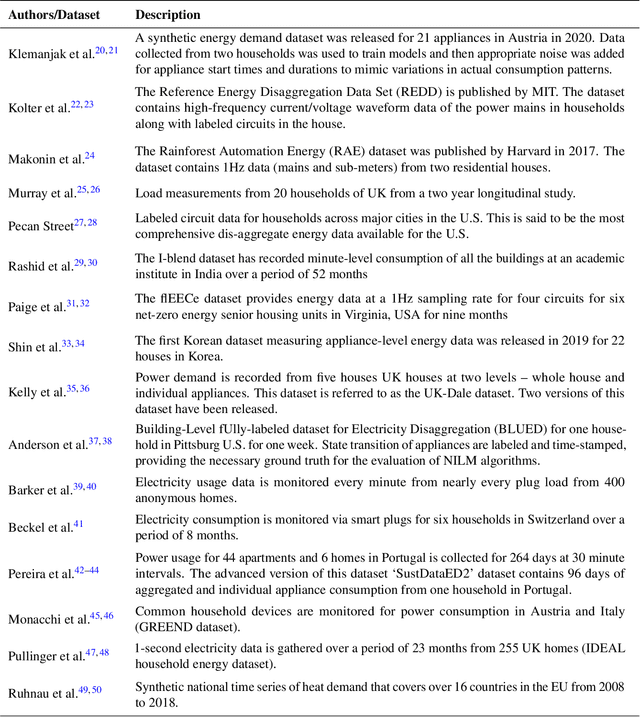
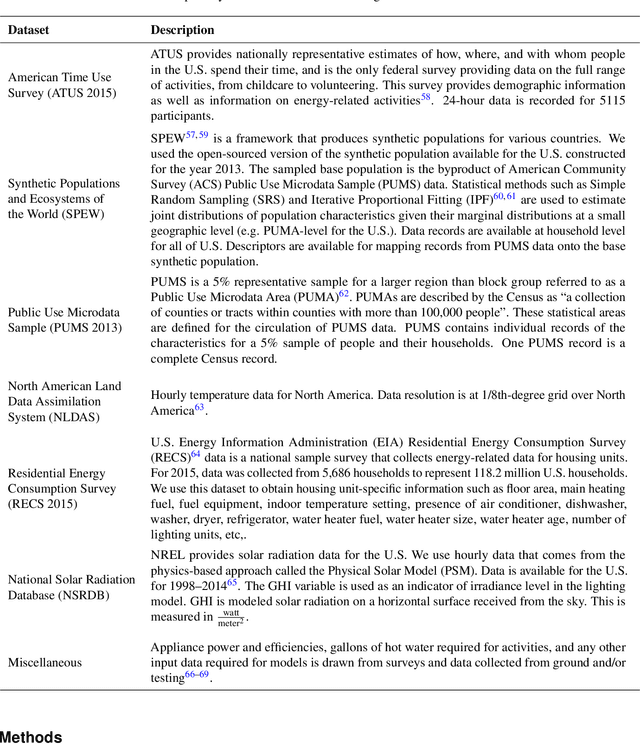
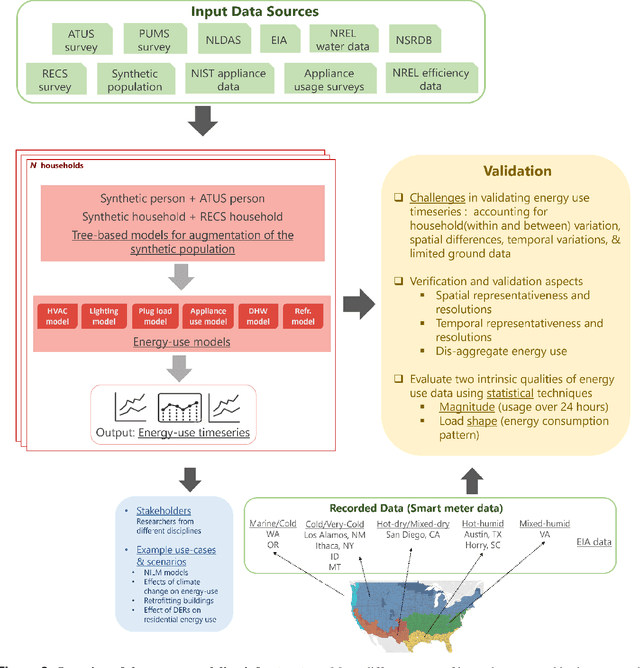
Efficient energy consumption is crucial for achieving sustainable energy goals in the era of climate change and grid modernization. Thus, it is vital to understand how energy is consumed at finer resolutions such as household in order to plan demand-response events or analyze the impacts of weather, electricity prices, electric vehicles, solar, and occupancy schedules on energy consumption. However, availability and access to detailed energy-use data, which would enable detailed studies, has been rare. In this paper, we release a unique, large-scale, synthetic, residential energy-use dataset for the residential sector across the contiguous United States covering millions of households. The data comprise of hourly energy use profiles for synthetic households, disaggregated into Thermostatically Controlled Loads (TCL) and appliance use. The underlying framework is constructed using a bottom-up approach. Diverse open-source surveys and first principles models are used for end-use modeling. Extensive validation of the synthetic dataset has been conducted through comparisons with reported energy-use data. We present a detailed, open, high-resolution, residential energy-use dataset for the United States.
A Scalable Data-Driven Technique for Joint Evacuation Routing and Scheduling Problems
Sep 12, 2022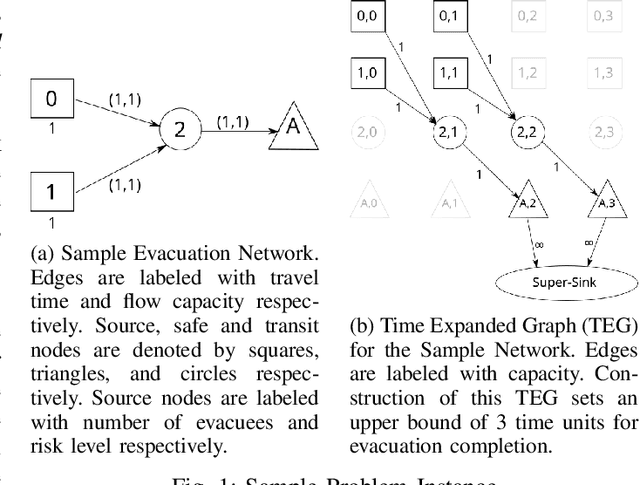
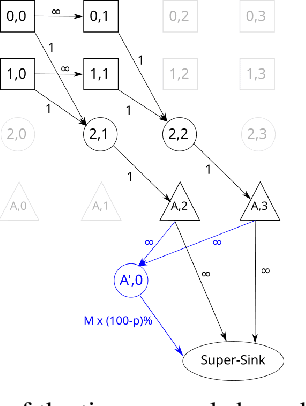
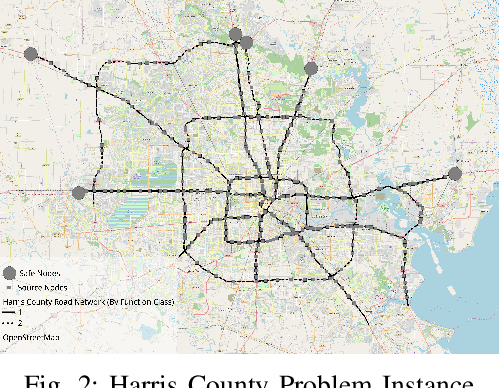
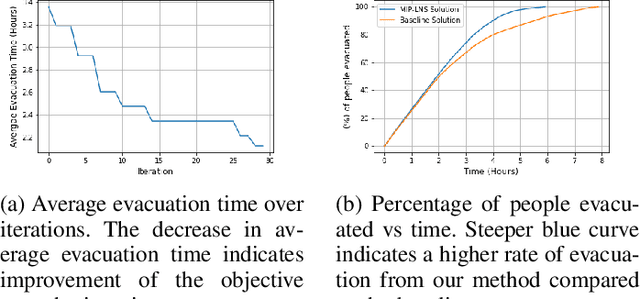
Evacuation planning is a crucial part of disaster management where the goal is to relocate people to safety and minimize casualties. Every evacuation plan has two essential components: routing and scheduling. However, joint optimization of these two components with objectives such as minimizing average evacuation time or evacuation completion time, is a computationally hard problem. To approach it, we present MIP-LNS, a scalable optimization method that combines heuristic search with mathematical optimization and can optimize a variety of objective functions. We use real-world road network and population data from Harris County in Houston, Texas, and apply MIP-LNS to find evacuation routes and schedule for the area. We show that, within a given time limit, our proposed method finds better solutions than existing methods in terms of average evacuation time, evacuation completion time and optimality guarantee of the solutions. We perform agent-based simulations of evacuation in our study area to demonstrate the efficacy and robustness of our solution. We show that our prescribed evacuation plan remains effective even if the evacuees deviate from the suggested schedule upto a certain extent. We also examine how evacuation plans are affected by road failures. Our results show that MIP-LNS can use information regarding estimated deadline of roads to come up with better evacuation plans in terms evacuating more people successfully and conveniently.