 Add to Chrome
 Add to Firefox
 Add to Edge
Have I Solved This Before? Retrieving Similar Segmentation Problems for Evolutionary Learning
Jun 06, 2026
Reliable integration and solid configuration of monitoring systems constitute a fundamental prerequisites for achieving high efficiency and productivity in contemporary manufacturing environments. Design decisions on sensor type and system architecture have to be made at an early stage and under comparably high uncertainty. This work investigates a research direction that deviates from the traditional monitoring-system development process by shifting the attention from algorithm design to a deeper analysis of the inspection problem. In contrast to traditional design cycles, this paper proposes to gradually collect knowledge and store it in an abstract system model. This enables the retrieval of similar solutions for future use cases, preventing the need for expensive model training from scratch and allowing instead for the incremental refinement of existing base configurations. Reuse of previously generated pipelines reduces the risk of late and costly revisions. As there is little knowledge on cross-domain transferability of filter pipelines, this study analyzes the potential of retrieving filter pipelines to transfer them to different but similar segmentation problems. Finally, we statistically analyze the benefits of this `transfer learning' variant which is predominantly applied to image segmentation problems. In addition, we discuss how simple models help balancing the trade-off between complexity, technical requirements, and reliability in the design process.

Analysing the Influence of Reorder Strategies for Cartesian Genetic Programming
Oct 01, 2024
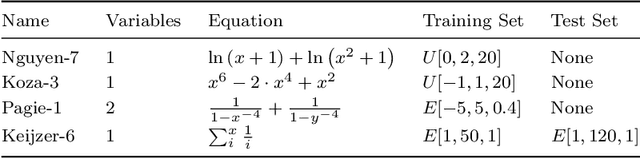
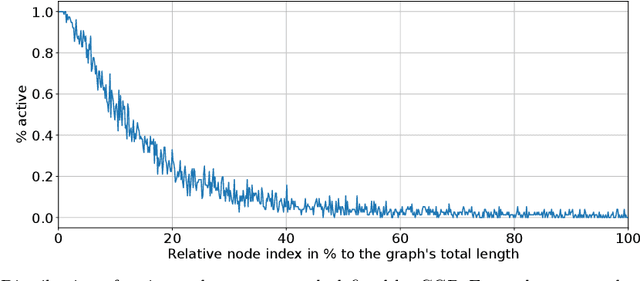
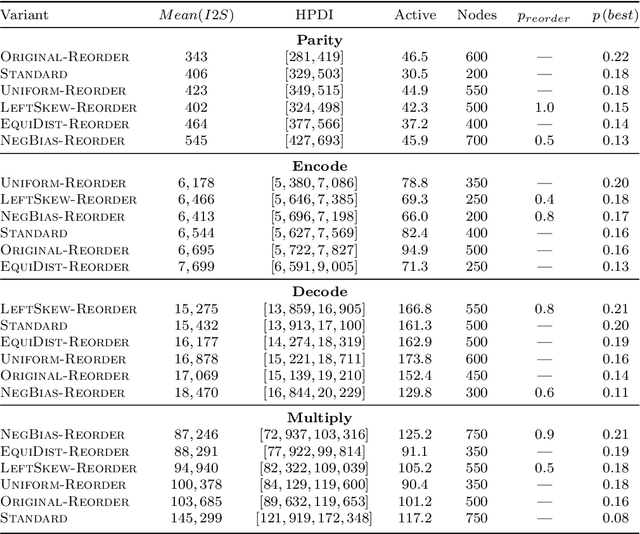
Cartesian Genetic Programming (CGP) suffers from a specific limitation: Positional bias, a phenomenon in which mostly genes at the start of the genome contribute to a program output, while genes at the end rarely do. This can lead to an overall worse performance of CGP. One solution to overcome positional bias is to introduce reordering methods, which shuffle the current genotype without changing its corresponding phenotype. There are currently two different reorder operators that extend the classic CGP formula and improve its fitness value. In this work, we discuss possible shortcomings of these two existing operators. Afterwards, we introduce three novel operators which reorder the genotype of a graph defined by CGP. We show empirically on four Boolean and four symbolic regression benchmarks that the number of iterations until a solution is found and/or the fitness value improves by using CGP with a reorder method. However, there is no consistently best performing reorder operator. Furthermore, their behaviour is analysed by investigating their convergence plots and we show that all behave the same in terms of convergence type.