 Add to Chrome
 Add to Firefox
 Add to Edge
A Multiplicative Neural Network Architecture: Locality and Regularity of Appriximation
Feb 06, 2026
We introduce a multiplicative neural network architecture in which multiplicative interactions constitute the fundamental representation, rather than appearing as auxiliary components within an additive model. We establish a universal approximation theorem for this architecture and analyze its approximation properties in terms of locality and regularity in Bessel potential spaces. To complement the theoretical results, we conduct numerical experiments on representative targets exhibiting sharp transition layers or pointwise loss of higher-order regularity. The experiments focus on the spatial structure of approximation errors and on regularity-sensitive quantities, in particular the convergence of Zygmund-type seminorms. The results show that the proposed multiplicative architecture yields residual error structures that are more tightly aligned with regions of reduced regularity and exhibits more stable convergence in regularity-sensitive metrics. These results demonstrate that adopting a multiplicative representation format has concrete implications for the localization and regularity behavior of neural network approximations, providing a direct connection between architectural design and analytical properties of the approximating functions.

Data-driven simulation for general purpose multibody dynamics using deep neural networks
Sep 02, 2019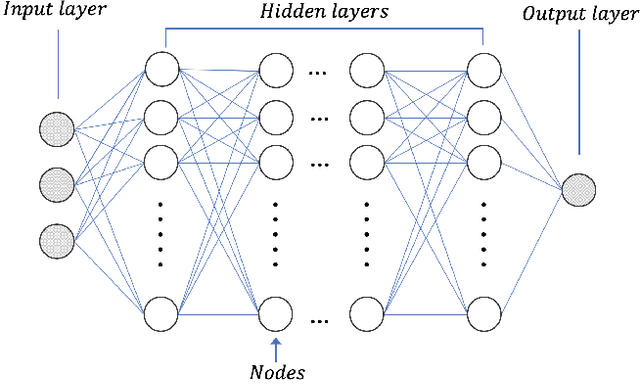
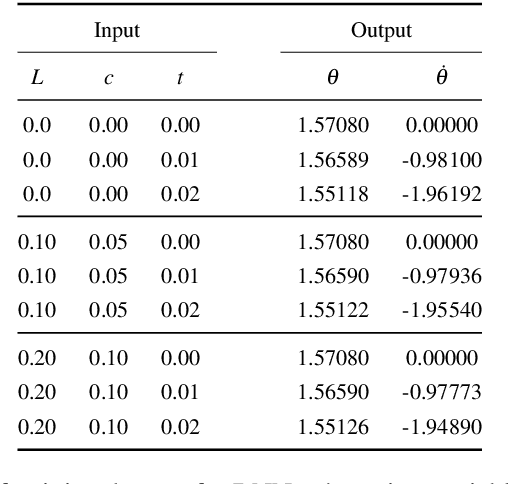
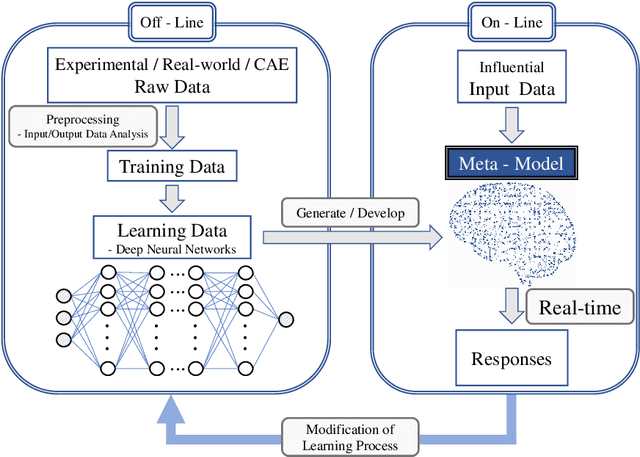
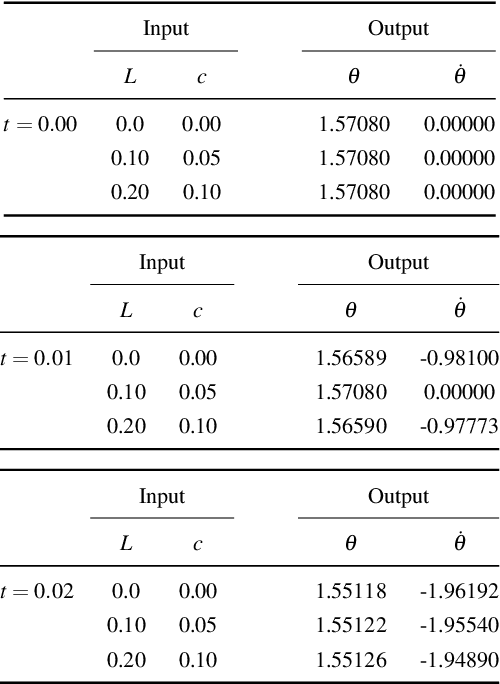
In this paper, a machine learning-based simulation framework of general-purpose multibody dynamics is introduced. The aim of the framework is to generate a well-trained meta-model of multibody dynamics (MBD) systems. To this end, deep neural network (DNN) is employed to the framework so as to construct data-based meta-model representing multibody systems. Constructing well-defined training data set with time variable is essential to get accurate and reliable motion data such as displacement, velocity, acceleration, and forces. As a result of the introduced approach, the meta-model provides motion estimation of system dynamics without solving the analytical equations of motion. The performance of the proposed DNN meta-modeling was evaluated to represent several MBD systems.