 Add to Chrome
 Add to Firefox
 Add to Edge
Learning Coordinate-based Convolutional Kernels for Continuous SE(3) Equivariant and Efficient Point Cloud Analysis
Mar 18, 2026
A symmetry on rigid motion is one of the salient factors in efficient learning of 3D point cloud problems. Group convolution has been a representative method to extract equivariant features, but its realizations have struggled to retain both rigorous symmetry and scalability simultaneously. We advocate utilizing the intertwiner framework to resolve this trade-off, but previous works on it, which did not achieve complete SE(3) symmetry or scalability to large-scale problems, necessitate a more advanced kernel architecture. We present Equivariant Coordinate-based Kernel Convolution, or ECKConv. It acquires SE(3) equivariance from the kernel domain defined in a double coset space, and its explicit kernel design using coordinate-based networks enhances its learning capability and memory efficiency. The experiments on diverse point cloud tasks, e.g., classification, pose registration, part segmentation, and large-scale semantic segmentation, validate the rigid equivariance, memory scalability, and outstanding performance of ECKConv compared to state-of-the-art equivariant methods.

Voronoi-based Second-order Descriptor with Whitened Metric in LiDAR Place Recognition
Mar 16, 2026The pooling layer plays a vital role in aggregating local descriptors into the metrizable global descriptor in the LiDAR Place Recognition (LPR). In particular, the second-order pooling is capable of capturing higher-order interactions among local descriptors. However, its existing methods in the LPR adhere to conventional implementations and post-normalization, and incur the descriptor unsuitable for Euclidean distancing. Based on the recent interpretation that associates NetVLAD with the second-order statistics, we propose to integrate second-order pooling with the inductive bias from Voronoi cells. Our novel pooling method aggregates local descriptors to form the second-order matrix and whitens the global descriptor to implicitly measure the Mahalanobis distance while conserving the cluster property from Voronoi cells, addressing its numerical instability during learning with diverse techniques. We demonstrate its performance gains through the experiments conducted on the Oxford Robotcar and Wild-Places benchmarks and analyze the numerical effect of the proposed whitening algorithm.
Variational Online Mirror Descent for Robust Learning in Schrödinger Bridge
Apr 03, 2025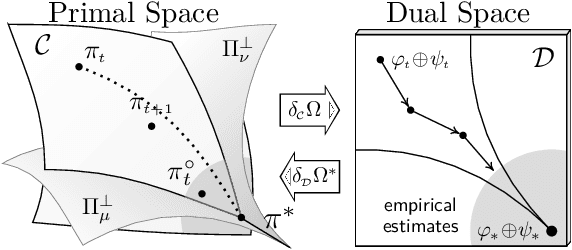
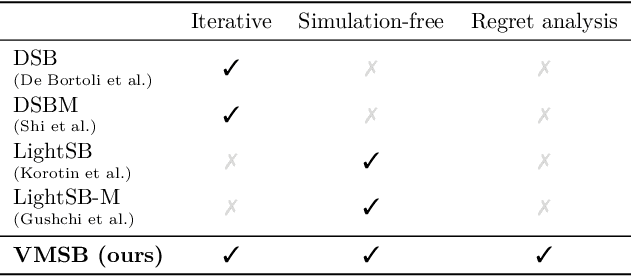
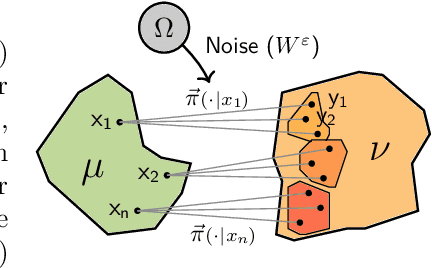
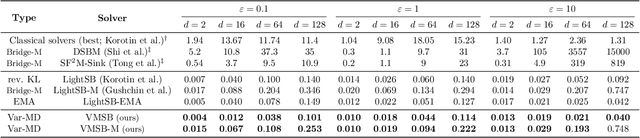
Sch\"odinger bridge (SB) has evolved into a universal class of probabilistic generative models. In practice, however, estimated learning signals are often uncertain, and the reliability promised by existing methods is often based on speculative optimal-case scenarios. Recent studies regarding the Sinkhorn algorithm through mirror descent (MD) have gained attention, revealing geometric insights into solution acquisition of the SB problems. In this paper, we propose a variational online MD (OMD) framework for the SB problems, which provides further stability to SB solvers. We formally prove convergence and a regret bound for the novel OMD formulation of SB acquisition. As a result, we propose a simulation-free SB algorithm called Variational Mirrored Schr\"odinger Bridge (VMSB) by utilizing the Wasserstein-Fisher-Rao geometry of the Gaussian mixture parameterization for Schr\"odinger potentials. Based on the Wasserstein gradient flow theory, the algorithm offers tractable learning dynamics that precisely approximate each OMD step. In experiments, we validate the performance of the proposed VMSB algorithm across an extensive suite of benchmarks. VMSB consistently outperforms contemporary SB solvers on a range of SB problems, demonstrating the robustness predicted by our theory.
Unveiling the Significance of Toddler-Inspired Reward Transition in Goal-Oriented Reinforcement Learning
Mar 18, 2024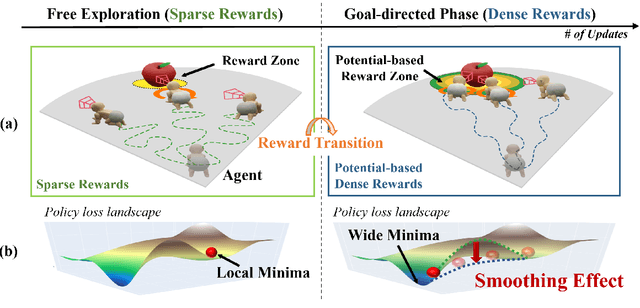

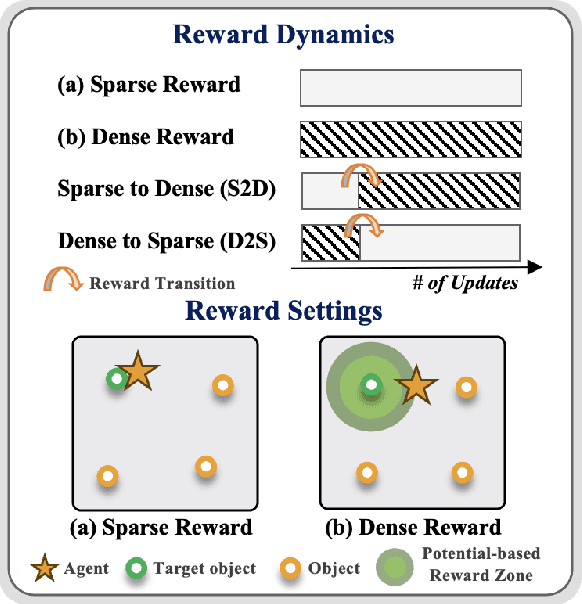
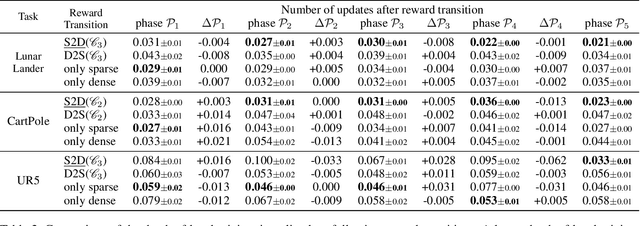
Toddlers evolve from free exploration with sparse feedback to exploiting prior experiences for goal-directed learning with denser rewards. Drawing inspiration from this Toddler-Inspired Reward Transition, we set out to explore the implications of varying reward transitions when incorporated into Reinforcement Learning (RL) tasks. Central to our inquiry is the transition from sparse to potential-based dense rewards, which share optimal strategies regardless of reward changes. Through various experiments, including those in egocentric navigation and robotic arm manipulation tasks, we found that proper reward transitions significantly influence sample efficiency and success rates. Of particular note is the efficacy of the toddler-inspired Sparse-to-Dense (S2D) transition. Beyond these performance metrics, using Cross-Density Visualizer technique, we observed that transitions, especially the S2D, smooth the policy loss landscape, promoting wide minima that enhance generalization in RL models.