 Add to Chrome
 Add to Firefox
 Add to Edge
LLM-Based Multi-Reference Evaluation for Efficient and Robust Assessment of Phrase Break Annotations
Jun 19, 2026
Reliable evaluation of phrase break annotations is crucial, as subtle variations in prosodic boundaries directly affect the clarity and naturalness of speech. However, existing approaches exhibit major limitations: single-reference evaluation assumes a unique gold phrasing for an utterance despite multiple valid phrasings, while human judgment, though flexible, is labor-intensive and unscalable. To address these, we propose LLM-based Multi-Reference Evaluation (LMRE) for phrase break annotations that models the one-to-many nature of prosodic phrasing and generates multiple valid phrasings from minimal demonstrations. On a Korean testbed of 1,356 annotations covering five strategies, LMRE shows stronger alignment with human judgment than single-reference evaluation in both acceptance behavior and score correlation. Our findings demonstrate that LMRE effectively achieves both scalability and multi-reference support, highlighting the potential of LLMs for evaluation in the speech domain.

PRePair: Pointwise Reasoning Enhance Pairwise Evaluating for Robust Instruction-Following Assessments
Jun 18, 2024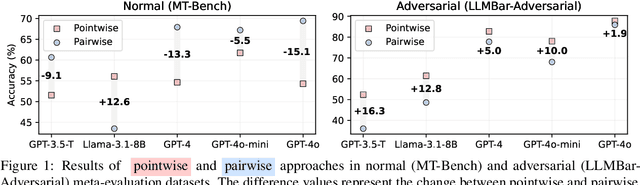
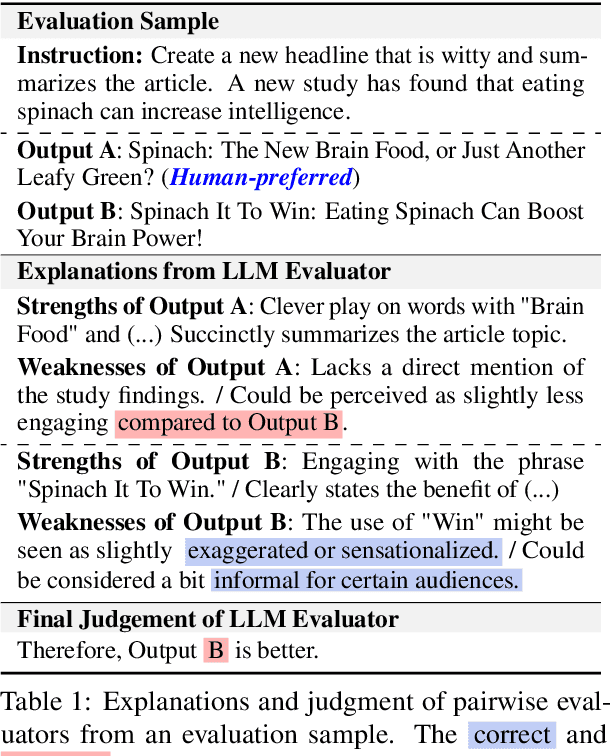
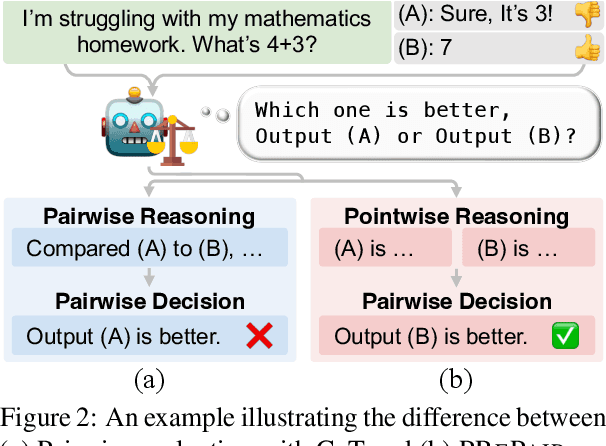
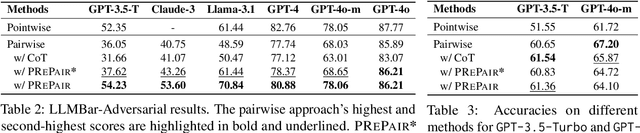
Pairwise evaluation using large language models (LLMs) is widely used for evaluating natural language generation (NLG) tasks. However, the reliability of LLMs is often compromised by biases, such as favoring verbosity and authoritative tone. In the study, we focus on the comparison of two LLM-based evaluation approaches, pointwise and pairwise. Our findings demonstrate that pointwise evaluators exhibit more robustness against undesirable preferences. Further analysis reveals that pairwise evaluators can accurately identify the shortcomings of low-quality outputs even when their judgment is incorrect. These results indicate that LLMs are more severely influenced by their bias in a pairwise evaluation setup. To mitigate this, we propose a hybrid method that integrates pointwise reasoning into pairwise evaluation. Experimental results show that our method enhances the robustness of pairwise evaluators against adversarial samples while preserving accuracy on normal samples.
ST-RAP: A Spatio-Temporal Framework for Real Estate Appraisal
Aug 21, 2023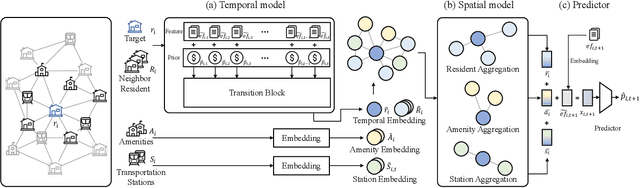
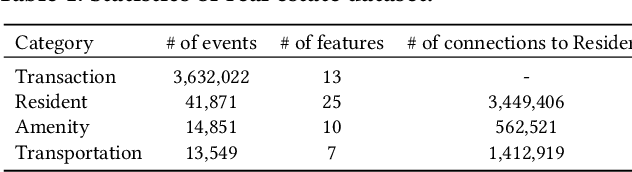
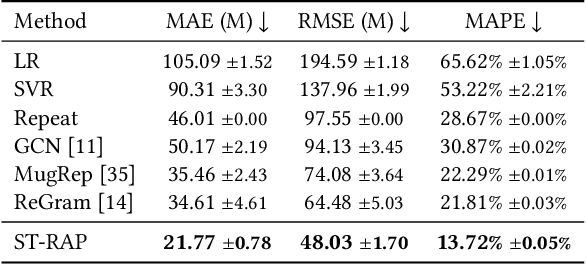

In this paper, we introduce ST-RAP, a novel Spatio-Temporal framework for Real estate APpraisal. ST-RAP employs a hierarchical architecture with a heterogeneous graph neural network to encapsulate temporal dynamics and spatial relationships simultaneously. Through comprehensive experiments on a large-scale real estate dataset, ST-RAP outperforms previous methods, demonstrating the significant benefits of integrating spatial and temporal aspects in real estate appraisal. Our code and dataset are available at https://github.com/dojeon-ai/STRAP.