 Add to Chrome
 Add to Firefox
 Add to Edge
LCC-LLM: Leveraging Code-Centric Large Language Models for Malware Attribution
May 07, 2026
LLMs are increasingly explored for malware analysis; however, current LLM-based malware attribution remains limited by unsupported indicators and insufficient code-level grounding for identifying malicious and vulnerable code segments. To address these limitations, this research introduces LCC-LLM, a code-centric benchmark dataset and evidence-grounded framework for malware attribution and multi-task static malware analysis. The proposed LCCD dataset contains approximately 34K PE samples processed through a large-scale reverse-engineering pipeline and represented using decompiled C code, assembly code, CFG/FCG artifacts, hexadecimal data, PE metadata, suspicious API evidence, and structural features. Beyond dataset construction, LCC-LLM integrates LangGraph-orchestrated static analysis with multi-source cybersecurity knowledge to support evidence-grounded malware reasoning. The framework employs a seven-layer retrieval-augmented generation pipeline, CoVe for IoC validation, and a multi-dimensional quality gate to improve factual reliability and analyst-oriented decision support. Curriculum-ordered instruction data is used to fine-tune DeepSeek-R1-Distill-Qwen-14B and Qwen3-Coder-30B-A3B using QLoRA. Evaluation across 43 malware-analysis task types achieves an average semantic similarity of 0.634, with the highest task-level performance in structured report generation, IoC extraction, vulnerability assessment, malware configuration extraction, and malware class detection. In a real-world case study using MalwareBazaar samples, the grounded pipeline achieves a 10/10 structured analysis pass rate, producing CFG/FCG evidence, MITRE ATT&CK mappings, detection guidance, and analyst-ready reports. These results show that code-centric representations, retrieval grounding, and verification-guided reasoning improve the reliability and operational usefulness of LLM-assisted malware attribution.

Ax-to-Grind Urdu: Benchmark Dataset for Urdu Fake News Detection
Mar 20, 2024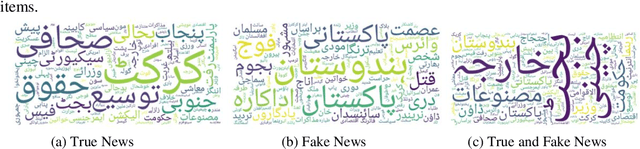
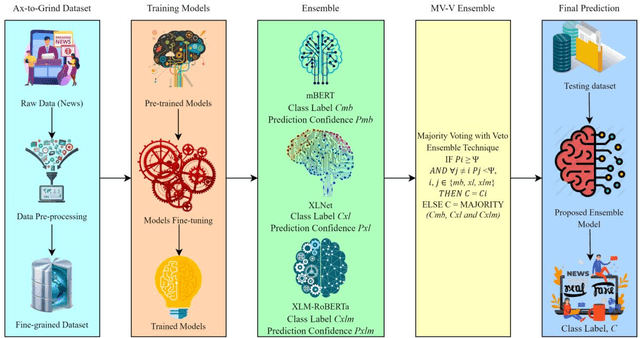

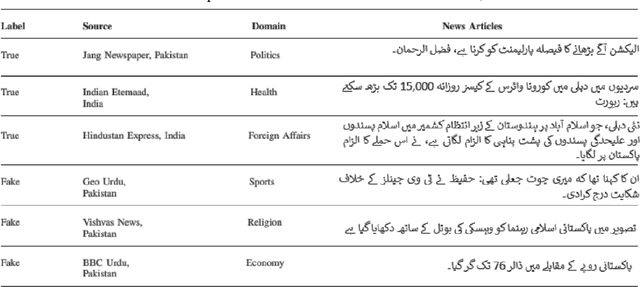
Misinformation can seriously impact society, affecting anything from public opinion to institutional confidence and the political horizon of a state. Fake News (FN) proliferation on online websites and Online Social Networks (OSNs) has increased profusely. Various fact-checking websites include news in English and barely provide information about FN in regional languages. Thus the Urdu FN purveyors cannot be discerned using factchecking portals. SOTA approaches for Fake News Detection (FND) count upon appropriately labelled and large datasets. FND in regional and resource-constrained languages lags due to the lack of limited-sized datasets and legitimate lexical resources. The previous datasets for Urdu FND are limited-sized, domain-restricted, publicly unavailable and not manually verified where the news is translated from English into Urdu. In this paper, we curate and contribute the first largest publicly available dataset for Urdu FND, Ax-to-Grind Urdu, to bridge the identified gaps and limitations of existing Urdu datasets in the literature. It constitutes 10,083 fake and real news on fifteen domains collected from leading and authentic Urdu newspapers and news channel websites in Pakistan and India. FN for the Ax-to-Grind dataset is collected from websites and crowdsourcing. The dataset contains news items in Urdu from the year 2017 to the year 2023. Expert journalists annotated the dataset. We benchmark the dataset with an ensemble model of mBERT,XLNet, and XLM RoBERTa. The selected models are originally trained on multilingual large corpora. The results of the proposed model are based on performance metrics, F1-score, accuracy, precision, recall and MCC value.