 Add to Chrome
 Add to Firefox
 Add to Edge
ADM-Fusion: Adaptive Deep Multi-Sensor Fusion for Robust Ego-Motion Estimation in Diverse Conditions
Jun 23, 2026
Robust multi-sensor fusion is essential for reliable autonomy in diverse and degraded environments, where sensor reliability can fluctuate rapidly. Because different modalities fail in distinct ways, effective fusion should adaptively balance complementary cues rather than rely on fixed weighting. This adaptability is particularly important for ego-motion estimation, since accurate updates depend on the consistent integration of complementary sensor information. We propose ADM-Fusion, an end-to-end deep learning based multi-sensor fusion method designed to adapt to environmental changes and sensor degradation. ADM-Fusion employs an adaptive sensor mixture-of-experts framework with content-aware routing to dynamically assign weights to sensor inputs in real time. The system further incorporates separate translation and rotation branches, coupled through a cross-task attention mechanism to preserve task-specific specialization while enabling information sharing. ADM-Fusion is trained on the CARLA-LOC simulated dataset and subsequently fine-tuned on KITTI real-world data, demonstrating effective simulation-to-real transfer. Experiments show that ADM-Fusion remains robust under degraded conditions while maintaining competitive performance against existing methods.

Efficient Adaptation For Remote Sensing Visual Grounding
Mar 29, 2025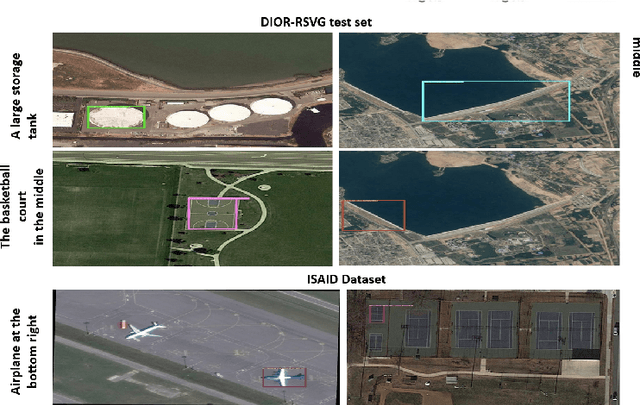
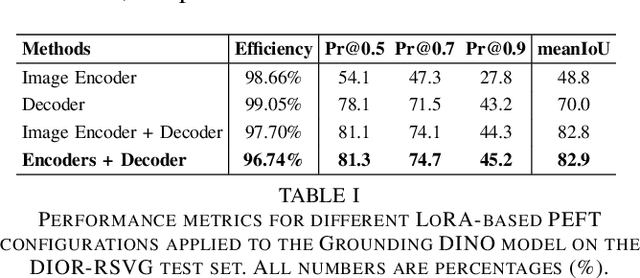
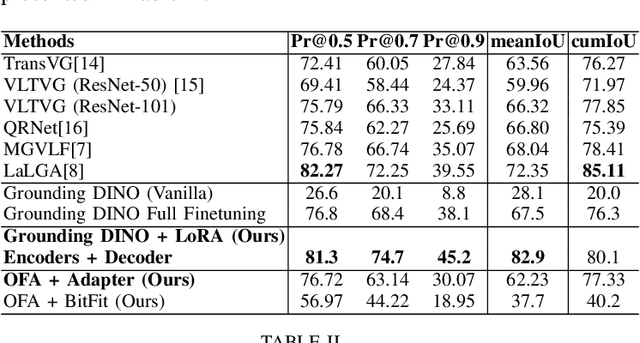
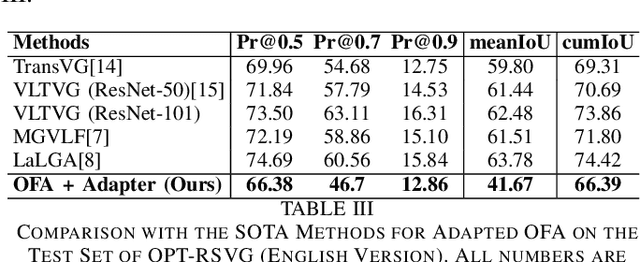
Foundation models have revolutionized artificial intelligence (AI), offering remarkable capabilities across multi-modal domains. Their ability to precisely locate objects in complex aerial and satellite images, using rich contextual information and detailed object descriptions, is essential for remote sensing (RS). These models can associate textual descriptions with object positions through the Visual Grounding (VG) task, but due to domain-specific challenges, their direct application to RS produces sub-optimal results. To address this, we applied Parameter Efficient Fine Tuning (PEFT) techniques to adapt these models for RS-specific VG tasks. Specifically, we evaluated LoRA placement across different modules in Grounding DINO and used BitFit and adapters to fine-tune the OFA foundation model pre-trained on general-purpose VG datasets. This approach achieved performance comparable to or surpassing current State Of The Art (SOTA) models while significantly reducing computational costs. This study highlights the potential of PEFT techniques to advance efficient and precise multi-modal analysis in RS, offering a practical and cost-effective alternative to full model training.
Zero-Shot Refinement of Buildings' Segmentation Models using SAM
Oct 03, 2023Foundation models have excelled in various tasks but are often evaluated on general benchmarks. The adaptation of these models for specific domains, such as remote sensing imagery, remains an underexplored area. In remote sensing, precise building instance segmentation is vital for applications like urban planning. While Convolutional Neural Networks (CNNs) perform well, their generalization can be limited. For this aim, we present a novel approach to adapt foundation models to address existing models' generalization dropback. Among several models, our focus centers on the Segment Anything Model (SAM), a potent foundation model renowned for its prowess in class-agnostic image segmentation capabilities. We start by identifying the limitations of SAM, revealing its suboptimal performance when applied to remote sensing imagery. Moreover, SAM does not offer recognition abilities and thus fails to classify and tag localized objects. To address these limitations, we introduce different prompting strategies, including integrating a pre-trained CNN as a prompt generator. This novel approach augments SAM with recognition abilities, a first of its kind. We evaluated our method on three remote sensing datasets, including the WHU Buildings dataset, the Massachusetts Buildings dataset, and the AICrowd Mapping Challenge. For out-of-distribution performance on the WHU dataset, we achieve a 5.47% increase in IoU and a 4.81% improvement in F1-score. For in-distribution performance on the WHU dataset, we observe a 2.72% and 1.58% increase in True-Positive-IoU and True-Positive-F1 score, respectively. We intend to release our code repository, hoping to inspire further exploration of foundation models for domain-specific tasks within the remote sensing community.