 Add to Chrome
 Add to Firefox
 Add to Edge
When Semantic Overlap Is Not Enough: Cross-Lingual Euphemism Transfer Between Turkish and English
Feb 18, 2026
Euphemisms substitute socially sensitive expressions, often softening or reframing meaning, and their reliance on cultural and pragmatic context complicates modeling across languages. In this study, we investigate how cross-lingual equivalence influences transfer in multilingual euphemism detection. We categorize Potentially Euphemistic Terms (PETs) in Turkish and English into Overlapping (OPETs) and Non-Overlapping (NOPETs) subsets based on their functional, pragmatic, and semantic alignment. Our findings reveal a transfer asymmetry: semantic overlap is insufficient to guarantee positive transfer, particularly in low-resource Turkish-to-English direction, where performance can degrade even for overlapping euphemisms, and in some cases, improve under NOPET-based training. Differences in label distribution help explain these counterintuitive results. Category-level analysis suggests that transfer may be influenced by domain-specific alignment, though evidence is limited by sparsity.

Turkish Delights: a Dataset on Turkish Euphemisms
Jul 17, 2024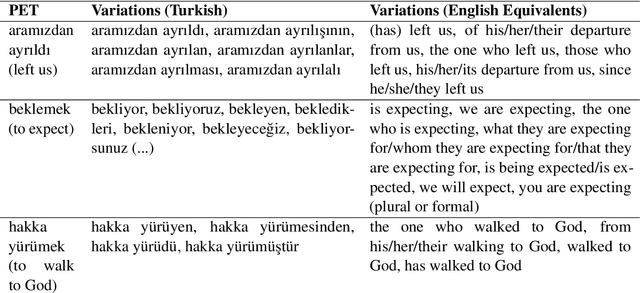
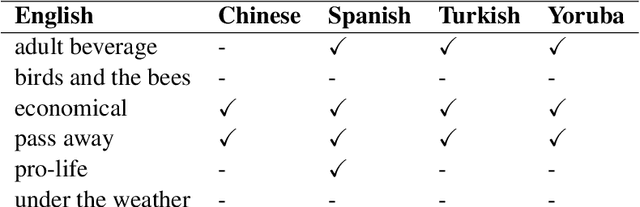
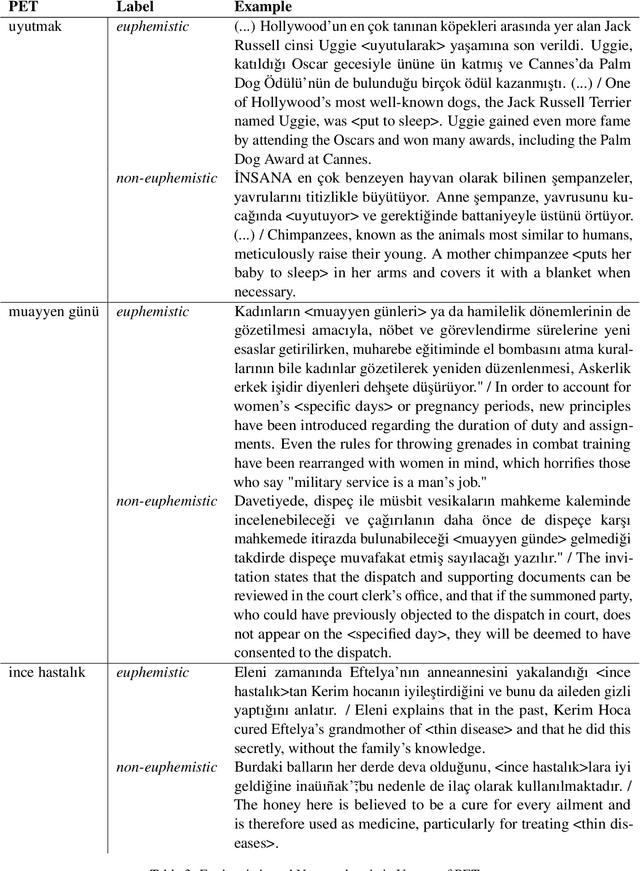
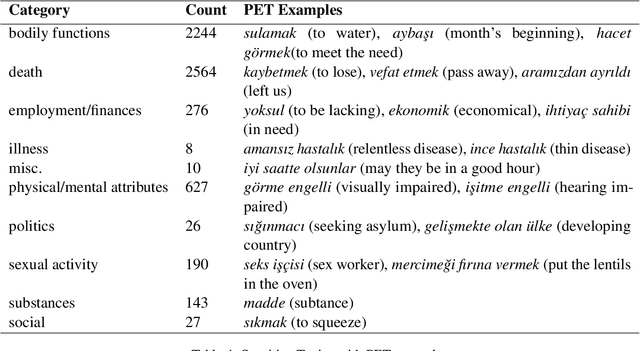
Euphemisms are a form of figurative language relatively understudied in natural language processing. This research extends the current computational work on potentially euphemistic terms (PETs) to Turkish. We introduce the Turkish PET dataset, the first available of its kind in the field. By creating a list of euphemisms in Turkish, collecting example contexts, and annotating them, we provide both euphemistic and non-euphemistic examples of PETs in Turkish. We describe the dataset and methodologies, and also experiment with transformer-based models on Turkish euphemism detection by using our dataset for binary classification. We compare performances across models using F1, accuracy, and precision as evaluation metrics.