 Add to Chrome
 Add to Firefox
 Add to Edge
HDR Video Generation via Latent Alignment with Logarithmic Encoding
Apr 13, 2026
High dynamic range (HDR) imagery offers a rich and faithful representation of scene radiance, but remains challenging for generative models due to its mismatch with the bounded, perceptually compressed data on which these models are trained. A natural solution is to learn new representations for HDR, which introduces additional complexity and data requirements. In this work, we show that HDR generation can be achieved in a much simpler way by leveraging the strong visual priors already captured by pretrained generative models. We observe that a logarithmic encoding widely used in cinematic pipelines maps HDR imagery into a distribution that is naturally aligned with the latent space of these models, enabling direct adaptation via lightweight fine-tuning without retraining an encoder. To recover details that are not directly observable in the input, we further introduce a training strategy based on camera-mimicking degradations that encourages the model to infer missing high dynamic range content from its learned priors. Combining these insights, we demonstrate high-quality HDR video generation using a pretrained video model with minimal adaptation, achieving strong results across diverse scenes and challenging lighting conditions. Our results indicate that HDR, despite representing a fundamentally different image formation regime, can be handled effectively without redesigning generative models, provided that the representation is chosen to align with their learned priors.

AVControl: Efficient Framework for Training Audio-Visual Controls
Mar 25, 2026Controlling video and audio generation requires diverse modalities, from depth and pose to camera trajectories and audio transformations, yet existing approaches either train a single monolithic model for a fixed set of controls or introduce costly architectural changes for each new modality. We introduce AVControl, a lightweight, extendable framework built on LTX-2, a joint audio-visual foundation model, where each control modality is trained as a separate LoRA on a parallel canvas that provides the reference signal as additional tokens in the attention layers, requiring no architectural changes beyond the LoRA adapters themselves. We show that simply extending image-based in-context methods to video fails for structural control, and that our parallel canvas approach resolves this. On the VACE Benchmark, we outperform all evaluated baselines on depth- and pose-guided generation, inpainting, and outpainting, and show competitive results on camera control and audio-visual benchmarks. Our framework supports a diverse set of independently trained modalities: spatially-aligned controls such as depth, pose, and edges, camera trajectory with intrinsics, sparse motion control, video editing, and, to our knowledge, the first modular audio-visual controls for a joint generation model. Our method is both compute- and data-efficient: each modality requires only a small dataset and converges within a few hundred to a few thousand training steps, a fraction of the budget of monolithic alternatives. We publicly release our code and trained LoRA checkpoints.
Clear Skies Ahead: Towards Real-Time Automatic Sky Replacement in Video
Mar 06, 2019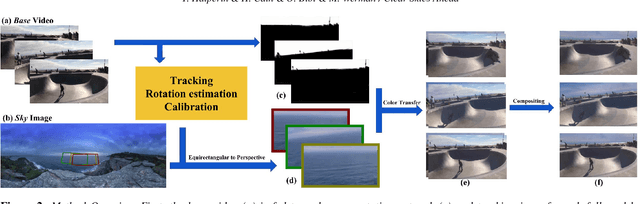
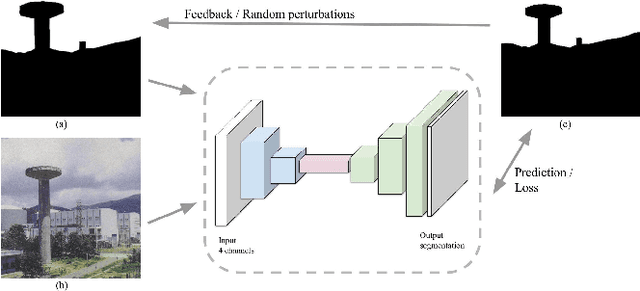
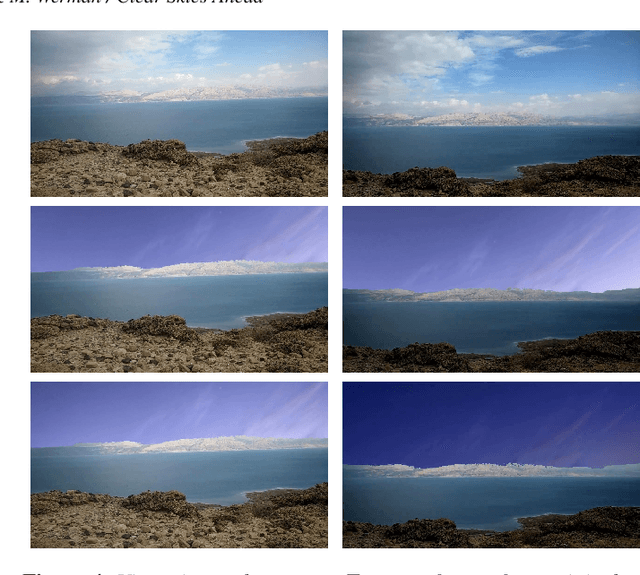
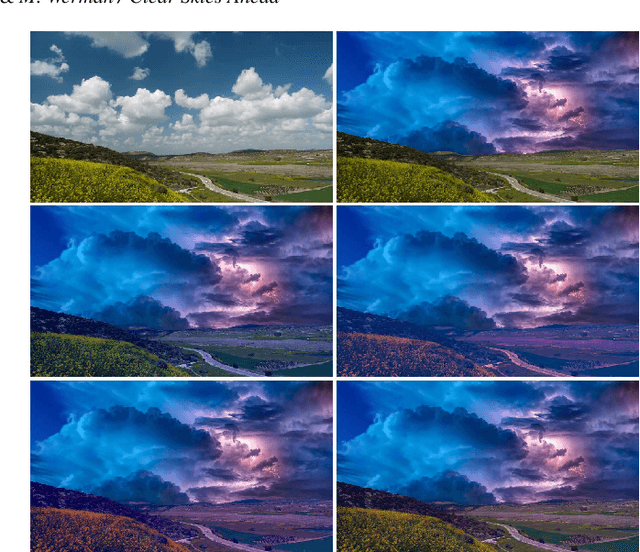
Digital videos such as those captured by a smartphone often exhibit exposure inconsistencies, a poorly exposed sky, or simply suffer from an uninteresting or plain looking sky. Professionals may edit these videos using advanced and time-consuming tools unavailable to most users, to replace the sky with a more expressive or imaginative sky. In this work, we propose an algorithm for automatic replacement of the sky region in a video with a different sky, providing nonprofessional users with a simple yet efficient tool to seamlessly replace the sky. The method is fast, achieving close to real-time performance on mobile devices and the user's involvement can remain as limited as simply selecting the replacement sky.