 Add to Chrome
 Add to Firefox
 Add to Edge
Selection Shapes the Boundary: A Preregistered Replication of Monotonicity and Label Agreement in Unselected NLI Populations
Jul 21, 2026
Prior work on human label variation (HLV) in natural language inference (NLI) has often relied on re-annotation resources that select items by disagreement level. An earlier study (arXiv:2607.15870) found that hypotheses containing non-upward monotonicity operators showed lower label agreement in ChaosNLI (Cliff's delta = -0.284), which is restricted to items whose majority label carries exactly three of five votes. We preregistered a replication of this boundary in the unselected populations that ChaosNLI was drawn from: the SNLI and MultiNLI development sets, using the same operator tagger and a four-level ordinal agreement outcome. The registered prediction fails. All seven contrasts return a positive Cliff's delta (non-upward items agree slightly more, not less), the only significant confirmatory contrast has the opposite sign to the registration, and every effect is far below our smallest effect size of interest (0.10). Robustness checks support the measurement: simulated tagger misclassification shrinks the effects rather than manufacturing them, and a manual re-tagging audit reaches four-class agreement of 0.875 on a fresh 200-item sample. We conclude that the earlier negative boundary is plausibly a structure conditional on low-agreement selection rather than a population-level property, and that HLV structure claims built on selected re-annotation resources should state their selection conditional explicitly.

How Much Human Label Variation Does Formal Semantic Structure Explain?: Group-Level Effects and Item-Level Ceilings in NLI
Jul 17, 2026Human label variation in natural language inference is increasingly treated as signal rather than noise, but how much of it formal semantic structure explains has not been measured directly. We measure it on the 3,113 SNLI and MNLI items of ChaosNLI, using a rule-based operator and monotonicity tagger validated against MED (0.883 agreement at the edit site, 0.807 on the sentence-level summary our analyses consume), three preregistered analysis blocks, and full reporting of negative results. Three bounds emerge. First, a group-level boundary: hypotheses that are not purely upward monotone show reliably higher label entropy (Cliff's delta = -0.284), and rank-based tests defend the effect against operator-presence and length reductions, though a bounded-outcome sensitivity check weakens the regression form of the length defense. Second, an item-level ceiling: the same formal profiles explain only 3.3 to 3.6 percent of entropy variance and reach a median-split AUC of 0.606, too weak to identify high-disagreement items. Third, composition invariance: across the boundary, three high-powered preregistered contrasts on validated error shares and explanation-type shares (VariErr, LiTEx) all return null results. In this sample, formal semantic structure shifts how much annotators disagree by a small amount and does not detectably change what they disagree about. ChaosNLI-S/M consists of items selected for low original agreement, and every claim is conditioned on that scope. All analyses were preregistered in a version-controlled research log, whose audit trail, including one corrected interpretation rule, the paper discloses.
RAMiT: Reciprocal Attention Mixing Transformer for Lightweight Image Restoration
May 22, 2023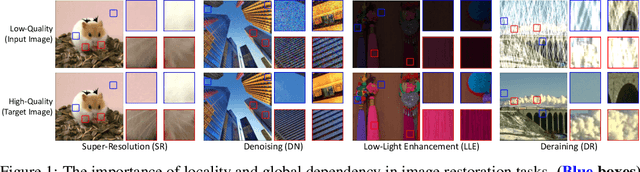
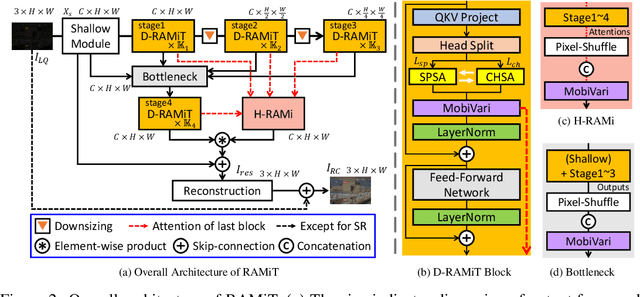
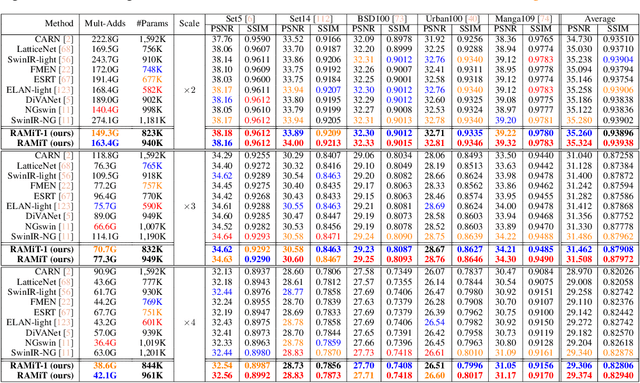
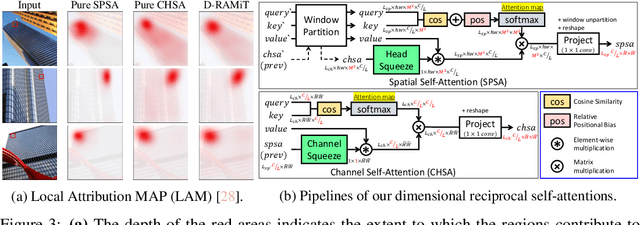
Although many recent works have made advancements in the image restoration (IR) field, they often suffer from an excessive number of parameters. Another issue is that most Transformer-based IR methods focus only on either local or global features, leading to limited receptive fields or deficient parameter issues. To address these problems, we propose a lightweight IR network, Reciprocal Attention Mixing Transformer (RAMiT). It employs our proposed dimensional reciprocal attention mixing Transformer (D-RAMiT) blocks, which compute bi-dimensional (spatial and channel) self-attentions in parallel with different numbers of multi-heads. The bi-dimensional attentions help each other to complement their counterpart's drawbacks and are then mixed. Additionally, we introduce a hierarchical reciprocal attention mixing (H-RAMi) layer that compensates for pixel-level information losses and utilizes semantic information while maintaining an efficient hierarchical structure. Furthermore, we revisit and modify MobileNet V1 and V2 to attach efficient convolutions to our proposed components. The experimental results demonstrate that RAMiT achieves state-of-the-art performance on multiple lightweight IR tasks, including super-resolution, color denoising, grayscale denoising, low-light enhancement, and deraining. Codes will be available soon.
Exploration of Lightweight Single Image Denoising with Transformers and Truly Fair Training
Apr 04, 2023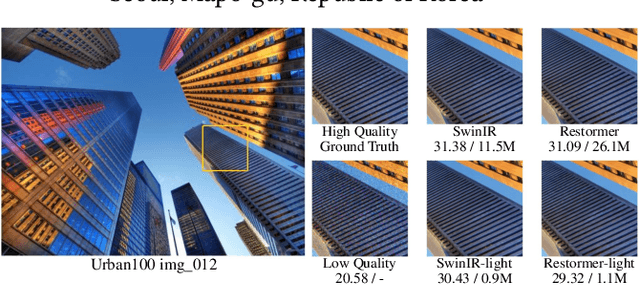
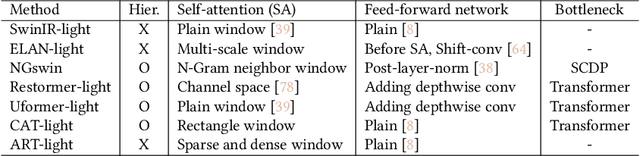
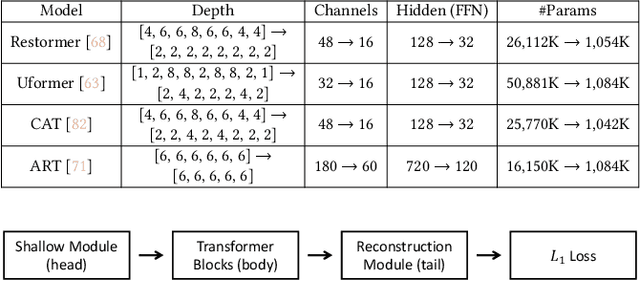
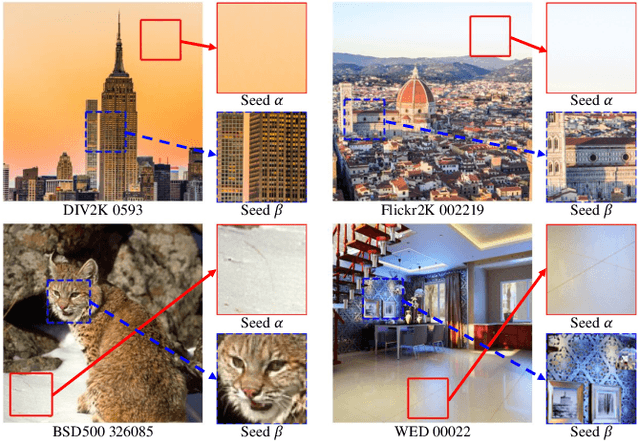
As multimedia content often contains noise from intrinsic defects of digital devices, image denoising is an important step for high-level vision recognition tasks. Although several studies have developed the denoising field employing advanced Transformers, these networks are too momory-intensive for real-world applications. Additionally, there is a lack of research on lightweight denosing (LWDN) with Transformers. To handle this, this work provides seven comparative baseline Transformers for LWDN, serving as a foundation for future research. We also demonstrate the parts of randomly cropped patches significantly affect the denoising performances during training. While previous studies have overlooked this aspect, we aim to train our baseline Transformers in a truly fair manner. Furthermore, we conduct empirical analyses of various components to determine the key considerations for constructing LWDN Transformers. Codes are available at https://github.com/rami0205/LWDN.
N-Gram in Swin Transformers for Efficient Lightweight Image Super-Resolution
Nov 21, 2022While some studies have proven that Swin Transformer (SwinT) with window self-attention (WSA) is suitable for single image super-resolution (SR), SwinT ignores the broad regions for reconstructing high-resolution images due to window and shift size. In addition, many deep learning SR methods suffer from intensive computations. To address these problems, we introduce the N-Gram context to the image domain for the first time in history. We define N-Gram as neighboring local windows in SwinT, which differs from text analysis that views N-Gram as consecutive characters or words. N-Grams interact with each other by sliding-WSA, expanding the regions seen to restore degraded pixels. Using the N-Gram context, we propose NGswin, an efficient SR network with SCDP bottleneck taking all outputs of the hierarchical encoder. Experimental results show that NGswin achieves competitive performance while keeping an efficient structure, compared with previous leading methods. Moreover, we also improve other SwinT-based SR methods with the N-Gram context, thereby building an enhanced model: SwinIR-NG. Our improved SwinIR-NG outperforms the current best lightweight SR approaches and establishes state-of-the-art results. Codes will be available soon.