 Add to Chrome
 Add to Firefox
 Add to Edge
Homotopy-Aware Corridor Generation without Predefined Reference Paths
Jul 31, 2026
Generating safe corridors is essential for collision-free robotic motion planning, yet most existing methods rely on predefined reference paths, which bias corridor geometry and implicitly limit the homotopy classes that can be explored. We propose a reference-path-free corridor generation framework on graphs of convex sets (GCS) that constructs corridors directly as sequences of convex sets, allowing corridor structure to emerge from the free-space representation rather than from a guiding path. To reason about similarity among corridors, we extend visibility-based deformation from paths to convex-set sequences, enabling the fusion of topologically redundant corridors while preserving distinct alternatives. To overcome the limited adaptability of existing GCS methods based on static global decompositions, we further develop an adaptive multi-scale GCS, in which a sampling-based fine-scale graph supports localized updates and a visibility-based coarse-scale graph enables compact global exploration. The two levels maintain topological consistency, allowing incremental updates without full graph reconstruction under environmental uncertainty. Numerical experiments characterize GCS construction, corridor generation, homotopy-aware exploration, and local updates, showing efficient graph construction, stable trajectory-level performance, and shorter-duration homotopy-aware trajectories than existing baselines. Hardware experiments on ground and aerial robots, including deployment with onboard localization, further validate the framework under translated and previously unknown obstacles.

Asynchronous Spatial Allocation Protocol for Trajectory Planning of Heterogeneous Multi-Agent Systems
Oct 02, 2023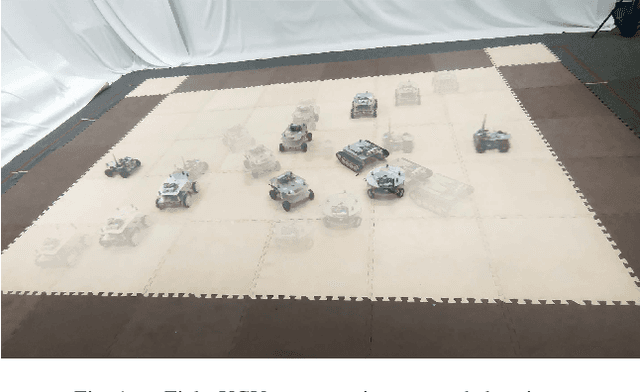
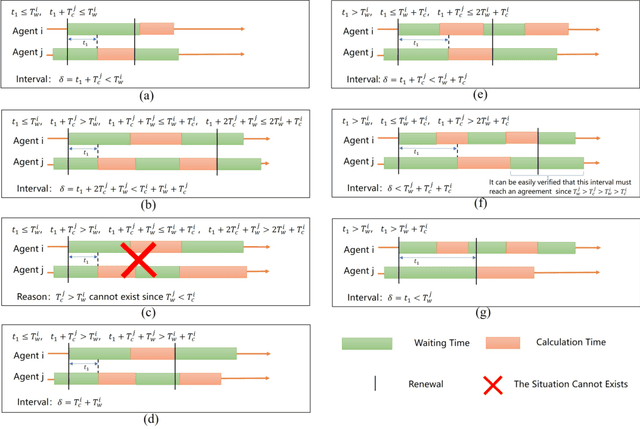
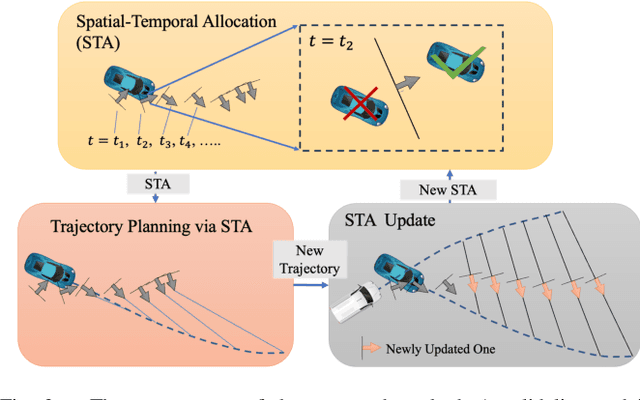
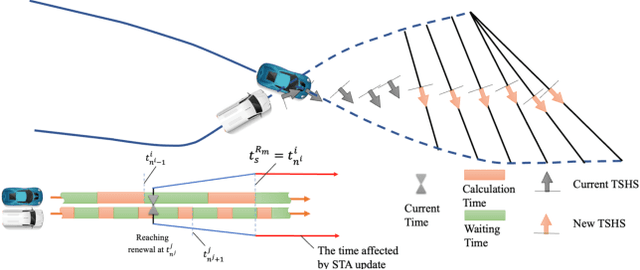
To plan the trajectories of a large and heterogeneous swarm, sequential or synchronous distributed methods usually become intractable, due to the lack of global connectivity and clock synchronization, Moreover, the existing asynchronously distributed schemes usually require recheck-like mechanisms instead of inherently considering the other' moving tendency. To this end, we propose a novel asynchronous protocol to allocate the agents' derivable space in a distributed way, by which each agent can replan trajectory depending on its own timetable. Properties such as collision avoidance and recursive feasibility are theoretically shown and a lower bound of protocol updating is provided. Comprehensive simulations and comparisons with five state-of-the-art methods validate the effectiveness of our method and illustrate the improvement in both the completion time and the moving distance. Finally, hardware experiments are carried out, where 8 heterogeneous unmanned ground vehicles with onboard computation navigate in cluttered scenarios at a high agility.