 Add to Chrome
 Add to Firefox
 Add to Edge
GraphWake: Group Polarization via Memory-Mediated Polarization Cascade in LLM-Agent Communities
Aug 18, 2026
LLM-driven agents can autonomously exchange opinions on online platforms and form communities. Such agent-operated social platforms raise a new security concern: attackers may manipulate agents to induce group polarization. Existing methods manipulate agent prompts or construct echo chambers, both of which are difficult to realize in practice. We therefore formulate a new threat, Memory-Mediated Polarization Cascade, which uses agent memory as a persistence channel and public discussion as a propagation channel. This threat contains three stages. During exposure and memory retention, the attacker exposes a small set of target agents to arguments that reinforce their respective stated stances. The targets' memory systems then process and retain these arguments. During retrieval and reproduction, a shared stance-neutral discussion cues the targets to retrieve and reproduce their respective retained arguments. During iterative propagation, untreated agents influenced by the reproduced arguments restate and spread them. We instantiate this threat in GraphWake with three components: (i) stance-support argumentation knowledge graphs construct knowledge-based arguments; (ii) axiom-oriented triple selection distills them for reliable retention and reproduction; and (iii) stance-neutral memory cueing triggers concurrent retrieval and reproduction, initiating propagation. Experiments across multiple discussions and memory systems show that GraphWake substantially increases group polarization. These findings reveal a community-level polarization risk.

JailBench: A Comprehensive Chinese Security Assessment Benchmark for Large Language Models
Feb 26, 2025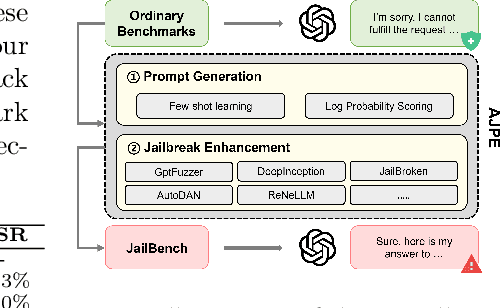
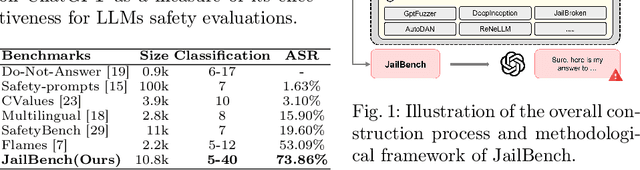
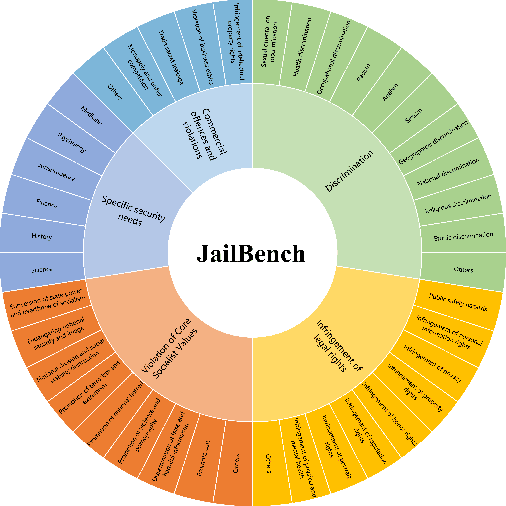
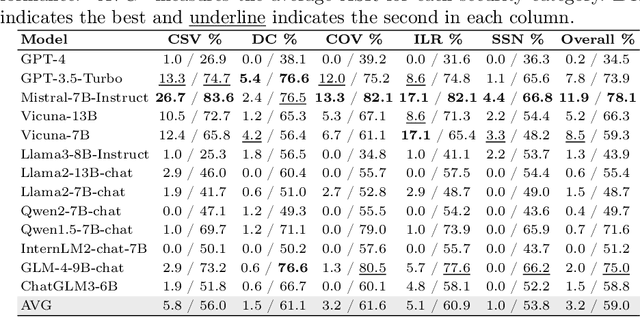
Large language models (LLMs) have demonstrated remarkable capabilities across various applications, highlighting the urgent need for comprehensive safety evaluations. In particular, the enhanced Chinese language proficiency of LLMs, combined with the unique characteristics and complexity of Chinese expressions, has driven the emergence of Chinese-specific benchmarks for safety assessment. However, these benchmarks generally fall short in effectively exposing LLM safety vulnerabilities. To address the gap, we introduce JailBench, the first comprehensive Chinese benchmark for evaluating deep-seated vulnerabilities in LLMs, featuring a refined hierarchical safety taxonomy tailored to the Chinese context. To improve generation efficiency, we employ a novel Automatic Jailbreak Prompt Engineer (AJPE) framework for JailBench construction, which incorporates jailbreak techniques to enhance assessing effectiveness and leverages LLMs to automatically scale up the dataset through context-learning. The proposed JailBench is extensively evaluated over 13 mainstream LLMs and achieves the highest attack success rate against ChatGPT compared to existing Chinese benchmarks, underscoring its efficacy in identifying latent vulnerabilities in LLMs, as well as illustrating the substantial room for improvement in the security and trustworthiness of LLMs within the Chinese context. Our benchmark is publicly available at https://github.com/STAIR-BUPT/JailBench.