 Add to Chrome
 Add to Firefox
 Add to Edge
Understanding Behavior Cloning with Action Quantization
Mar 20, 2026
Behavior cloning is a fundamental paradigm in machine learning, enabling policy learning from expert demonstrations across robotics, autonomous driving, and generative models. Autoregressive models like transformer have proven remarkably effective, from large language models (LLMs) to vision-language-action systems (VLAs). However, applying autoregressive models to continuous control requires discretizing actions through quantization, a practice widely adopted yet poorly understood theoretically. This paper provides theoretical foundations for this practice. We analyze how quantization error propagates along the horizon and interacts with statistical sample complexity. We show that behavior cloning with quantized actions and log-loss achieves optimal sample complexity, matching existing lower bounds, and incurs only polynomial horizon dependence on quantization error, provided the dynamics are stable and the policy satisfies a probabilistic smoothness condition. We further characterize when different quantization schemes satisfy or violate these requirements, and propose a model-based augmentation that provably improves the error bound without requiring policy smoothness. Finally, we establish fundamental limits that jointly capture the effects of quantization error and statistical complexity.

Is Score Matching Suitable for Estimating Point Processes?
Oct 05, 2024
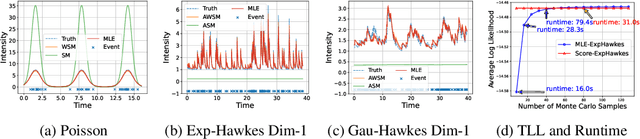
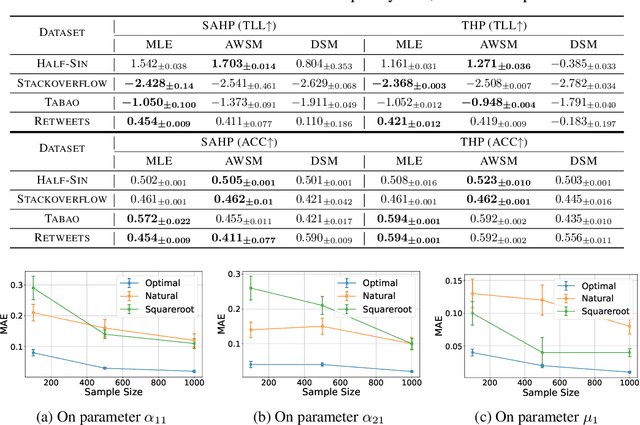

Score matching estimators have gained widespread attention in recent years partly because they are free from calculating the integral of normalizing constant, thereby addressing the computational challenges in maximum likelihood estimation (MLE). Some existing works have proposed score matching estimators for point processes. However, this work demonstrates that the incompleteness of the estimators proposed in those works renders them applicable only to specific problems, and they fail for more general point processes. To address this issue, this work introduces the weighted score matching estimator to point processes. Theoretically, we prove the consistency of our estimator and establish its rate of convergence. Experimental results indicate that our estimator accurately estimates model parameters on synthetic data and yields results consistent with MLE on real data. In contrast, existing score matching estimators fail to perform effectively. Codes are publicly available at \url{https://github.com/KenCao2007/WSM_TPP}.
Accelerating Convergence in Bayesian Few-Shot Classification
May 02, 2024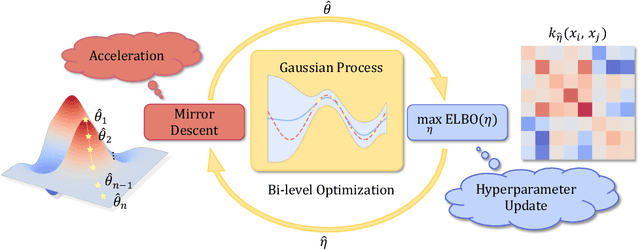
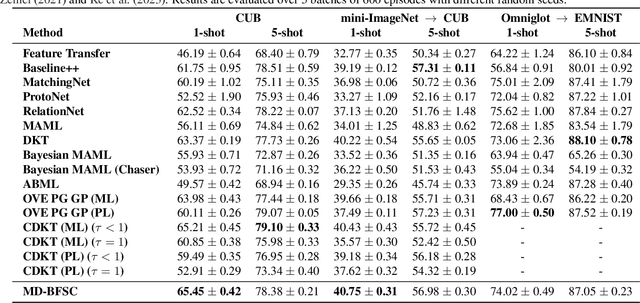
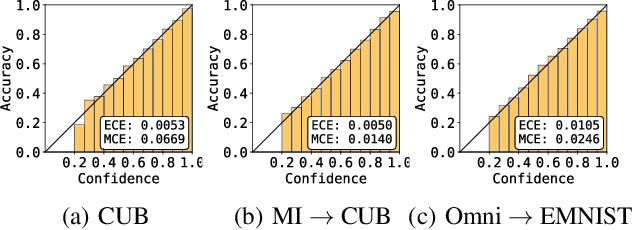
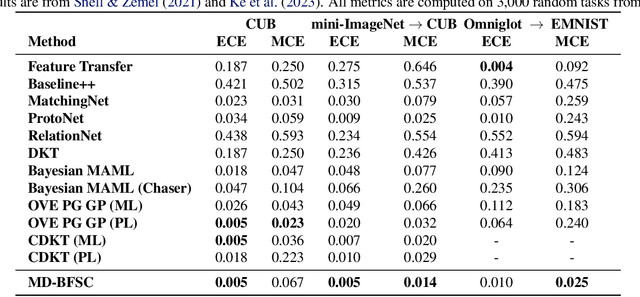
Bayesian few-shot classification has been a focal point in the field of few-shot learning. This paper seamlessly integrates mirror descent-based variational inference into Gaussian process-based few-shot classification, addressing the challenge of non-conjugate inference. By leveraging non-Euclidean geometry, mirror descent achieves accelerated convergence by providing the steepest descent direction along the corresponding manifold. It also exhibits the parameterization invariance property concerning the variational distribution. Experimental results demonstrate competitive classification accuracy, improved uncertainty quantification, and faster convergence compared to baseline models. Additionally, we investigate the impact of hyperparameters and components. Code is publicly available at https://github.com/keanson/MD-BSFC.
Revisiting Logistic-softmax Likelihood in Bayesian Meta-Learning for Few-Shot Classification
Oct 16, 2023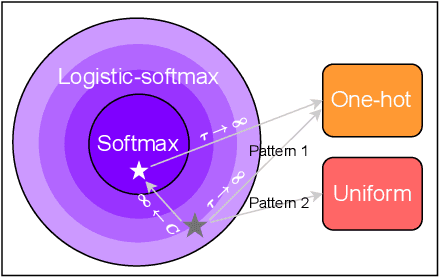
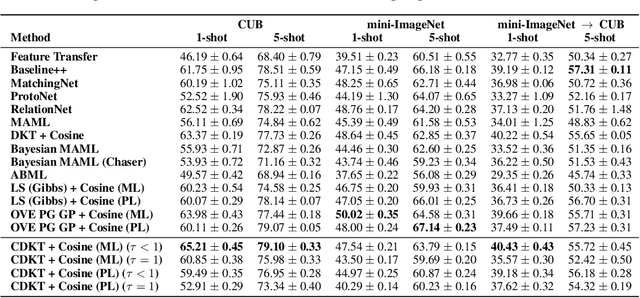
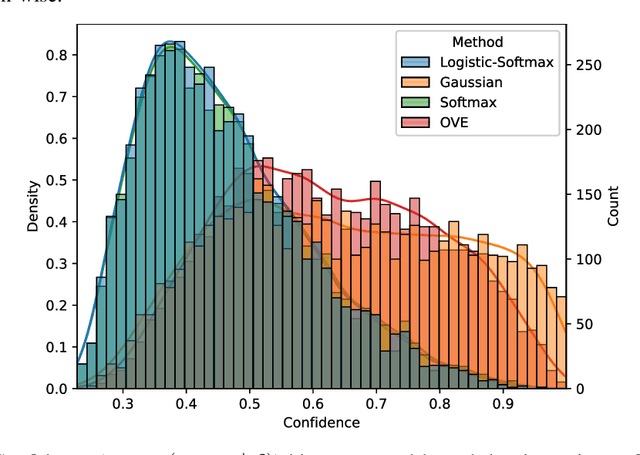
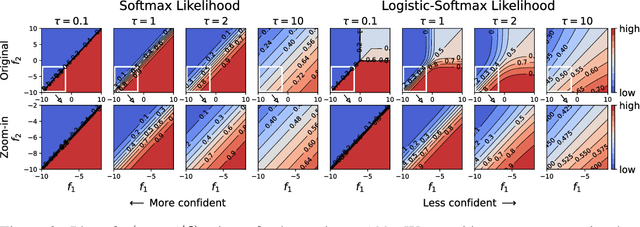
Meta-learning has demonstrated promising results in few-shot classification (FSC) by learning to solve new problems using prior knowledge. Bayesian methods are effective at characterizing uncertainty in FSC, which is crucial in high-risk fields. In this context, the logistic-softmax likelihood is often employed as an alternative to the softmax likelihood in multi-class Gaussian process classification due to its conditional conjugacy property. However, the theoretical property of logistic-softmax is not clear and previous research indicated that the inherent uncertainty of logistic-softmax leads to suboptimal performance. To mitigate these issues, we revisit and redesign the logistic-softmax likelihood, which enables control of the \textit{a priori} confidence level through a temperature parameter. Furthermore, we theoretically and empirically show that softmax can be viewed as a special case of logistic-softmax and logistic-softmax induces a larger family of data distribution than softmax. Utilizing modified logistic-softmax, we integrate the data augmentation technique into the deep kernel based Gaussian process meta-learning framework, and derive an analytical mean-field approximation for task-specific updates. Our approach yields well-calibrated uncertainty estimates and achieves comparable or superior results on standard benchmark datasets. Code is publicly available at \url{https://github.com/keanson/revisit-logistic-softmax}.