 Add to Chrome
 Add to Firefox
 Add to Edge
MED-COPILOT: A Medical Assistant Powered by GraphRAG and Similar Patient Case Retrieval
Feb 28, 2026
Clinical decision-making requires synthesizing heterogeneous evidence, including patient histories, clinical guidelines, and trajectories of comparable cases. While large language models (LLMs) offer strong reasoning capabilities, they remain prone to hallucinations and struggle to integrate long, structured medical documents. We present MED-COPILOT, an interactive clinical decision-support system designed for clinicians and medical trainees, which combines guideline-grounded GraphRAG retrieval with hybrid semantic-keyword similar-patient retrieval to support transparent and evidence-aware clinical reasoning. The system builds a structured knowledge graph from WHO and NICE guidelines, applies community-level summarization for efficient retrieval, and maintains a 36,000-case similar-patient database derived from SOAP-normalized MIMIC-IV notes and Synthea-generated records. We evaluate our framework on clinical note completion and medical question answering, and demonstrate that it consistently outperforms parametric LLM baselines and standard RAG, improving both generation fidelity and clinical reasoning accuracy. The full system is available at https://huggingface.co/spaces/Cryo3978/Med_GraphRAG , enabling users to inspect retrieved evidence, visualize token-level similarity contributions, and conduct guided follow-up analysis. Our results demonstrate a practical and interpretable approach to integrating structured guideline knowledge with patient-level analogical evidence for clinical LLMs.

Machine Learning-Based Model for Postoperative Stroke Prediction in Coronary Artery Disease
Mar 15, 2025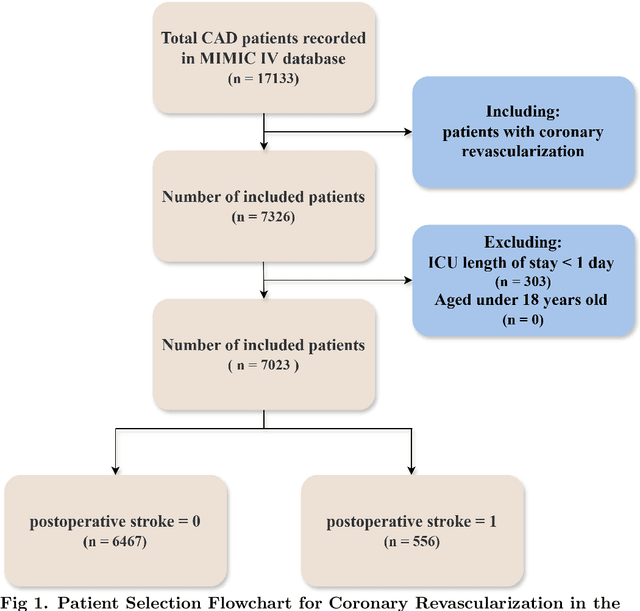
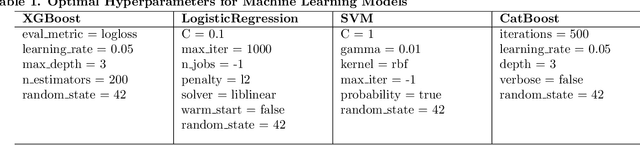
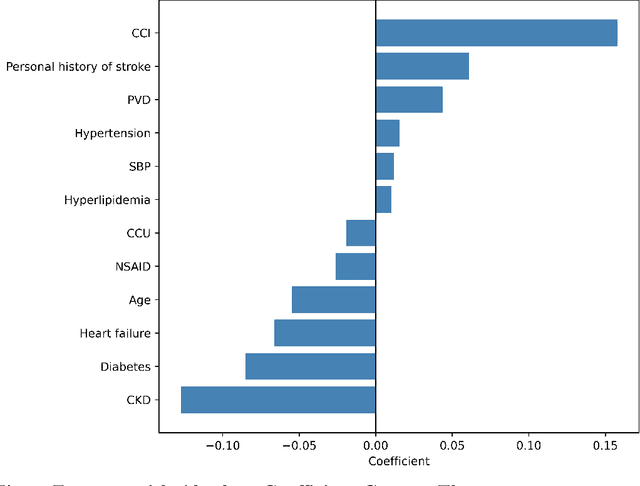
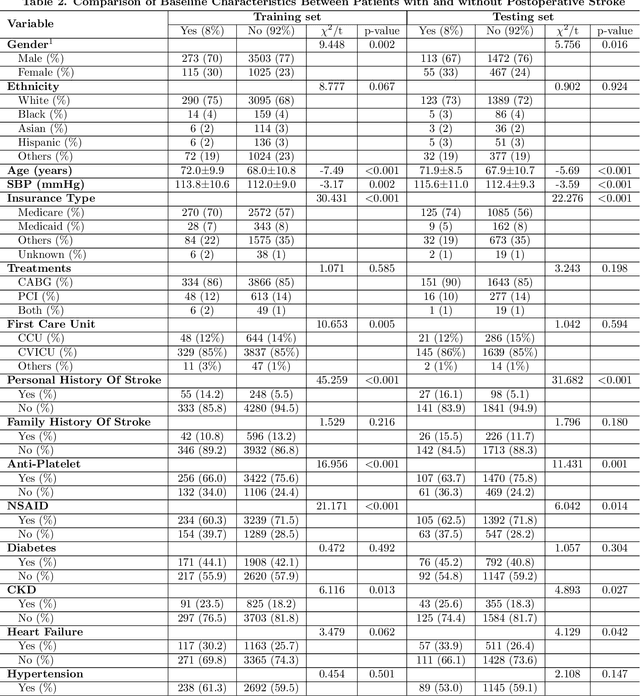
Coronary artery disease remains one of the leading causes of mortality globally. Despite advances in revascularization treatments like PCI and CABG, postoperative stroke is inevitable. This study aims to develop and evaluate a sophisticated machine learning prediction model to assess postoperative stroke risk in coronary revascularization patients.This research employed data from the MIMIC-IV database, consisting of a cohort of 7023 individuals. Study data included clinical, laboratory, and comorbidity variables. To reduce multicollinearity, variables with over 30% missing values and features with a correlation coefficient larger than 0.9 were deleted. The dataset has 70% training and 30% test. The Random Forest technique interpolated residual dataset missing values. Numerical values were normalized, whereas categorical variables were one-hot encoded. LASSO regularization selected features, and grid search found model hyperparameters. Finally, Logistic Regression, XGBoost, SVM, and CatBoost were employed for predictive modeling, and SHAP analysis assessed stroke risk for each variable. AUC of 0.855 (0.829-0.878) showed that SVM model outperformed logistic regression and CatBoost models in prior research. SHAP research showed that the Charlson Comorbidity Index (CCI), diabetes, chronic kidney disease, and heart failure are significant prognostic factors for postoperative stroke. This study shows that improved machine learning reduces overfitting and improves model predictive accuracy. Models using the CCI alone cannot predict postoperative stroke risk as accurately as those using independent comorbidity variables. The suggested technique provides a more thorough and individualized risk assessment by encompassing a wider range of clinically relevant characteristics, making it a better reference for preoperative risk assessments and targeted intervention.