 Add to Chrome
 Add to Firefox
 Add to Edge
Metasurfaces Enable Active-Like Passive Radar
Dec 09, 2025
Passive radars (PRs) provide a low-cost and energy-efficient approach to object detection by reusing existing wireless transmissions instead of emitting dedicated probing signals. Yet, conventional passive systems require prior knowledge of non-cooperative source waveforms, are vulnerable to strong interference, and rely on Doppler signatures, limiting their ability to detect subtle or slow-moving targets. Here, we introduce a metasurface-enabled PR (MEPR) concept that integrates a space-time-coding programmable metasurface to imprint distinct spatiotemporal tags onto ambient wireless wavefields. This mechanism transforms a PR into an active-like sensing platform without the need for source control, enabling interference suppression, signal enhancement, and accurate target localization and tracking in cluttered environments. A proof-of-concept implementation operating at 5.48 GHz confirms real-time imaging and tracking of unmanned aerial vehicles under interference-rich conditions, with performance comparable to active radar systems. These results establish MEPR as a solid foundation for scalable, adaptive, and energy-efficient next-generation integrated sensing and communication systems.

Intelligent Meta-Imagers: From Compressed to Learned Sensing
Oct 28, 2021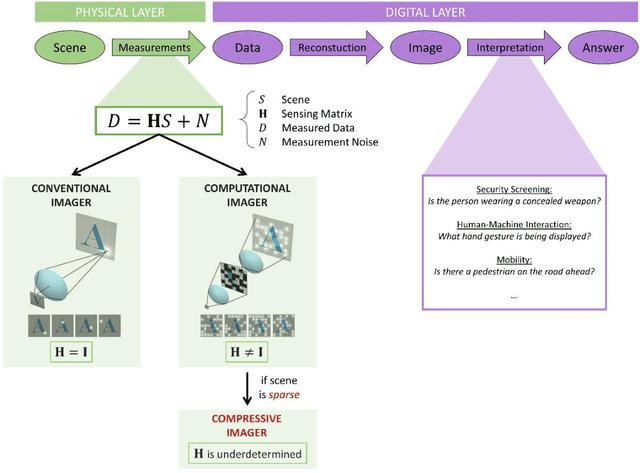
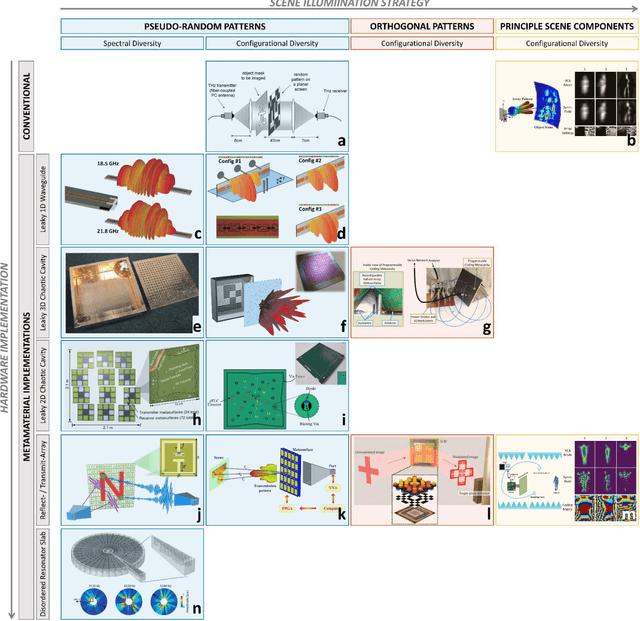
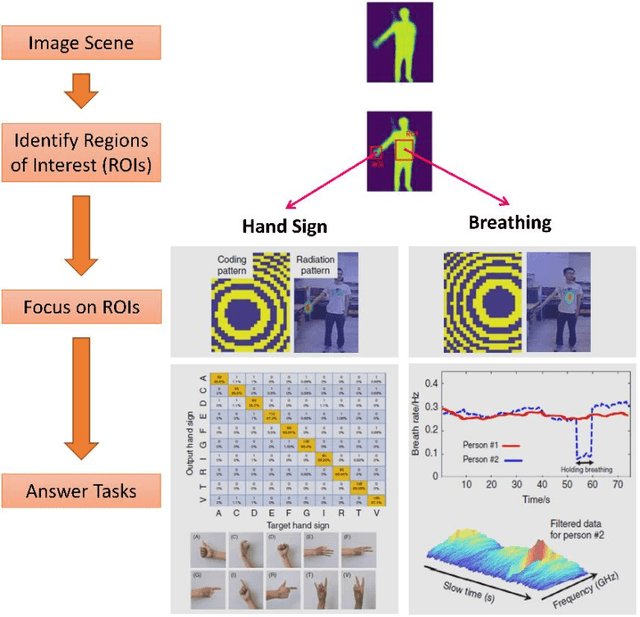
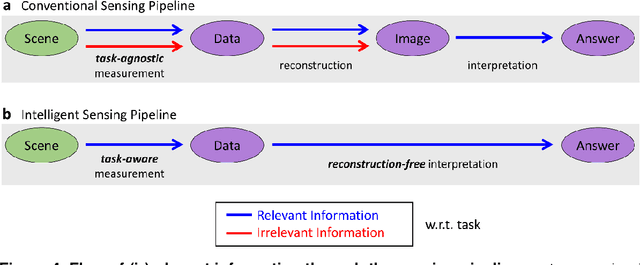
Computational meta-imagers synergize metamaterial hardware with advanced signal processing approaches such as compressed sensing. Recent advances in artificial intelligence (AI) are gradually reshaping the landscape of meta-imaging. Most recent works use AI for data analysis, but some also use it to program the physical meta-hardware. The role of "intelligence" in the measurement process and its implications for critical metrics like latency are often not immediately clear. Here, we comprehensively review the evolution of computational meta-imaging from the earliest frequency-diverse compressive systems to modern programmable intelligent meta-imagers. We introduce a clear taxonomy in terms of the flow of task-relevant information that has direct links to information theory: compressive meta-imagers indiscriminately acquire all scene information in a task-agnostic measurement process that aims at a near-isometric embedding; intelligent meta-imagers highlight task-relevant information in a task-aware measurement process that is purposefully non-isometric. We provide explicit design tutorials for the integration of programmable meta-atoms as trainable physical weights into an intelligent end-to-end sensing pipeline. This merging of the physical world of metamaterial engineering and the digital world of AI enables the remarkable latency gains of intelligent meta-imagers. We further outline emerging opportunities for cognitive meta-imagers with reverberation-enhanced resolution and we point out how the meta-imaging community can reap recent advances in the vibrant field of metamaterial wave processors to reach the holy grail of low-energy ultra-fast all-analog intelligent meta-sensors.