 Add to Chrome
 Add to Firefox
 Add to Edge
Seeing to Generalize: How Visual Data Corrects Binding Shortcuts
Feb 16, 2026
Vision Language Models (VLMs) are designed to extend Large Language Models (LLMs) with visual capabilities, yet in this work we observe a surprising phenomenon: VLMs can outperform their underlying LLMs on purely text-only tasks, particularly in long-context information retrieval. To investigate this effect, we build a controlled synthetic retrieval task and find that a transformer trained only on text achieves perfect in-distribution accuracy but fails to generalize out of distribution, while subsequent training on an image-tokenized version of the same task nearly doubles text-only OOD performance. Mechanistic interpretability reveals that visual training changes the model's internal binding strategy: text-only training encourages positional shortcuts, whereas image-based training disrupts them through spatial translation invariance, forcing the model to adopt a more robust symbolic binding mechanism that persists even after text-only examples are reintroduced. We further characterize how binding strategies vary across training regimes, visual encoders, and initializations, and show that analogous shifts occur during pretrained LLM-to-VLM transitions. Our findings suggest that cross-modal training can enhance reasoning and generalization even for tasks grounded in a single modality.

Failout: Achieving Failure-Resilient Inference in Distributed Neural Networks
Feb 18, 2020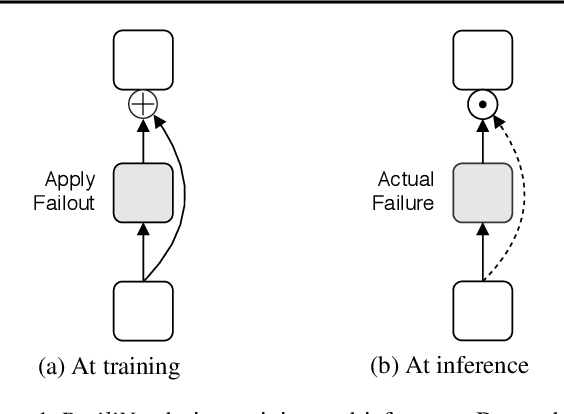
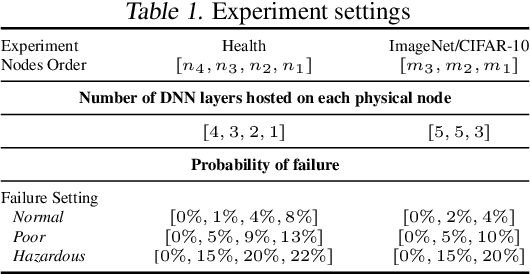
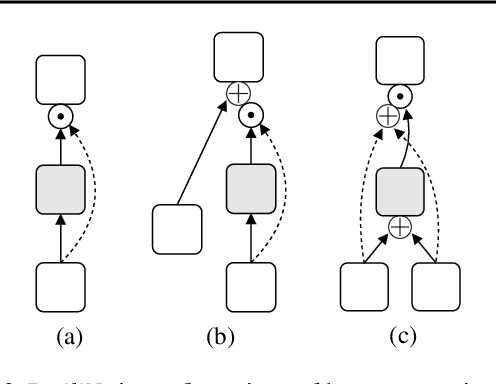
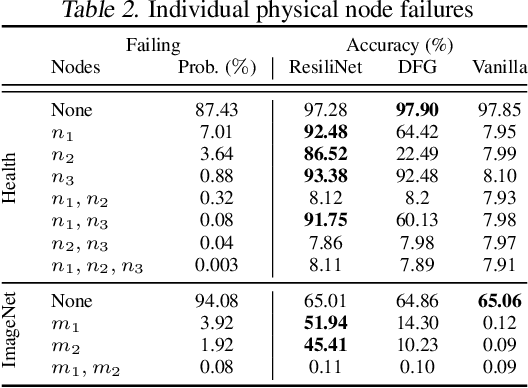
When a neural network is partitioned and distributed across physical nodes, failure of physical nodes causes the failure of the neural units that are placed on those nodes, which results in a significant performance drop. Current approaches focus on resiliency of training in distributed neural networks. However, resiliency of inference in distributed neural networks is less explored. We introduce ResiliNet, a scheme for making inference in distributed neural networks resilient to physical node failures. ResiliNet combines two concepts to provide resiliency: skip connection in residual neural networks, and a novel technique called failout, which is introduced in this paper. Failout simulates physical node failure conditions during training using dropout, and is specifically designed to improve the resiliency of distributed neural networks. The results of the experiments and ablation studies using three datasets confirm the ability of ResiliNet to provide inference resiliency for distributed neural networks.