 Add to Chrome
 Add to Firefox
 Add to Edge
TADDLE: A Tool-Augmented Agent for Detecting Deficient LLM-Generated Peer Reviews
May 26, 2026
LLM-generated peer reviews are increasingly common at major venues, yet their deficiencies are hard to detect because they are uniformly fluent and well-structured. Existing work either classifies authorship without judging quality, or scores quality with features designed for human-written reviews; no prior system detects deficiencies in LLM-generated reviews at the level of individual defect types. To bridge the gap, we introduce TADDLE, a Tool-Augmented Agent for Detecting Deficient LLM-Generated Peer Reviews, together with the first expert-annotated benchmark for this task. Our benchmark comprises 1,800 reviews on 50 ICLR 2025 papers, multi-label-annotated by 18 domain experts against a taxonomy of six defect categories (plus a non-deficient label). TADDLE decomposes detection into four specialized analysis tools -- Verify, Correct, Complete, and Transform -- orchestrated by an agent; an integrator synthesizes their outputs into binary and multi-label classifications via two-stage semi-supervised learning. Extensive experiments show that TADDLE performs strongly on both binary detection and the multi-label classification task. We release the benchmark and code at https://github.com/AquariusAQ/TADDLE.

Can Large Language Models Act as Ensembler for Multi-GNNs?
Oct 22, 2024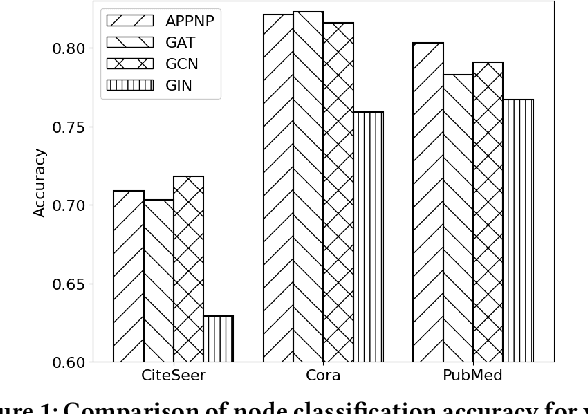
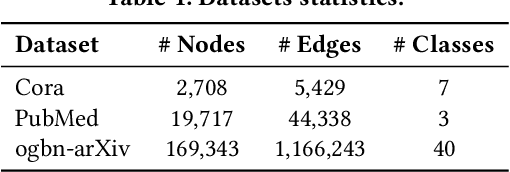
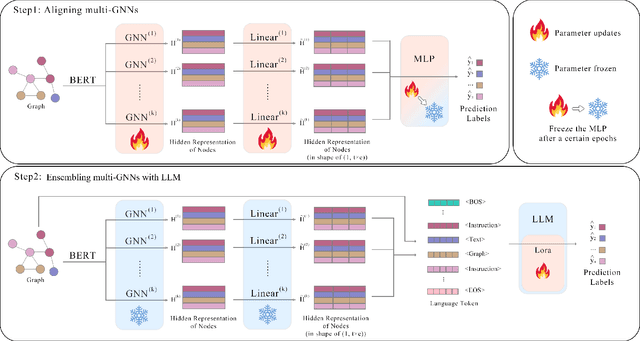
Graph Neural Networks (GNNs) have emerged as powerful models for learning from graph-structured data. However, GNNs lack the inherent semantic understanding capability of rich textual nodesattributes, limiting their effectiveness in applications. On the other hand, we empirically observe that for existing GNN models, no one can consistently outperforms others across diverse datasets. In this paper, we study whether LLMs can act as an ensembler for multi-GNNs and propose the LensGNN model. The model first aligns multiple GNNs, mapping the representations of different GNNs into the same space. Then, through LoRA fine-tuning, it aligns the space between the GNN and the LLM, injecting graph tokens and textual information into LLMs. This allows LensGNN to integrate multiple GNNs and leverage LLM's strengths, resulting in better performance. Experimental results show that LensGNN outperforms existing models. This research advances text-attributed graph ensemble learning by providing a robust, superior solution for integrating semantic and structural information. We provide our code and data here: https://anonymous.4open.science/r/EnsemGNN-E267/.