 Add to Chrome
 Add to Firefox
 Add to Edge
Measuring What the Crawler Sees: Discovery Curves, Core Persistence, and Shell Dynamics in Longitudinal Web Crawls
Jul 15, 2026
A longitudinal web crawl is a sequence of partial samples of an evolving URL population. Pairwise containment between two crawls is the standard probe; under a simple \emph{urn} model of the crawl -- each round samples a fraction of the URLs and replaces a fraction -- it recovers two interpretable rates, per-round survival $α$ and coverage $c$, but treats the population as uniform and consumes one pair at a time. In this work, we define a formal language for talking about a crawl. We extend this analysis with the \emph{discovery curve} $U(s, T)$, the cumulative URL footprint over a sliding window of $T$ crawls starting at $s$, which under the same urn model is also a closed-form function of $(α, c)$. Containment and the discovery curve are then two projections of one process: independent fits agree on $(α, c)$ when the urn is homogeneous, so any disagreement is itself a measurement. Applied to Common Crawl (2020--2025, domain granularity) and to the German Academic Web (GAW, URL granularity), the two projections disagree on both archives, and a two-component urn with a persistent core fraction $κ$ alongside shell parameters $(α_\partial, c_\partial)$ reconciles the disagreement. A residual on $c_\partial$ remains, signaling that the shell itself is not homogeneous; $κ$ is recorded as the scalar entry point to a rank-resolved generalization, which is left to follow-up work. \keywords{web archive \and crawl coverage \and discovery curve \and urn model \and two-component model \and URL lifetime}

CommonLID: Re-evaluating State-of-the-Art Language Identification Performance on Web Data
Jan 25, 2026Language identification (LID) is a fundamental step in curating multilingual corpora. However, LID models still perform poorly for many languages, especially on the noisy and heterogeneous web data often used to train multilingual language models. In this paper, we introduce CommonLID, a community-driven, human-annotated LID benchmark for the web domain, covering 109 languages. Many of the included languages have been previously under-served, making CommonLID a key resource for developing more representative high-quality text corpora. We show CommonLID's value by using it, alongside five other common evaluation sets, to test eight popular LID models. We analyse our results to situate our contribution and to provide an overview of the state of the art. In particular, we highlight that existing evaluations overestimate LID accuracy for many languages in the web domain. We make CommonLID and the code used to create it available under an open, permissive license.
Uncertainty-Aware Natural Language Inference with Stochastic Weight Averaging
Apr 10, 2023This paper introduces Bayesian uncertainty modeling using Stochastic Weight Averaging-Gaussian (SWAG) in Natural Language Understanding (NLU) tasks. We apply the approach to standard tasks in natural language inference (NLI) and demonstrate the effectiveness of the method in terms of prediction accuracy and correlation with human annotation disagreements. We argue that the uncertainty representations in SWAG better reflect subjective interpretation and the natural variation that is also present in human language understanding. The results reveal the importance of uncertainty modeling, an often neglected aspect of neural language modeling, in NLU tasks.
Predicting Prosodic Prominence from Text with Pre-trained Contextualized Word Representations
Aug 06, 2019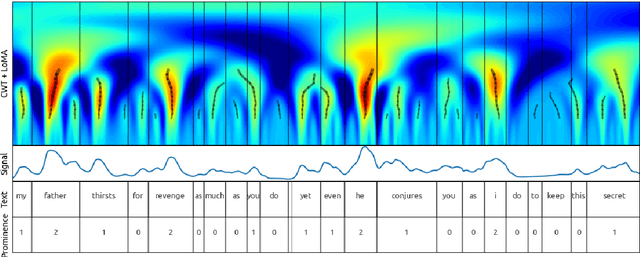
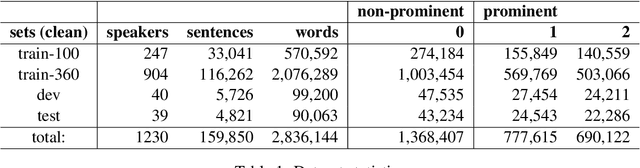

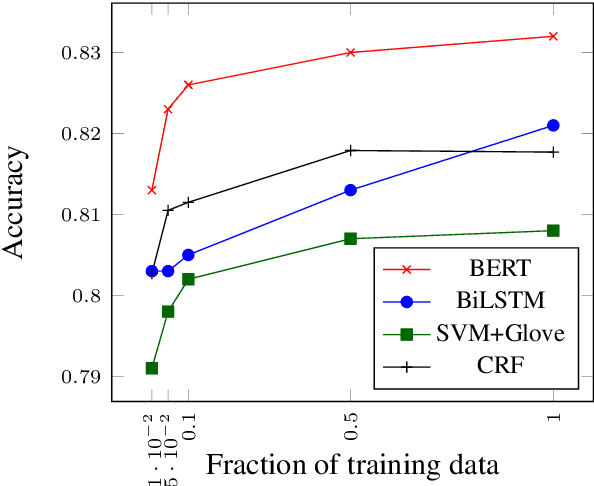
In this paper we introduce a new natural language processing dataset and benchmark for predicting prosodic prominence from written text. To our knowledge this will be the largest publicly available dataset with prosodic labels. We describe the dataset construction and the resulting benchmark dataset in detail and train a number of different models ranging from feature-based classifiers to neural network systems for the prediction of discretized prosodic prominence. We show that pre-trained contextualized word representations from BERT outperform the other models even with less than 10% of the training data. Finally we discuss the dataset in light of the results and point to future research and plans for further improving both the dataset and methods of predicting prosodic prominence from text. The dataset and the code for the models are publicly available.