 Add to Chrome
 Add to Firefox
 Add to Edge
The LLM Fallacy: Misattribution in AI-Assisted Cognitive Workflows
Apr 16, 2026
The rapid integration of large language models (LLMs) into everyday workflows has transformed how individuals perform cognitive tasks such as writing, programming, analysis, and multilingual communication. While prior research has focused on model reliability, hallucination, and user trust calibration, less attention has been given to how LLM usage reshapes users' perceptions of their own capabilities. This paper introduces the LLM fallacy, a cognitive attribution error in which individuals misinterpret LLM-assisted outputs as evidence of their own independent competence, producing a systematic divergence between perceived and actual capability. We argue that the opacity, fluency, and low-friction interaction patterns of LLMs obscure the boundary between human and machine contribution, leading users to infer competence from outputs rather than from the processes that generate them. We situate the LLM fallacy within existing literature on automation bias, cognitive offloading, and human--AI collaboration, while distinguishing it as a form of attributional distortion specific to AI-mediated workflows. We propose a conceptual framework of its underlying mechanisms and a typology of manifestations across computational, linguistic, analytical, and creative domains. Finally, we examine implications for education, hiring, and AI literacy, and outline directions for empirical validation. We also provide a transparent account of human--AI collaborative methodology. This work establishes a foundation for understanding how generative AI systems not only augment cognitive performance but also reshape self-perception and perceived expertise.

Natural Language Declarative Prompting (NLD-P): A Modular Governance Method for Prompt Design Under Model Drift
Feb 26, 2026The rapid evolution of large language models (LLMs) has transformed prompt engineering from a localized craft into a systems-level governance challenge. As models scale and update across generations, prompt behavior becomes sensitive to shifts in instruction-following policies, alignment regimes, and decoding strategies, a phenomenon we characterize as GPT-scale model drift. Under such conditions, surface-level formatting conventions and ad hoc refinement are insufficient to ensure stable, interpretable control. This paper reconceptualizes Natural Language Declarative Prompting (NLD-P) as a declarative governance method rather than a rigid field template. NLD-P is formalized as a modular control abstraction that separates provenance, constraint logic, task content, and post-generation evaluation, encoded directly in natural language without reliance on external orchestration code. We define minimal compliance criteria, analyze model-dependent schema receptivity, and position NLD-P as an accessible governance framework for non-developer practitioners operating within evolving LLM ecosystems. Portions of drafting and editorial refinement employed a schema-bound LLM assistant configured under NLD-P. All conceptual framing, methodological claims, and final revisions were directed, reviewed, and approved by the human author under a documented human-in-the-loop protocol. The paper concludes by outlining implications for declarative control under ongoing model evolution and identifying directions for future empirical validation.
Machine-Facing English: Defining a Hybrid Register Shaped by Human-AI Discourse
May 29, 2025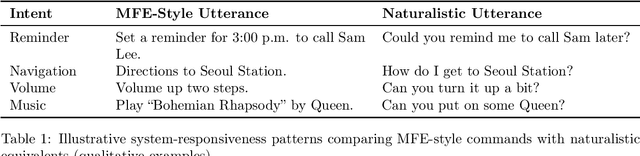
Machine-Facing English (MFE) is an emergent register shaped by the adaptation of everyday language to the expanding presence of AI interlocutors. Drawing on register theory (Halliday 1985, 2006), enregisterment (Agha 2003), audience design (Bell 1984), and interactional pragmatics (Giles & Ogay 2007), this study traces how sustained human-AI interaction normalizes syntactic rigidity, pragmatic simplification, and hyper-explicit phrasing - features that enhance machine parseability at the expense of natural fluency. Our analysis is grounded in qualitative observations from bilingual (Korean/English) voice- and text-based product testing sessions, with reflexive drafting conducted using Natural Language Declarative Prompting (NLD-P) under human curation. Thematic analysis identifies five recurrent traits - redundant clarity, directive syntax, controlled vocabulary, flattened prosody, and single-intent structuring - that improve execution accuracy but compress expressive range. MFE's evolution highlights a persistent tension between communicative efficiency and linguistic richness, raising design challenges for conversational interfaces and pedagogical considerations for multilingual users. We conclude by underscoring the need for comprehensive methodological exposition and future empirical validation.