 Add to Chrome
 Add to Firefox
 Add to Edge
Latent Programming Horizons in Coding Agents
Jul 06, 2026
A coding agent solving a software-engineering task spends dozens of steps reasoning, editing code, and running tests, yet little is known about what the underlying language model internally represents about the program it is working on. We show that the residual streams of language models under coding agents linearly encode properties of the evolving program: a logistic-regression probe on hidden states is able to decode whether the current code parses, passes its test suite, reduces the number of failing tests, and introduces regressions, reaching AUC up to 0.83 for correctness across two models and two benchmarks. Our second finding is more surprising: these representations run ahead of the agent's own edits. Probes trained to predict the outcome of future edits (before they are materialized and written on disk) achieve performance above chance up to roughly 25 steps in advance. We call this the agent's latent programming horizon. As a proof of external validity, we show that the probes transfer across benchmarks without retraining. Our positive results open calls for more research in mechanistic interpretability of coding agents.

A robust single-pixel particle image velocimetry based on fully convolutional networks with cross-correlation embedded
Oct 31, 2021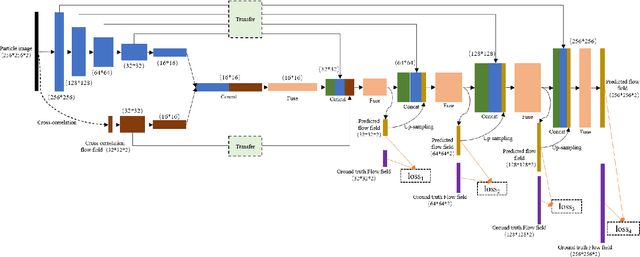
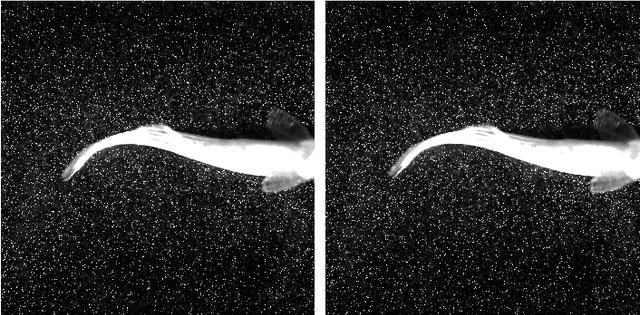
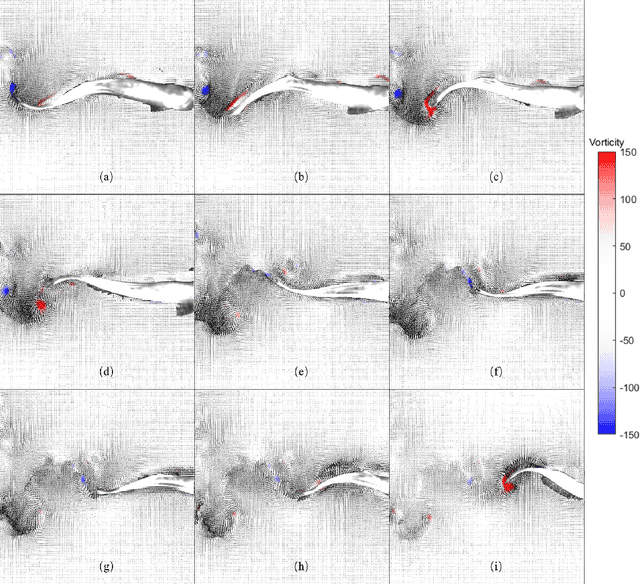
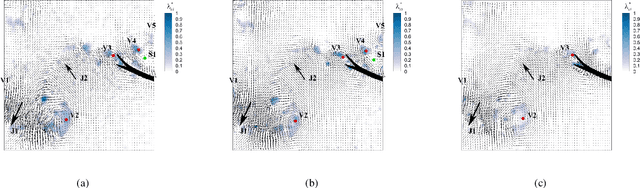
Particle image velocimetry (PIV) is essential in experimental fluid dynamics. In the current work, we propose a new velocity field estimation paradigm, which achieves a synergetic combination of the deep learning method and the traditional cross-correlation method. Specifically, the deep learning method is used to optimize and correct a coarse velocity guess to achieve a super-resolution calculation. And the cross-correlation method provides the initial velocity field based on a coarse correlation with a large interrogation window. As a reference, the coarse velocity guess helps with improving the robustness of the proposed algorithm. This fully convolutional network with embedded cross-correlation is named as CC-FCN. CC-FCN has two types of input layers, one is for the particle images, and the other is for the initial velocity field calculated using cross-correlation with a coarse resolution. Firstly, two pyramidal modules extract features of particle images and initial velocity field respectively. Then the fusion module appropriately fuses these features. Finally, CC-FCN achieves the super-resolution calculation through a series of deconvolution layers to obtain the single-pixel velocity field. As the supervised learning strategy is considered, synthetic data sets including ground-truth fluid motions are generated to train the network parameters. Synthetic and real experimental PIV data sets are used to test the trained neural network in terms of accuracy, precision, spatial resolution and robustness. The test results show that these attributes of CC-FCN are further improved compared with those of other tested PIV algorithms. The proposed model could therefore provide competitive and robust estimations for PIV experiments.