 Add to Chrome
 Add to Firefox
 Add to Edge
Estimation and Optimization of Ship Fuel Consumption in Maritime: Review, Challenges and Future Directions
Feb 25, 2026
To reduce carbon emissions and minimize shipping costs, improving the fuel efficiency of ships is crucial. Various measures are taken to reduce the total fuel consumption of ships, including optimizing vessel parameters and selecting routes with the lowest fuel consumption. Different estimation methods are proposed for predicting fuel consumption, while various optimization methods are proposed to minimize fuel oil consumption. This paper provides a comprehensive review of methods for estimating and optimizing fuel oil consumption in maritime transport. Our novel contributions include categorizing fuel oil consumption \& estimation methods into physics-based, machine-learning, and hybrid models, exploring their strengths and limitations. Furthermore, we highlight the importance of data fusion techniques, which combine AIS, onboard sensors, and meteorological data to enhance accuracy. We make the first attempt to discuss the emerging role of Explainable AI in enhancing model transparency for decision-making. Uniquely, key challenges, including data quality, availability, and the need for real-time optimization, are identified, and future research directions are proposed to address these gaps, with a focus on hybrid models, real-time optimization, and the standardization of datasets.
* 23 pages, 4 figures. Published in Journal of Marine Science and Technology (2026)

Physics-Informed Machine Learning for Vessel Shaft Power and Fuel Consumption Prediction: Interpretable KAN-based Approach
Feb 25, 2026Accurate prediction of shaft rotational speed, shaft power, and fuel consumption is crucial for enhancing operational efficiency and sustainability in maritime transportation. Conventional physics-based models provide interpretability but struggle with real-world variability, while purely data-driven approaches achieve accuracy at the expense of physical plausibility. This paper introduces a Physics-Informed Kolmogorov-Arnold Network (PI-KAN), a hybrid method that integrates interpretable univariate feature transformations with a physics-informed loss function and a leakage-free chained prediction pipeline. Using operational and environmental data from five cargo vessels, PI-KAN consistently outperforms the traditional polynomial method and neural network baselines. The model achieves the lowest mean absolute error (MAE) and root mean squared error (RMSE), and the highest coefficient of determination (R^2) for shaft power and fuel consumption across all vessels, while maintaining physically consistent behavior. Interpretability analysis reveals rediscovery of domain-consistent dependencies, such as cubic-like speed-power relationships and cosine-like wave and wind effects. These results demonstrate that PI-KAN achieves both predictive accuracy and interpretability, offering a robust tool for vessel performance monitoring and decision support in operational settings.
Physics-guided Neural Network-based Shaft Power Prediction for Vessels
Dec 23, 2025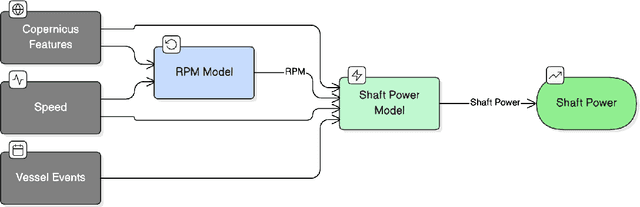
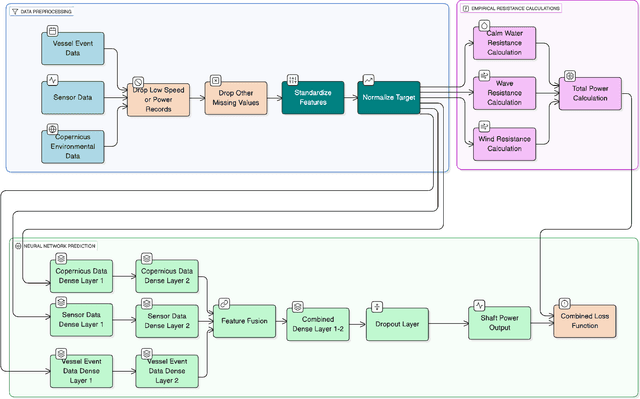
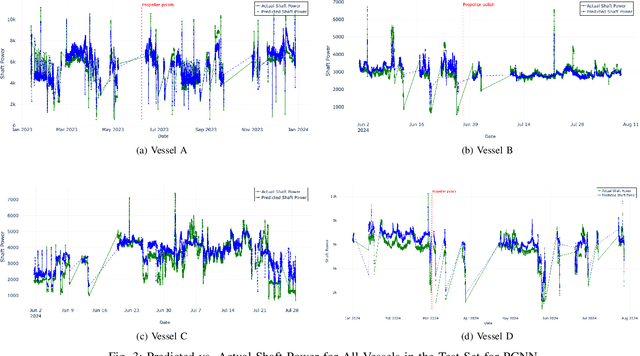

Optimizing maritime operations, particularly fuel consumption for vessels, is crucial, considering its significant share in global trade. As fuel consumption is closely related to the shaft power of a vessel, predicting shaft power accurately is a crucial problem that requires careful consideration to minimize costs and emissions. Traditional approaches, which incorporate empirical formulas, often struggle to model dynamic conditions, such as sea conditions or fouling on vessels. In this paper, we present a hybrid, physics-guided neural network-based approach that utilizes empirical formulas within the network to combine the advantages of both neural networks and traditional techniques. We evaluate the presented method using data obtained from four similar-sized cargo vessels and compare the results with those of a baseline neural network and a traditional approach that employs empirical formulas. The experimental results demonstrate that the physics-guided neural network approach achieves lower mean absolute error, root mean square error, and mean absolute percentage error for all tested vessels compared to both the empirical formula-based method and the base neural network.