 Add to Chrome
 Add to Firefox
 Add to Edge
On the Persistent Effects of Lexicality in Large Language Models
Jun 03, 2026
Representations extracted from large language models (LLMs) play an important role in many downstream applications. However, the structure of these representations is often influenced by lexical overlap rather than semantic content. Our understanding of the relationship between this lexical influence and semantic content, and its implications for downstream tasks, remains limited. In this work, we investigate representations to quantify the effect of lexical overlap relative to semantic content. We consider several adversarial semantic stress tests and further connect our findings to the information theory perspective. We find that lexical influence extends across the depth of models, consistently across architectures, training regimes, and objective functions, including the models trained for semantic similarity. Moreover, we observe a mid-depth region in which both lexical and semantic signals degrade simultaneously, indicating a transitional regime where representations are poor for both surface form and meaning. We further demonstrate the effect of lexical influence on downstream uses of LLMs using summarization and model editing as a case study.

Multi-Granular Node Pruning for Circuit Discovery
Dec 11, 2025Circuit discovery aims to identify minimal subnetworks that are responsible for specific behaviors in large language models (LLMs). Existing approaches primarily rely on iterative edge pruning, which is computationally expensive and limited to coarse-grained units such as attention heads or MLP blocks, overlooking finer structures like individual neurons. We propose a node-level pruning framework for circuit discovery that addresses both scalability and granularity limitations. Our method introduces learnable masks across multiple levels of granularity, from entire blocks to individual neurons, within a unified optimization objective. Granularity-specific sparsity penalties guide the pruning process, allowing a comprehensive compression in a single fine-tuning run. Empirically, our approach identifies circuits that are smaller in nodes than those discovered by prior methods; moreover, we demonstrate that many neurons deemed important by coarse methods are actually irrelevant, while still maintaining task performance. Furthermore, our method has a significantly lower memory footprint, 5-10x, as it does not require keeping intermediate activations in the memory to work.
Resolving Lexical Bias in Edit Scoping with Projector Editor Networks
Aug 19, 2024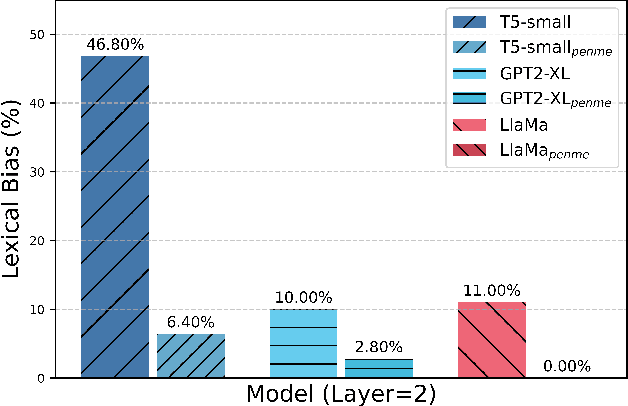
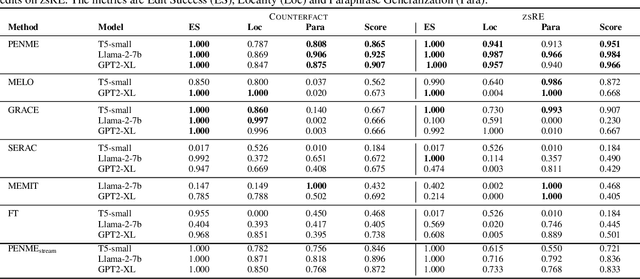
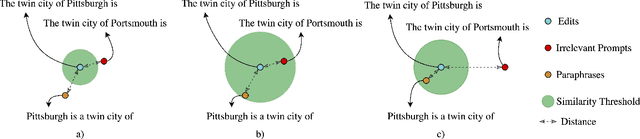

Weight-preserving model editing techniques heavily rely on the scoping mechanism that decides when to apply an edit to the base model. These scoping mechanisms utilize distance functions in the representation space to ascertain the scope of the edit. In this work, we show that distance-based scoping functions grapple with lexical biases leading to issues such as misfires with irrelevant prompts that share similar lexical characteristics. To address this problem, we introduce, Projector Editor Networks for Model Editing (PENME),is a model editing approach that employs a compact adapter with a projection network trained via a contrastive learning objective. We demonstrate the efficacy of PENME in achieving superior results while being compute efficient and flexible to adapt across model architectures.