 Add to Chrome
 Add to Firefox
 Add to Edge
UKP_Psycontrol at SemEval-2026 Task 2: Modeling Valence and Arousal Dynamics from Text
Apr 23, 2026
This paper presents our system developed for SemEval-2026 Task 2. The task requires modeling both current affect and short-term affective change in chronologically ordered user-generated texts. We explore three complementary approaches: (1) LLM prompting under user-aware and user-agnostic settings, (2) a pairwise Maximum Entropy (MaxEnt) model with Ising-style interactions for structured transition modeling, and (3) a lightweight neural regression model incorporating recent affective trajectories and trainable user embeddings. Our findings indicate that LLMs effectively capture static affective signals from text, whereas short-term affective variation in this dataset is more strongly explained by recent numeric state trajectories than by textual semantics. Our system ranked first among participating teams in both Subtask 1 and Subtask 2A based on the official evaluation metric.

deepmriprep: Voxel-based Morphometry (VBM) Preprocessing via Deep Neural Networks
Aug 20, 2024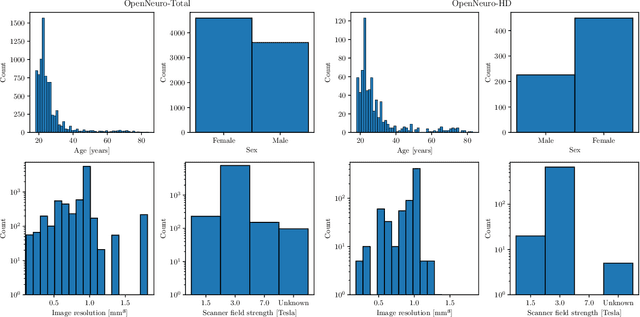
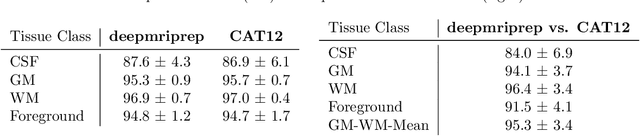
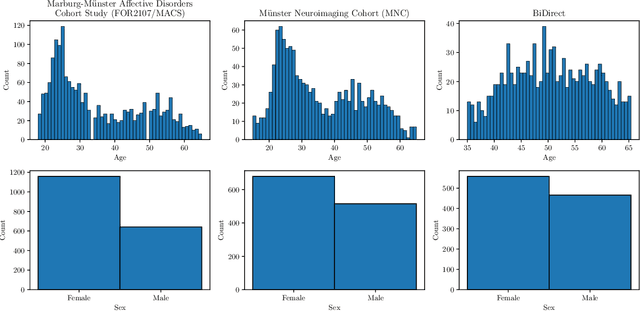
Voxel-based Morphometry (VBM) has emerged as a powerful approach in neuroimaging research, utilized in over 7,000 studies since the year 2000. Using Magnetic Resonance Imaging (MRI) data, VBM assesses variations in the local density of brain tissue and examines its associations with biological and psychometric variables. Here, we present deepmriprep, a neural network-based pipeline that performs all necessary preprocessing steps for VBM analysis of T1-weighted MR images using deep neural networks. Utilizing the Graphics Processing Unit (GPU), deepmriprep is 37 times faster than CAT12, the leading VBM preprocessing toolbox. The proposed method matches CAT12 in accuracy for tissue segmentation and image registration across more than 100 datasets and shows strong correlations in VBM results. Tissue segmentation maps from deepmriprep have over 95% agreement with ground truth maps, and its non-linear registration, using supervised SYMNet, predicts smooth deformation fields comparable to CAT12. The high processing speed of deepmriprep enables rapid preprocessing of extensive datasets and thereby fosters the application of VBM analysis to large-scale neuroimaging studies and opens the door to real-time applications. Finally, deepmripreps straightforward, modular design enables researchers to easily understand, reuse, and advance the underlying methods, fostering further advancements in neuroimaging research. deepmriprep can be conveniently installed as a Python package and is publicly accessible at https://github.com/wwu-mmll/deepmriprep.