 Add to Chrome
 Add to Firefox
 Add to Edge
Concomitant DAG Learning: On the Roles of Noise Adaptivity, Sparsity, and Non-negativity
May 22, 2026
Directed acyclic graphs (DAGs) constitute a central modeling tool to enable principled reasoning about cause-effect interactions in complex systems. However, since the causal structure underlying a group of variables is often unknown and interventions may be infeasible or ethically challenging to implement, there is a need to address the task of inferring DAGs from observational data. However, most classical structure identification approaches face two key obstacles: the combinatorial challenge of enforcing acyclicity, which severely limits scalability, and identifiability challenges arising from latent confounding or heterogeneous noise. This tutorial offers an overview of recent signal processing and optimization advances that address these issues by recasting DAG structure learning as a continuous, score-based estimation problem over adjacency matrices. We begin with a didactic introduction to structural equation models and the formulation of causal graph recovery, followed by a historical survey of score-based methods ranging from early combinatorial search schemes and greedy heuristics to modern continuous frameworks that leverage smooth characterizations of acyclicity. Building on this foundation, we describe concomitant DAG estimation methods that jointly infer sparse causal structure and exogenous noise levels, improving robustness under heteroscedasticity and distribution shifts by rendering the estimator noise adaptive. All in all, the tutorial introduces readers to challenges and opportunities for signal processing research at the crossroads of causal inference, high-dimensional statistics, and scalable graph learning, while outlining emerging directions including online, nonlinear, and neural causal discovery.

NeuroMambaLLM: Dynamic Graph Learning of fMRI Functional Connectivity in Autistic Brains Using Mamba and Language Model Reasoning
Feb 14, 2026Large Language Models (LLMs) have demonstrated strong semantic reasoning across multimodal domains. However, their integration with graph-based models of brain connectivity remains limited. In addition, most existing fMRI analysis methods rely on static Functional Connectivity (FC) representations, which obscure transient neural dynamics critical for neurodevelopmental disorders such as autism. Recent state-space approaches, including Mamba, model temporal structure efficiently, but are typically used as standalone feature extractors without explicit high-level reasoning. We propose NeuroMambaLLM, an end-to-end framework that integrates dynamic latent graph learning and selective state-space temporal modelling with LLMs. The proposed method learns the functional connectivity dynamically from raw Blood-Oxygen-Level-Dependent (BOLD) time series, replacing fixed correlation graphs with adaptive latent connectivity while suppressing motion-related artifacts and capturing long-range temporal dependencies. The resulting dynamic brain representations are projected into the embedding space of an LLM model, where the base language model remains frozen and lightweight low-rank adaptation (LoRA) modules are trained for parameter-efficient alignment. This design enables the LLM to perform both diagnostic classification and language-based reasoning, allowing it to analyze dynamic fMRI patterns and generate clinically meaningful textual reports.
BUILD with Precision: Bottom-Up Inference of Linear DAGs
Dec 18, 2025Learning the structure of directed acyclic graphs (DAGs) from observational data is a central problem in causal discovery, statistical signal processing, and machine learning. Under a linear Gaussian structural equation model (SEM) with equal noise variances, the problem is identifiable and we show that the ensemble precision matrix of the observations exhibits a distinctive structure that facilitates DAG recovery. Exploiting this property, we propose BUILD (Bottom-Up Inference of Linear DAGs), a deterministic stepwise algorithm that identifies leaf nodes and their parents, then prunes the leaves by removing incident edges to proceed to the next step, exactly reconstructing the DAG from the true precision matrix. In practice, precision matrices must be estimated from finite data, and ill-conditioning may lead to error accumulation across BUILD steps. As a mitigation strategy, we periodically re-estimate the precision matrix (with less variables as leaves are pruned), trading off runtime for enhanced robustness. Reproducible results on challenging synthetic benchmarks demonstrate that BUILD compares favorably to state-of-the-art DAG learning algorithms, while offering an explicit handle on complexity.
Dirichlet Meets Horvitz and Thompson: Estimating Homophily in Large Networks via Sampling
Dec 18, 2025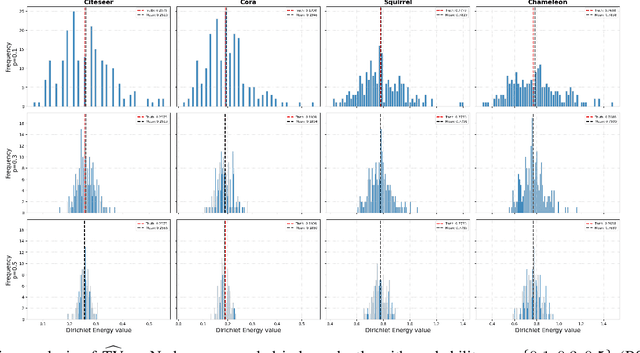
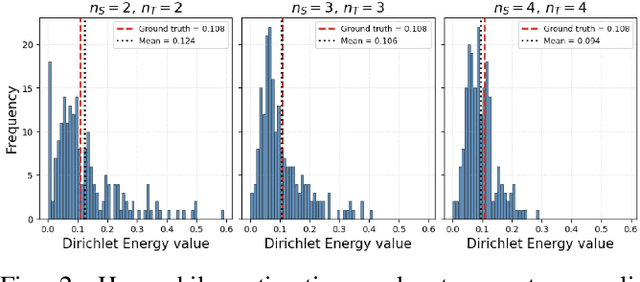
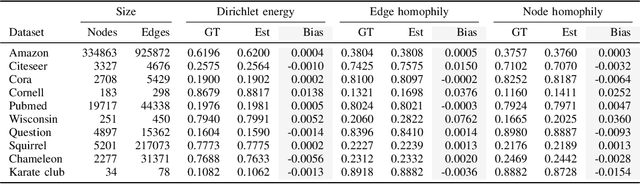
Assessing homophily in large-scale networks is central to understanding structural regularities in graphs, and thus inform the choice of models (such as graph neural networks) adopted to learn from network data. Evaluation of smoothness metrics requires access to the entire network topology and node features, which may be impractical in several large-scale, dynamic, resource-limited, or privacy-constrained settings. In this work, we propose a sampling-based framework to estimate homophily via the Dirichlet energy (Laplacian-based total variation) of graph signals, leveraging the Horvitz-Thompson (HT) estimator for unbiased inference from partial graph observations. The Dirichlet energy is a so-termed total (of squared nodal feature deviations) over graph edges; hence, estimable under general network sampling designs for which edge-inclusion probabilities can be analytically derived and used as weights in the proposed HT estimator. We establish that the Dirichlet energy can be consistently estimated from sampled graphs, and empirically study other heterophily measures as well. Experiments on several heterophilic benchmark datasets demonstrate the effectiveness of the proposed HT estimators in reliably capturing homophilic structure (or lack thereof) from sampled network measurements.
Directed Acyclic Graph Convolutional Networks
Jun 13, 2025Directed acyclic graphs (DAGs) are central to science and engineering applications including causal inference, scheduling, and neural architecture search. In this work, we introduce the DAG Convolutional Network (DCN), a novel graph neural network (GNN) architecture designed specifically for convolutional learning from signals supported on DAGs. The DCN leverages causal graph filters to learn nodal representations that account for the partial ordering inherent to DAGs, a strong inductive bias does not present in conventional GNNs. Unlike prior art in machine learning over DAGs, DCN builds on formal convolutional operations that admit spectral-domain representations. We further propose the Parallel DCN (PDCN), a model that feeds input DAG signals to a parallel bank of causal graph-shift operators and processes these DAG-aware features using a shared multilayer perceptron. This way, PDCN decouples model complexity from graph size while maintaining satisfactory predictive performance. The architectures' permutation equivariance and expressive power properties are also established. Comprehensive numerical tests across several tasks, datasets, and experimental conditions demonstrate that (P)DCN compares favorably with state-of-the-art baselines in terms of accuracy, robustness, and computational efficiency. These results position (P)DCN as a viable framework for deep learning from DAG-structured data that is designed from first (graph) signal processing principles.
Convolutional Learning on Directed Acyclic Graphs
May 05, 2024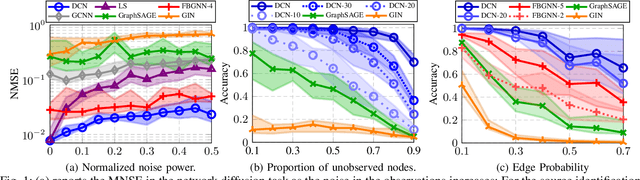
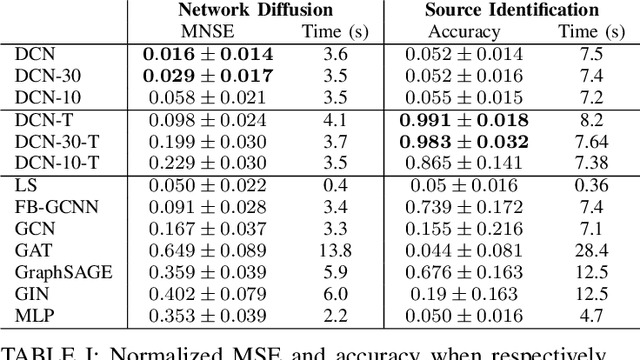
We develop a novel convolutional architecture tailored for learning from data defined over directed acyclic graphs (DAGs). DAGs can be used to model causal relationships among variables, but their nilpotent adjacency matrices pose unique challenges towards developing DAG signal processing and machine learning tools. To address this limitation, we harness recent advances offering alternative definitions of causal shifts and convolutions for signals on DAGs. We develop a novel convolutional graph neural network that integrates learnable DAG filters to account for the partial ordering induced by the graph topology, thus providing valuable inductive bias to learn effective representations of DAG-supported data. We discuss the salient advantages and potential limitations of the proposed DAG convolutional network (DCN) and evaluate its performance on two learning tasks using synthetic data: network diffusion estimation and source identification. DCN compares favorably relative to several baselines, showcasing its promising potential.