 Add to Chrome
 Add to Firefox
 Add to Edge
Efficiency Matters in Autonomous Research
Jul 27, 2026
AI-driven autonomous research (AR) systems are becoming increasingly effective across a broad range of tasks. Their performance, however, is still evaluated primarily by the quality of the final outcome. In this paper, we argue that the efficiency of the solution-search process is an equally important but often overlooked dimension of performance. A strong AR system should not only produce high-quality results, but also reach them with as small a budget as possible. Search efficiency will become increasingly important as AR expands from domains with inexpensive verification, such as mathematics and coding, to real-world scientific settings in which solution evaluation may require costly physical experiments. To capture this dimension, we propose evaluating AR systems using the area under the curve (AUC) of the Pareto frontier, alongside final outcome quality. We compare several families of search algorithms, including hill climbing, beam search, tree search, and evolutionary search, across twelve systems-optimization tasks. We find that no single search structure is consistently the most efficient. We also show that search efficiency and final outcome quality are distinct performance dimensions: a method that eventually achieves the best result may nevertheless improve slowly and consume substantially more evaluation budget before reaching that result. Because the most effective search policy is generally unknown in advance, we introduce an adaptive procedure called fluid search, which uses a portfolio bandit to dynamically allocate a fixed evaluation budget across a forest of search processes. Across the evaluated tasks, fluid search achieves the highest overall search efficiency, closely matching the performance of a per-task oracle that is given the best search structure for each task in advance.

Beyond Fixed Representations: The Vocabulary and Verifier Gaps in Open-Ended AI
Jul 10, 2026Modern AI systems are increasingly being evaluated for their ability to reason, code, prove theorems, use tools, and long-horizon research tasks. These are powerful capabilities, but they share a structural limitation: the representational frame within which the model operates, including its conceptual vocabulary, the space of admissible solutions it can search, and the criteria by which success is evaluated, is typically fixed and supplied in advance. This paper argues that building stronger intelligent systems capable of open-ended innovation requires additional classes of operations: the creation, stabilization, and reuse of new representational primitives, which alter the space being searched rather than simply searching within it. We characterize the distance between current AI systems and genuinely open-ended intelligence through two gaps. The first is the vocabulary gap, the difficulty of inventing and stabilizing new representational primitives rather than merely recombining existing ones. The second is the verifier gap, the difficulty of judging the value of a new primitive when its full payoff may be visible only after future reuse. We interpret both gaps through a unified framework of intelligence as cognitive discrepancy reduction. By viewing intelligent behaviors as a sequence of cognitive transformations, we distinguish intra-space transformations which operate within a fixed representational frame, from generative transformations which may modify the frame itself. On this basis, we propose a ladder of innovation autonomy and outline several directions for advancing open-ended AI, including objectives that reward useful representational change, persistent memory architectures for invented primitives, and adaptive verification mechanisms capable of evolving alongside the representations they evaluate.
LEIA: Learned Environment for Interactive Architected Materials
May 28, 2026World models have enabled interactive exploration of game environments and robotic manipulation, but physical engineering remains beyond their reach: real materials exhibit nonlinear constitutive laws, carry history-dependent internal state, undergo inertial dynamics, and may possess hierarchical structures spanning multiple length scales. We present LEIA (Learned Environment for Interactive Architected materials), a world model that lets engineers apply boundary conditions step by step and observe the resulting deformation and stress fields in real time. LEIA handles large three-dimensional unstructured meshes and generates autoregressive responses to user-specified loading. We introduce MicroPlate, a benchmark of architected plates spanning two regimes of microstructure modeling: architected lattices that resolve microstructure explicitly through three-dimensional geometry, and a homogeneous plate where microstructural change is modeled implicitly through internal degrees of freedom. MicroPlate is used to assess LEIA alongside four baseline methods across both regimes. Finally, we demonstrate that LEIA enables efficient candidate generation and ranking for fast surrogate-guided search for de novo designs of architected materials, with stress-accurate candidate ranking validated by finite element ground truth.
Generative optimal transport via forward-backward HJB matching
Apr 09, 2026Controlling the evolution of a many-body stochastic system from a disordered reference state to a structured target ensemble, characterized empirically through samples, arises naturally in non-equilibrium statistical mechanics and stochastic control. The natural relaxation of such a system - driven by diffusion - runs from the structured target toward the disordered reference. The natural question is then: what is the minimum-work stochastic process that reverses this relaxation, given a pathwise cost functional combining spatial penalties and control effort? Computing this optimal process requires knowledge of trajectories that already sample the target ensemble - precisely the object one is trying to construct. We resolve this by establishing a time-reversal duality: the value function governing the hard backward dynamics satisfies an equivalent forward-in-time HJB equation, whose solution can be read off directly from the tractable forward relaxation trajectories. Via the Cole-Hopf transformation and its associated Feynman-Kac representation, this forward potential is computed as a path-space free energy averaged over these forward trajectories - the same relaxation paths that are easy to simulate - without any backward simulation or knowledge of the target beyond samples. The resulting framework provides a physically interpretable description of stochastic transport in terms of path-space free energy, risk-sensitive control, and spatial cost geometry. We illustrate the theory with numerical examples that visualize the learned value function and the induced controlled diffusions, demonstrating how spatial cost fields shape transport geometry analogously to Fermat's Principle in inhomogeneous media. Our results establish a unifying connection between stochastic optimal control, Schrödinger bridge theory, and non-equilibrium statistical mechanics.
Multicell-Fold: geometric learning in folding multicellular life
Jul 09, 2024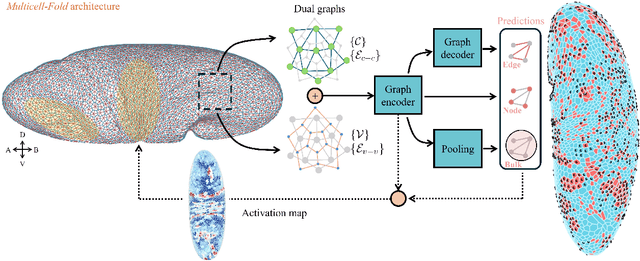
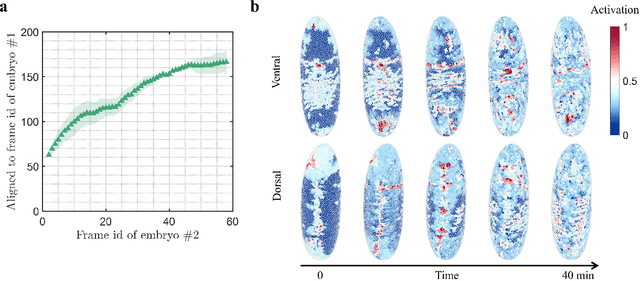
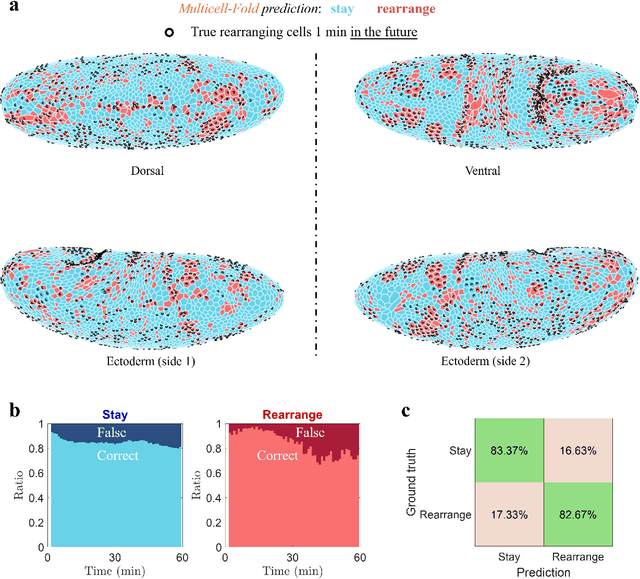
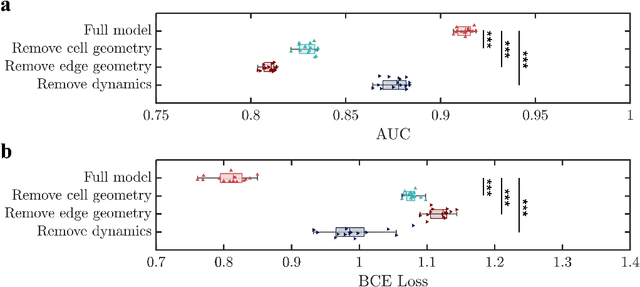
During developmental processes such as embryogenesis, how a group of cells fold into specific structures, is a central question in biology that defines how living organisms form. Establishing tissue-level morphology critically relies on how every single cell decides to position itself relative to its neighboring cells. Despite its importance, it remains a major challenge to understand and predict the behavior of every cell within the living tissue over time during such intricate processes. To tackle this question, we propose a geometric deep learning model that can predict multicellular folding and embryogenesis, accurately capturing the highly convoluted spatial interactions among cells. We demonstrate that multicellular data can be represented with both granular and foam-like physical pictures through a unified graph data structure, considering both cellular interactions and cell junction networks. We successfully use our model to achieve two important tasks, interpretable 4-D morphological sequence alignment, and predicting local cell rearrangements before they occur at single-cell resolution. Furthermore, using an activation map and ablation studies, we demonstrate that cell geometries and cell junction networks together regulate local cell rearrangement which is critical for embryo morphogenesis. This approach provides a novel paradigm to study morphogenesis, highlighting a unified data structure and harnessing the power of geometric deep learning to accurately model the mechanisms and behaviors of cells during development. It offers a pathway toward creating a unified dynamic morphological atlas for a variety of developmental processes such as embryogenesis.
Learning Dynamics from Multicellular Graphs with Deep Neural Networks
Jan 22, 2024The inference of multicellular self-assembly is the central quest of understanding morphogenesis, including embryos, organoids, tumors, and many others. However, it has been tremendously difficult to identify structural features that can indicate multicellular dynamics. Here we propose to harness the predictive power of graph-based deep neural networks (GNN) to discover important graph features that can predict dynamics. To demonstrate, we apply a physically informed GNN (piGNN) to predict the motility of multicellular collectives from a snapshot of their positions both in experiments and simulations. We demonstrate that piGNN is capable of navigating through complex graph features of multicellular living systems, which otherwise can not be achieved by classical mechanistic models. With increasing amounts of multicellular data, we propose that collaborative efforts can be made to create a multicellular data bank (MDB) from which it is possible to construct a large multicellular graph model (LMGM) for general-purposed predictions of multicellular organization.