 Add to Chrome
 Add to Firefox
 Add to Edge
A Unified Stochastic Mechanism Underlying Collective Behavior in Ants, Physical Systems, and Robotic Swarms
Nov 08, 2025
Biological swarms, such as ant colonies, achieve collective goals through decentralized and stochastic individual behaviors. Similarly, physical systems composed of gases, liquids, and solids exhibit random particle motion governed by entropy maximization, yet do not achieve collective objectives. Despite this analogy, no unified framework exists to explain the stochastic behavior in both biological and physical systems. Here, we present empirical evidence from \textit{Formica polyctena} ants that reveals a shared statistical mechanism underlying both systems: maximization under different energy function constraints. We further demonstrate that robotic swarms governed by this principle can exhibit scalable, decentralized cooperation, mimicking physical phase-like behaviors with minimal individual computation. These findings established a unified stochastic model linking biological, physical, and robotic swarms, offering a scalable principle for designing robust and intelligent swarm robotics.

Trust-aware Collaborative Denoising Auto-Encoder for Top-N Recommendation
May 08, 2017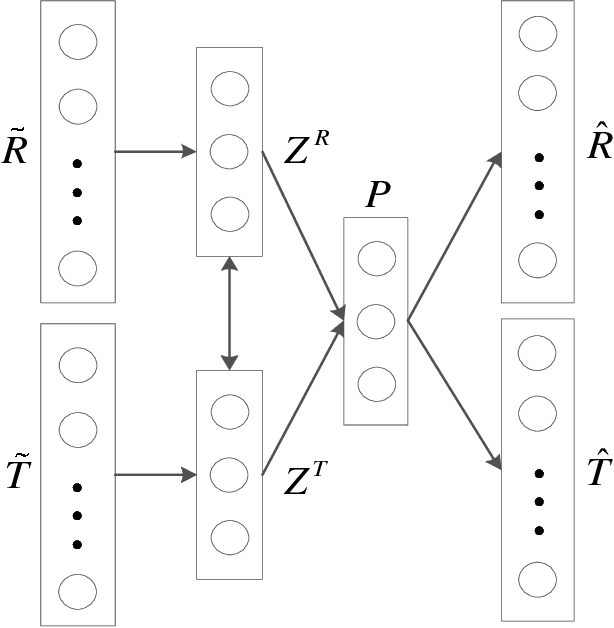
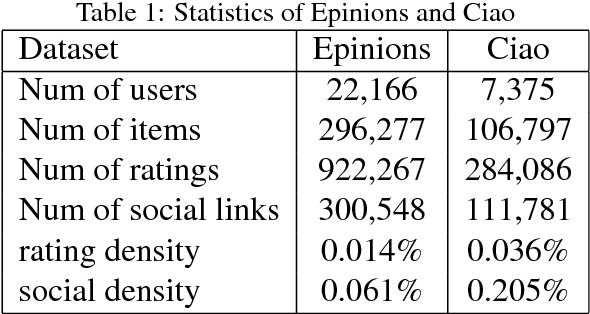
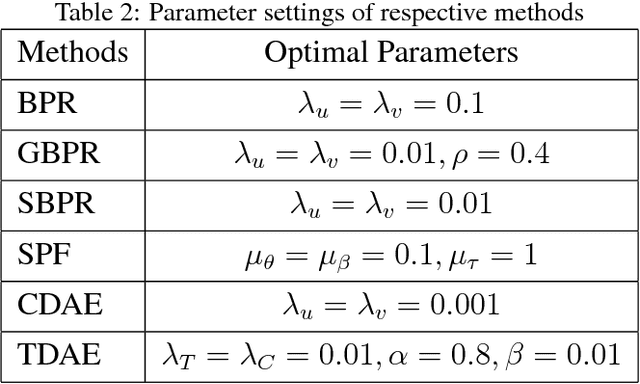
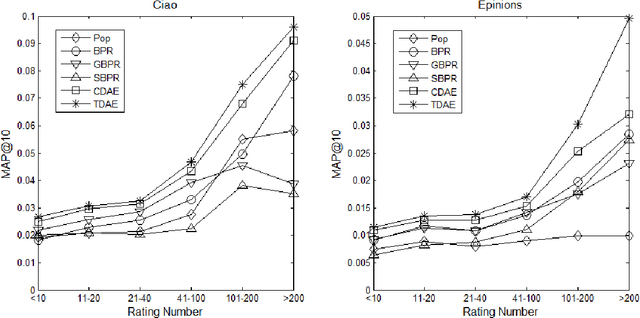
Both feedback of ratings and trust relationships can be used to reveal users' tastes for improving recommendation performance, especially for cold users. However, both of them are facing data sparsity problem, which may severely degrade recommendation performance. In this paper, we propose to utilize the idea of Denoising Auto-Encoders (DAE) to tackle this problem. Specially, we propose a novel deep learning model, the \textit{Trust-aware Collaborative Denoising Auto-Encoder} (TDAE), to learn compact and effective representations from both rating and trust data for top-N recommendation. In particular, we present a novel neutral network with a weighted hidden layer to balance the importance of these representations. Moreover, we propose a novel correlative regularization to bridge relations between user preferences in different perspectives. We also conduct comprehensive experiments on two public datasets to compare with several state-of-the-art approaches. The results demonstrate that the proposed method significantly outperforms other comparisons for top-N recommendation task.