 Add to Chrome
 Add to Firefox
 Add to Edge
Energy-Efficient Federated Edge Learning For Small-Scale Datasets in Large IoT Networks
Apr 12, 2026
Large-scale Internet of Things (IoT) networks enable intelligent services such as smart cities and autonomous driving, but often face resource constraints. Collecting heterogeneous sensory data, especially in small-scale datasets, is challenging, and independent edge nodes can lead to inefficient resource utilization and reduced learning performance. To address these issues, this paper proposes a collaborative optimization framework for energy-efficient federated edge learning with small-scale datasets. We first derive an expected learning loss to quantify the relationship between the number of training samples and learning objectives. A stochastic online learning algorithm is then designed to adapt to data variations, and a resource optimization problem with a convergence bound is formulated. Finally, an online distributed algorithm efficiently solves large-scale optimization problems with high scalability. Extensive simulations and autonomous navigation case studies with collision avoidance demonstrate that the proposed approach significantly improves learning performance and resource efficiency compared to state-of-the-art benchmarks.

Edge Learning for Large-Scale Internet of Things With Task-Oriented Efficient Communication
Apr 30, 2023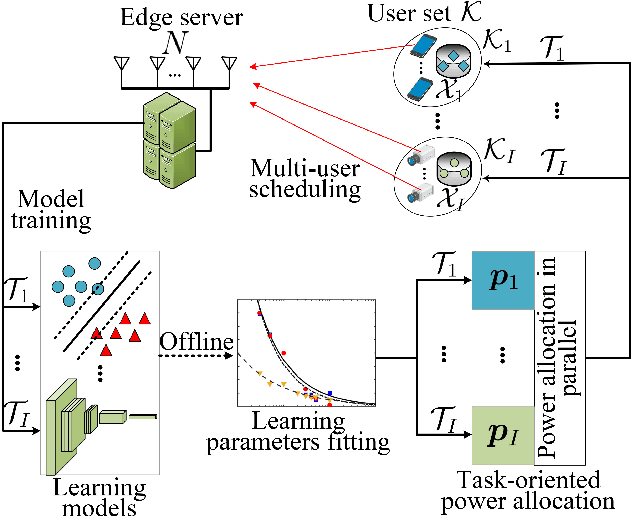


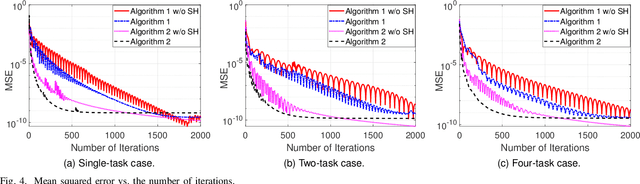
In the Internet of Things (IoT) networks, edge learning for data-driven tasks provides intelligent applications and services. As the network size becomes large, different users may generate distinct datasets. Thus, to suit multiple edge learning tasks for large-scale IoT networks, this paper performs efficient communication under the task-oriented principle by using the collaborative design of wireless resource allocation and edge learning error prediction. In particular, we start with multi-user scheduling to alleviate co-channel interference in dense networks. Then, we perform optimal power allocation in parallel for different learning tasks. Thanks to the high parallelization of the designed algorithm, extensive experimental results corroborate that the multi-user scheduling and task-oriented power allocation improve the performance of distinct edge learning tasks efficiently compared with the state-of-the-art benchmark algorithms.