 Add to Chrome
 Add to Firefox
 Add to Edge
Alleviating Regional Shortcuts for Few-Shot Class-Incremental Learning
Jul 24, 2026
Few-shot class-incremental learning (FSCIL) aims to incrementally learn novel classes with only a few samples while avoiding forgetting base classes. However, current methods show a tendency to misclassify novel-class samples into base classes, which we find to be caused by the excessive focus on base-class-discriminative regions on novel-class samples. In this work, we aim to explore the underlying mechanism for an interpretation and solution. We first provide a compositional view to analyze the transferred and reused spatial patterns on novel-class samples. Then, through extensive experiments and theoretical analysis, we identify both empirically and theoretically that a shortcut exists in the model's base-class training, which naturally forms the excessive focus on only the most discriminative regions (primitives), which we term as the regional shortcut. Finally, based on this interpretation, to address this problem, we propose a compositional-learning-based method to learn two primitive sets (a common set and a discriminative set), which alleviates the regional shortcut by constraining the model to learn and utilize the common primitive set for base- and novel-class recognition. Extensive experiments on standard FSCIL benchmarks demonstrate the effectiveness of our approach, yielding consistent improvements over existing state-of-the-art methods in both accuracy and interpretability.

Compositional Few-Shot Class-Incremental Learning
May 27, 2024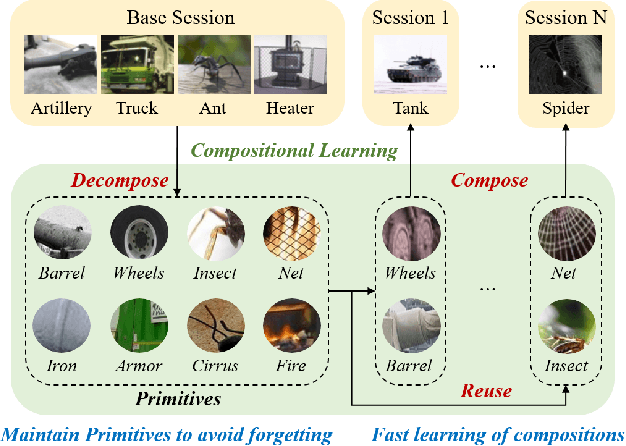

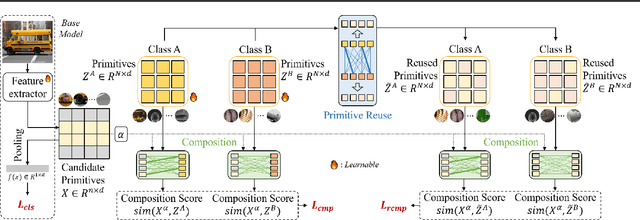
Few-shot class-incremental learning (FSCIL) is proposed to continually learn from novel classes with only a few samples after the (pre-)training on base classes with sufficient data. However, this remains a challenge. In contrast, humans can easily recognize novel classes with a few samples. Cognitive science demonstrates that an important component of such human capability is compositional learning. This involves identifying visual primitives from learned knowledge and then composing new concepts using these transferred primitives, making incremental learning both effective and interpretable. To imitate human compositional learning, we propose a cognitive-inspired method for the FSCIL task. We define and build a compositional model based on set similarities, and then equip it with a primitive composition module and a primitive reuse module. In the primitive composition module, we propose to utilize the Centered Kernel Alignment (CKA) similarity to approximate the similarity between primitive sets, allowing the training and evaluation based on primitive compositions. In the primitive reuse module, we enhance primitive reusability by classifying inputs based on primitives replaced with the closest primitives from other classes. Experiments on three datasets validate our method, showing it outperforms current state-of-the-art methods with improved interpretability. Our code is available at https://github.com/Zoilsen/Comp-FSCIL.
Delve into Base-Novel Confusion: Redundancy Exploration for Few-Shot Class-Incremental Learning
May 08, 2024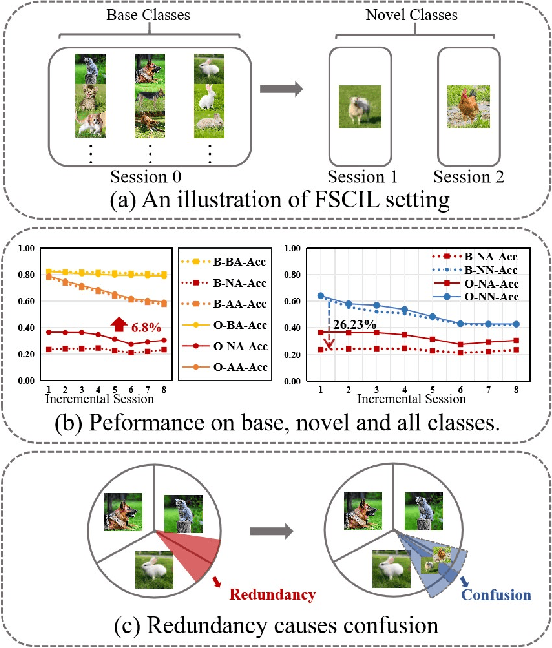
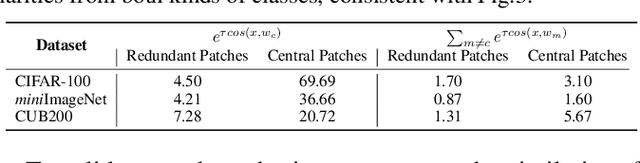


Few-shot class-incremental learning (FSCIL) aims to acquire knowledge from novel classes with limited samples while retaining information about base classes. Existing methods address catastrophic forgetting and overfitting by freezing the feature extractor during novel-class learning. However, these methods usually tend to cause the confusion between base and novel classes, i.e., classifying novel-class samples into base classes. In this paper, we delve into this phenomenon to study its cause and solution. We first interpret the confusion as the collision between the novel-class and the base-class region in the feature space. Then, we find the collision is caused by the label-irrelevant redundancies within the base-class feature and pixel space. Through qualitative and quantitative experiments, we identify this redundancy as the shortcut in the base-class training, which can be decoupled to alleviate the collision. Based on this analysis, to alleviate the collision between base and novel classes, we propose a method for FSCIL named Redundancy Decoupling and Integration (RDI). RDI first decouples redundancies from base-class space to shrink the intra-base-class feature space. Then, it integrates the redundancies as a dummy class to enlarge the inter-base-class feature space. This process effectively compresses the base-class feature space, creating buffer space for novel classes and alleviating the model's confusion between the base and novel classes. Extensive experiments across benchmark datasets, including CIFAR-100, miniImageNet, and CUB-200-2011 demonstrate that our method achieves state-of-the-art performance.