 Add to Chrome
 Add to Firefox
 Add to Edge
Comprehensive Benchmarking of Deep Learning Architectures for Lung Cancer Histopathology
Aug 16, 2026
Lung cancer remains the leading cause of cancer-related mortality worldwide, while histopathological diagnosis is often affected by inter-observer variability and the substantial workload associated with manual slide examination. Although deep learning has shown considerable potential in computational pathology, comprehensive benchmarks that integrate tissue classification and region segmentation within a unified analytical framework remain limited. This study presents a two-stage deep learning framework for multi-class tissue classification and pixel-level histopathological region segmentation, accompanied by a systematic comparison of state-of-the-art architectures at each stage. For tissue classification, six models, a custom convolutional neural network, VGG16, DenseNet, MobileNetV3, a custom Vision Transformer, and YOLO11, are evaluated on a combined dataset of 39,000 images derived from LC25000 and LungHist700. The models distinguish between adenocarcinoma, squamous cell carcinoma, and normal lung tissue. YOLO11 achieves the best classification performance, with an accuracy of 98.38%, a five-fold cross-validation accuracy of 98.21 +/- 0.35%, and a macro F1-score of 0.98. For region segmentation, U-Net, ResNet-encoder U-Net, DeepLabV3+, and YOLO11-seg are evaluated using the GlaS gland segmentation benchmark. DeepLabV3+ obtains the highest Intersection over Union of 0.80 and a Dice score of 0.89, while YOLO11-seg achieves a comparable Intersection over Union of 0.79 using approximately 14x fewer parameters. The best-performing classification and segmentation models are subsequently integrated into an end-to-end framework, providing an accurate, computationally efficient, and reproducible baseline for automated histopathological image analysis.

Toward Trustworthy Large Language Model Agents in Healthcare
Jul 06, 2026Healthcare appointment scheduling remains a persistent operational bottleneck, driven by manual coordination, fragmented legacy systems, and high administrative overhead. These inefficiencies constrain provider availability and degrade patient access to care. This paper presents CareConnect, a safety-first conversational agent for healthcare logistics automation that leverages large language model (LLM) function calling, retrieval-augmented generation (RAG), and layered deterministic safety guardrails. The system orchestrates eight domain-specific tools to support appointment booking, modification, cancellation, and facility information retrieval, while enforcing strict scope constraints that prohibit medical advice or diagnosis. Safety-critical situations are handled through deterministic short-circuit mechanisms for emergency detection and medical intent refusal. We evaluate CareConnect on a comprehensive benchmark of 680 task-oriented scenarios spanning end-to-end workflows, multi-turn interactions, and edge cases. Experimental results demonstrate a 91.8% task completion rate with a median per-request latency of 2.2 seconds, 96.0% safety compliance on the dedicated safety-critical evaluation subset, and an average operational cost of $0.0324 per appointment, yielding a significant cost reduction compared to manual human scheduling. These findings show that carefully scoped and rigorously safeguarded LLM-based agents can reliably automate complex healthcare operational workflows while maintaining safety guarantees and achieving substantial cost efficiency. The source code and system implementation are publicly available at https://github.com/Hadi-Hsn/CareConnect.
Human-Robot Interaction using VAHR: Virtual Assistant, Human, and Robots in the Loop
Mar 31, 2023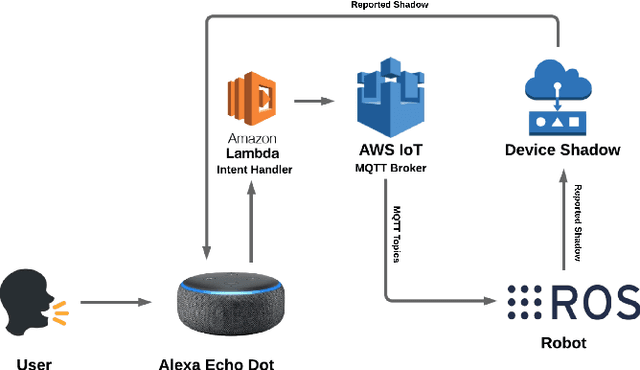
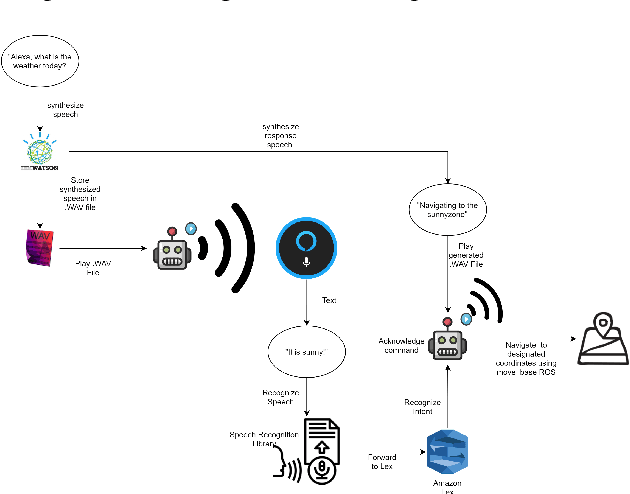
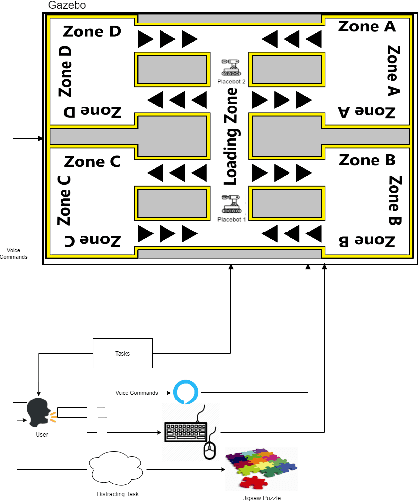
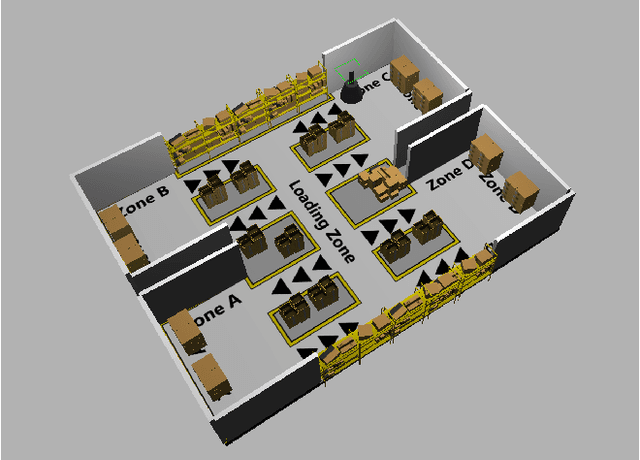
Robots have become ubiquitous tools in various industries and households, highlighting the importance of human-robot interaction (HRI). This has increased the need for easy and accessible communication between humans and robots. Recent research has focused on the intersection of virtual assistant technology, such as Amazon's Alexa, with robots and its effect on HRI. This paper presents the Virtual Assistant, Human, and Robots in the loop (VAHR) system, which utilizes bidirectional communication to control multiple robots through Alexa. VAHR's performance was evaluated through a human-subjects experiment, comparing objective and subjective metrics of traditional keyboard and mouse interfaces to VAHR. The results showed that VAHR required 41% less Robot Attention Demand and ensured 91% more Fan-out time compared to the standard method. Additionally, VAHR led to a 62.5% improvement in multi-tasking, highlighting the potential for efficient human-robot interaction in physically- and mentally-demanding scenarios. However, subjective metrics revealed a need for human operators to build confidence and trust with this new method of operation.