 Add to Chrome
 Add to Firefox
 Add to Edge
Geometric Framework for Robust Order Detection in Delay-Coordinates Dynamic Mode Decomposition
Mar 15, 2026
Delay-coordinates dynamic mode decomposition (DC-DMD) is widely used to extract coherent spatiotemporal modes from high-dimensional time series. A central challenge is distinguishing dynamically meaningful modes from spurious modes induced by noise and order overestimation. We show that model order detection and mode selection in DC-DMD are fundamentally problems of subspace geometry. Specifically, true modes are characterized by concentration within a low-dimensional signal subspace, whereas spurious modes necessarily retain non-negligible components outside any moderate overestimate of that subspace. This geometric distinction yields a perturbation-robust definition of true and spurious modes and yields fully data-driven selection criteria. This geometric framework leads to two complementary data-driven selection criteria. The first is derived directly from the geometric distinction and uses a data-driven proxy of the signal-subspace to compute a residual score. The second arises from a new operator-theoretic analysis of delay embedding. Using a block-companion formulation, we show that all modes exhibit a Kronecker-Vandermonde (KV) structure induced by the delay-coordinates, and true modes are distinguished by the degree to which they conform to it. Importantly, we also show that this deviation is governed precisely by the geometric residual. In addition, our analysis provides a principled explanation for the empirical behavior of magnitude- and norm-based heuristics, clarifying when and why they fail under delay-coordinates. Extensive numerical experiments confirm the theoretical predictions and demonstrate that the proposed geometric and structure-based methods achieve robust and accurate order detection and mode selection, consistently better than existing baselines across noise levels, spectral separations, damping regimes, and embedding lengths.

Unsupervised Feature Selection Through Group Discovery
Nov 12, 2025Unsupervised feature selection (FS) is essential for high-dimensional learning tasks where labels are not available. It helps reduce noise, improve generalization, and enhance interpretability. However, most existing unsupervised FS methods evaluate features in isolation, even though informative signals often emerge from groups of related features. For example, adjacent pixels, functionally connected brain regions, or correlated financial indicators tend to act together, making independent evaluation suboptimal. Although some methods attempt to capture group structure, they typically rely on predefined partitions or label supervision, limiting their applicability. We propose GroupFS, an end-to-end, fully differentiable framework that jointly discovers latent feature groups and selects the most informative groups among them, without relying on fixed a priori groups or label supervision. GroupFS enforces Laplacian smoothness on both feature and sample graphs and applies a group sparsity regularizer to learn a compact, structured representation. Across nine benchmarks spanning images, tabular data, and biological datasets, GroupFS consistently outperforms state-of-the-art unsupervised FS in clustering and selects groups of features that align with meaningful patterns.
Contextual Feature Selection with Conditional Stochastic Gates
Dec 21, 2023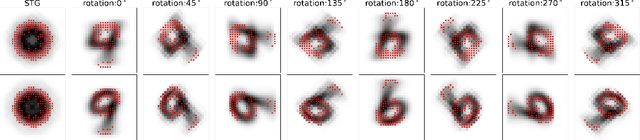
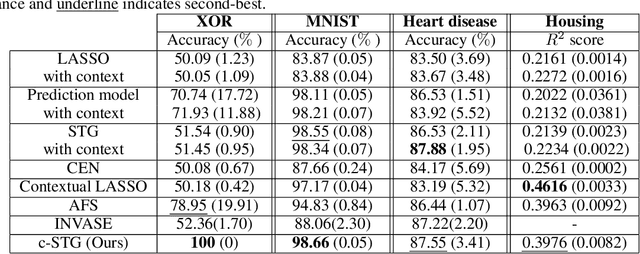
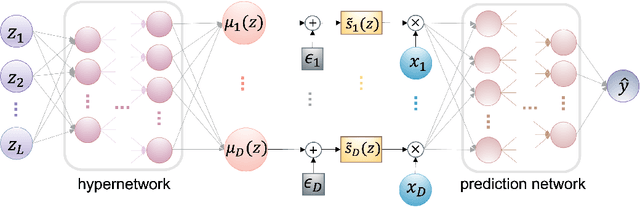
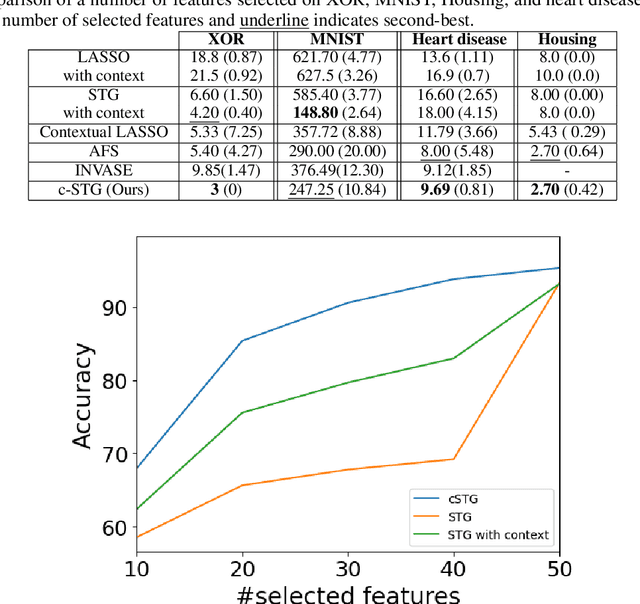
We study the problem of contextual feature selection, where the goal is to learn a predictive function while identifying subsets of informative features conditioned on specific contexts. Towards this goal, we generalize the recently proposed stochastic gates (STG) Yamada et al. [2020] by modeling the probabilistic gates as conditional Bernoulli variables whose parameters are predicted based on the contextual variables. Our new scheme, termed conditional-STG (c-STG), comprises two networks: a hypernetwork that establishes the mapping between contextual variables and probabilistic feature selection parameters and a prediction network that maps the selected feature to the response variable. Training the two networks simultaneously ensures the comprehensive incorporation of context and feature selection within a unified model. We provide a theoretical analysis to examine several properties of the proposed framework. Importantly, our model leads to improved flexibility and adaptability of feature selection and, therefore, can better capture the nuances and variations in the data. We apply c-STG to simulated and real-world datasets, including healthcare, housing, and neuroscience, and demonstrate that it effectively selects contextually meaningful features, thereby enhancing predictive performance and interpretability.
Data Processing of Functional Optical Microscopy for Neuroscience
Jan 10, 2022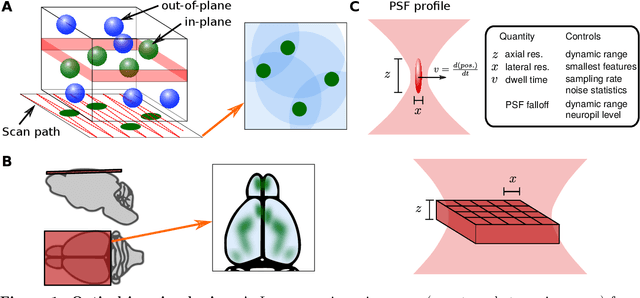
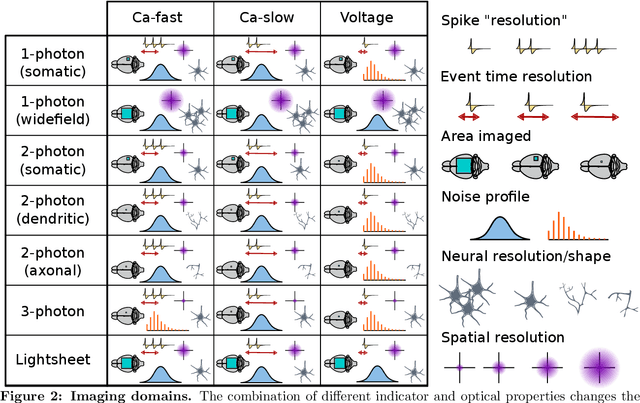
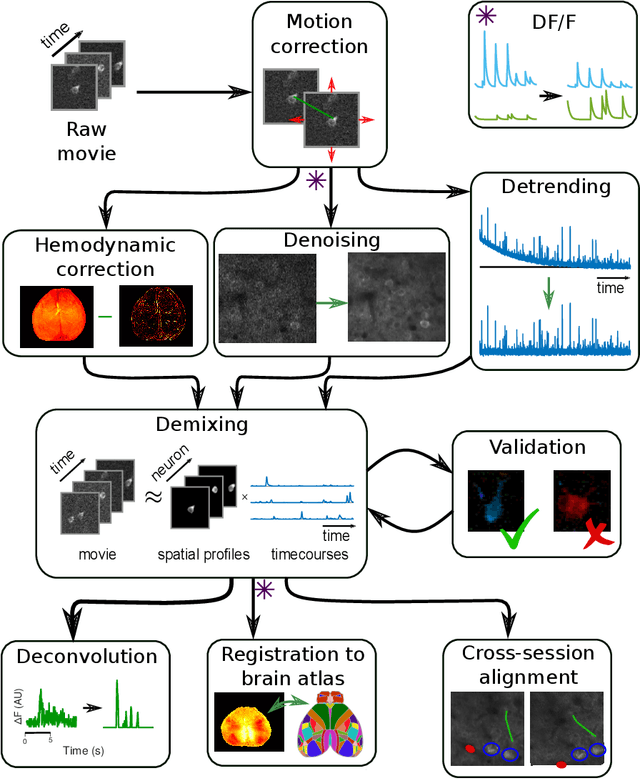
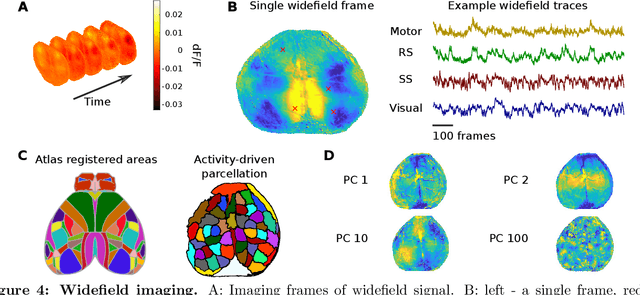
Functional optical imaging in neuroscience is rapidly growing with the development of new optical systems and fluorescence indicators. To realize the potential of these massive spatiotemporal datasets for relating neuronal activity to behavior and stimuli and uncovering local circuits in the brain, accurate automated processing is increasingly essential. In this review, we cover recent computational developments in the full data processing pipeline of functional optical microscopy for neuroscience data and discuss ongoing and emerging challenges.