 Add to Chrome
 Add to Firefox
 Add to Edge
Bootstrapped Physically-Primed Neural Networks for Robust T2 Distribution Estimation in Low-SNR Pancreatic MRI
Mar 14, 2026
Estimating multi-component T2 relaxation distributions from Multi-Echo Spin Echo (MESE) MRI is a severely ill-posed inverse problem, traditionally solved using regularized non-negative least squares (NNLS). In abdominal imaging, particularly the pancreas, low SNR and residual uncorrelated noise challenge classical solvers and deterministic deep learning models. We introduce a bootstrap-based inference framework for robust distributional T2 estimation that performs stochastic resampling of the echo train and aggregates predictions across multiple subsets. This treats the acquisition as a distribution rather than a fixed input, yielding variance-reduced, physically consistent estimates and converting deterministic relaxometry networks into probabilistic ensemble predictors. Applied to the P2T2 architecture, our method uses inference-time bootstrapping to smooth noise artifacts and enhance fidelity to the underlying relaxation distribution. Noninvasive pancreatic evaluation is limited by location and biopsy risks, highlighting the need for biomarkers capable of capturing early pathophysiological changes. In type 1 diabetes (T1DM), progressive beta-cell destruction begins years before overt hyperglycemia, yet current imaging cannot assess early islet decline. We evaluate clinical utility via a test-retest reproducibility study (N=7) and a T1DM versus healthy differentiation task (N=8). Our approach achieves the lowest Wasserstein distances across repeated scans and superior sensitivity to physiology-driven shifts in the relaxation-time distribution, outperforming NNLS and deterministic deep learning baselines. These results establish inference-time bootstrapping as an effective enhancement for quantitative T2 relaxometry in low-SNR abdominal imaging.

Rethinking The Memory Staleness Problem In Dynamics GNN
Sep 06, 2022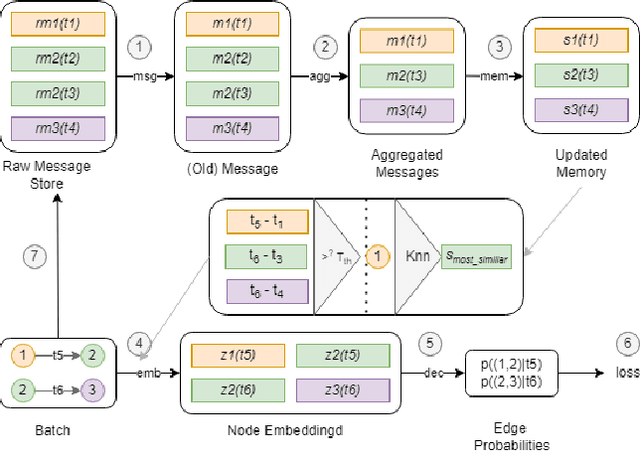
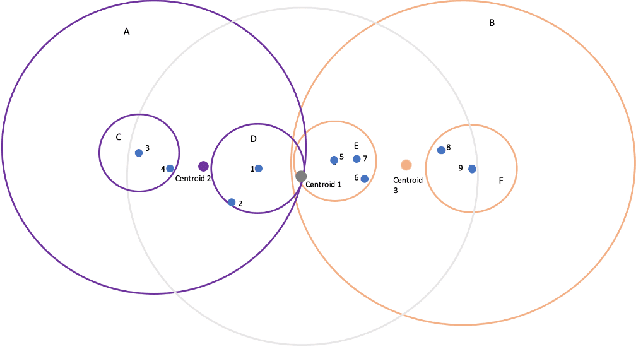
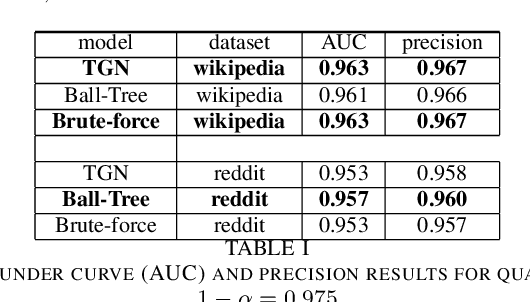
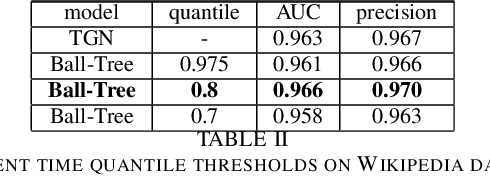
The staleness problem is a well-known problem when working with dynamic data, due to the absence of events for a long time. Since the memory of the node is updated only when the node is involved in an event, its memory becomes stale. Usually, it refers to a lack of events such as a temporal deactivation of a social account. To overcome the memory staleness problem aggregate information from the nodes neighbors memory in addition to the nodes memory. Inspired by that, we design an updated embedding module that inserts the most similar node in addition to the nodes neighbors. Our method achieved similar results to the TGN, with a slight improvement. This could indicate a potential improvement after fine-tuning our hyper-parameters, especially the time threshold, and using a learnable similarity metric.