 Add to Chrome
 Add to Firefox
 Add to Edge
SwiftQK: Fast and Communication-Efficient Tensor Parallelism for Query-Key Normalization
Aug 10, 2026
Query-Key Normalization (QK-Norm) improves the training stability and quality of modern Large Language Models (LLMs). However, under Tensor Parallelism (TP), layerwise QK-Norm introduces additional cross-GPU communication because the normalization factor depends on the full hidden vector. We present SwiftQK, a multi-GPU RMSNorm kernel that exchanges only scalar normalization statistics and overlaps the remaining Peer-to-Peer reduction with independent element-wise computation in a deadlock-safe persistent kernel. Evaluations on recent LLMs show that SwiftQK reduces QK-Norm latency by 81.4--93.9% relative to the standard TP QK-Norm using full-vector All-Gather. In end-to-end serving, SwiftQK reduces TPOT on average by 29.5% over the All-Gather-based baseline and by 14.3% over an optimized scalar-aggregation implementation.

HeteroSwitch: Characterizing and Taming System-Induced Data Heterogeneity in Federated Learning
Mar 07, 2024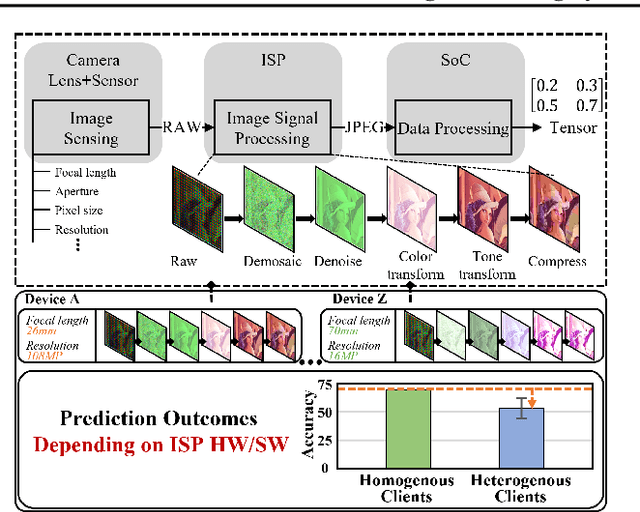
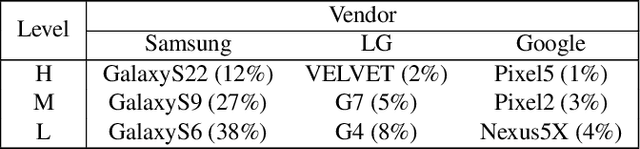
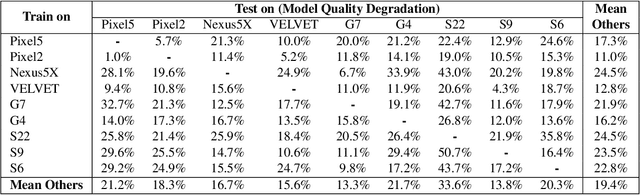
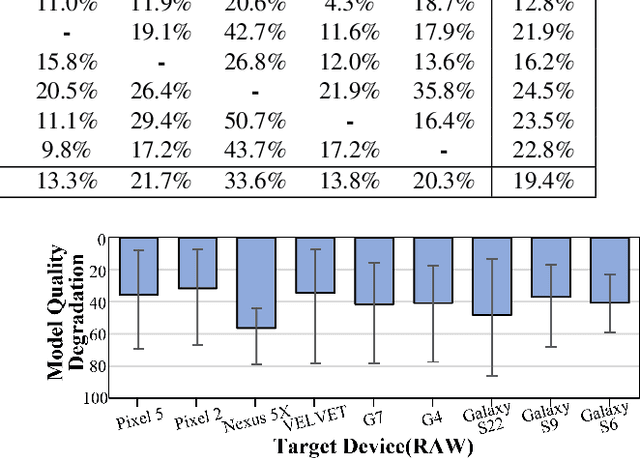
Federated Learning (FL) is a practical approach to train deep learning models collaboratively across user-end devices, protecting user privacy by retaining raw data on-device. In FL, participating user-end devices are highly fragmented in terms of hardware and software configurations. Such fragmentation introduces a new type of data heterogeneity in FL, namely \textit{system-induced data heterogeneity}, as each device generates distinct data depending on its hardware and software configurations. In this paper, we first characterize the impact of system-induced data heterogeneity on FL model performance. We collect a dataset using heterogeneous devices with variations across vendors and performance tiers. By using this dataset, we demonstrate that \textit{system-induced data heterogeneity} negatively impacts accuracy, and deteriorates fairness and domain generalization problems in FL. To address these challenges, we propose HeteroSwitch, which adaptively adopts generalization techniques (i.e., ISP transformation and SWAD) depending on the level of bias caused by varying HW and SW configurations. In our evaluation with a realistic FL dataset (FLAIR), HeteroSwitch reduces the variance of averaged precision by 6.3\% across device types.