 Add to Chrome
 Add to Firefox
 Add to Edge
TRIAGE: Dialectical Reasoning for Explainable Risk Prediction on Irregularly Sampled Medical Time Series with LLMs
Jun 08, 2026
Clinical early warning systems built on electronic health records, in which clinical observations are recorded as irregularly sampled medical time series (ISMTS), must deliver both calibrated risk scores for patient triage and interpretable rationales that clinicians can verify. Large Language Models (LLMs) have been explored for this task, yet they collapse graded clinical risk into overconfident binary predictions. This risk polarization undermines both calibration and cross-patient comparability. To address this, we propose TRIAGE, a framework that trains an LLM to generate dialectical reasoning over competing clinical outcomes by eliciting outcome-specific rationales. This dialectical formulation mitigates risk polarization, enabling a single LLM to yield continuous risk scores grounded in explicit clinical reasoning. Evaluated on three ISMTS benchmarks, TRIAGE achieves an average AUPRC improvement of 3.3% and reduces calibration error by 81% compared to the competitive baselines. An LLM-as-a-judge assessment further shows that our rationales surpass post-hoc explanations from the baseline by 20% in clinical reasoning quality. The source code is available at https://github.com/HyeongWon-Jang/TRIAGE .

Discounted Beta--Bernoulli Reward Estimation for Sample-Efficient Reinforcement Learning with Verifiable Rewards
Mar 19, 2026Reinforcement learning with verifiable rewards (RLVR) has emerged as an effective post-training paradigm for improving the reasoning capabilities of large language models. However, existing group-based RLVR methods often suffer from severe sample inefficiency. This inefficiency stems from reliance on point estimation of rewards from a small number of rollouts, leading to high estimation variance, variance collapse, and ineffective utilization of generated responses. In this work, we reformulate RLVR from a statistical estimation perspective by modeling rewards as samples drawn from a policy-induced distribution and casting advantage computation as the problem of estimating the reward distribution from finite data. Building on this view, we propose Discounted Beta--Bernoulli (DBB) reward estimation, which leverages historical reward statistics for the non-stationary distribution. Although biased, the resulting estimator exhibits reduced and stable variance, theoretically avoids estimated variance collapse, and achieves lower mean squared error than standard point estimation. Extensive experiments across six in-distribution and three out-of-distribution reasoning benchmarks demonstrate that GRPO with DBB consistently outperforms naive GRPO, achieving average Acc@8 improvements of 3.22/2.42 points in-distribution and 12.49/6.92 points out-of-distribution on the 1.7B and 8B models, respectively, without additional computational cost or memory usage.
Argument Reconstruction as Supervision for Critical Thinking in LLMs
Mar 18, 2026To think critically about arguments, human learners are trained to identify, reconstruct, and evaluate arguments. Argument reconstruction is especially important because it makes an argument's underlying inferences explicit. However, it remains unclear whether LLMs can similarly enhance their critical thinking ability by learning to reconstruct arguments. To address this question, we introduce a holistic framework with three contributions. We (1) propose an engine that automatically reconstructs arbitrary arguments (GAAR), (2) synthesize a new high-quality argument reconstruction dataset (Arguinas) using the GAAR engine, and (3) investigate whether learning argument reconstruction benefits downstream critical thinking tasks. Our experimental results show that, across seven critical thinking tasks, models trained to learn argument reconstruction outperform models that do not, with the largest performance gains observed when training on the proposed Arguinas dataset. The source code and dataset will be publicly available.
Every Expert Matters: Towards Effective Knowledge Distillation for Mixture-of-Experts Language Models
Feb 18, 2025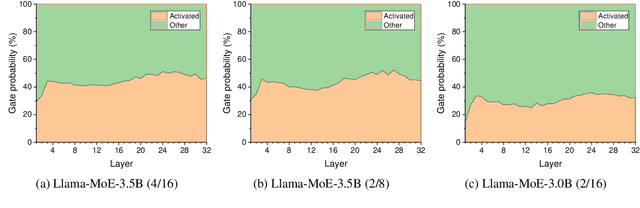
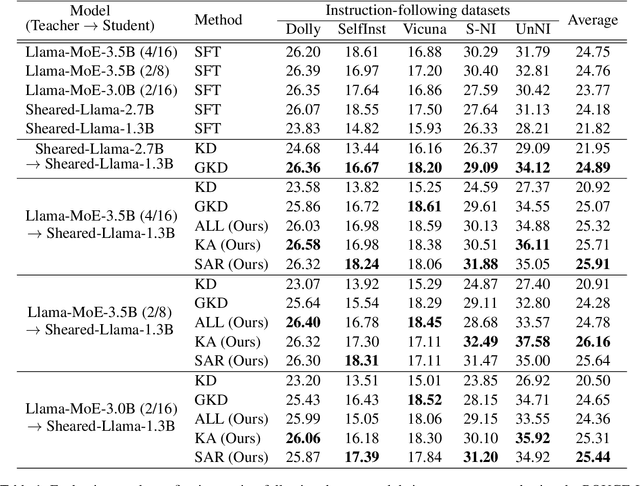
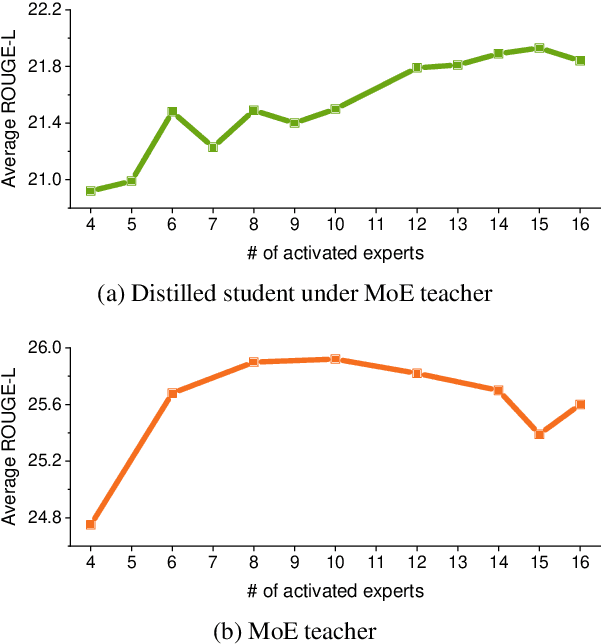
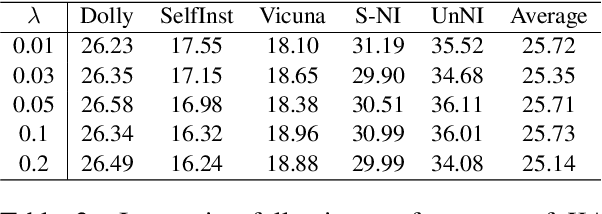
With the emergence of Mixture-of-Experts (MoE), the efficient scaling of model size has accelerated the development of large language models in recent years. However, their high memory requirements prevent their use in resource-constrained environments. While knowledge distillation (KD) has been a proven method for model compression, its application to MoE teacher models remains underexplored. Through our investigation, we discover that non-activated experts in MoE models possess valuable knowledge that benefits student models. We further demonstrate that existing KD methods are not optimal for compressing MoE models, as they fail to leverage this knowledge effectively. To address this, we propose two intuitive MoE-specific KD methods for the first time: Knowledge Augmentation (KA) and Student-Aware Router (SAR), both designed to effectively extract knowledge from all experts. Specifically, KA augments knowledge by sampling experts multiple times, while SAR uses all experts and adjusts the expert weights through router training to provide optimal knowledge. Extensive experiments show that our methods outperform conventional KD methods, demonstrating their effectiveness for MoE teacher models.