 Add to Chrome
 Add to Firefox
 Add to Edge
Local-Curvature-Aware Knowledge Graph Embedding: An Extended Ricci Flow Approach
Dec 10, 2025
Knowledge graph embedding (KGE) relies on the geometry of the embedding space to encode semantic and structural relations. Existing methods place all entities on one homogeneous manifold, Euclidean, spherical, hyperbolic, or their product/multi-curvature variants, to model linear, symmetric, or hierarchical patterns. Yet a predefined, homogeneous manifold cannot accommodate the sharply varying curvature that real-world graphs exhibit across local regions. Since this geometry is imposed a priori, any mismatch with the knowledge graph's local curvatures will distort distances between entities and hurt the expressiveness of the resulting KGE. To rectify this, we propose RicciKGE to have the KGE loss gradient coupled with local curvatures in an extended Ricci flow such that entity embeddings co-evolve dynamically with the underlying manifold geometry towards mutual adaptation. Theoretically, when the coupling coefficient is bounded and properly selected, we rigorously prove that i) all the edge-wise curvatures decay exponentially, meaning that the manifold is driven toward the Euclidean flatness; and ii) the KGE distances strictly converge to a global optimum, which indicates that geometric flattening and embedding optimization are promoting each other. Experimental improvements on link prediction and node classification benchmarks demonstrate RicciKGE's effectiveness in adapting to heterogeneous knowledge graph structures.

KGOT: Unified Knowledge Graph and Optimal Transport Pseudo-Labeling for Molecule-Protein Interaction Prediction
Dec 10, 2025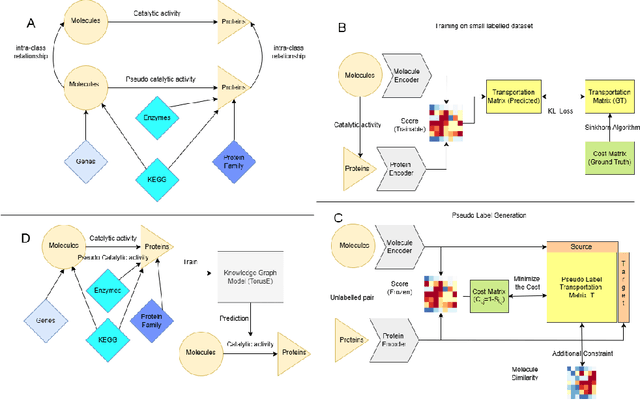
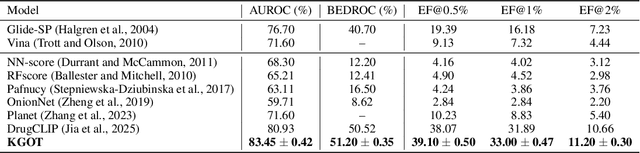
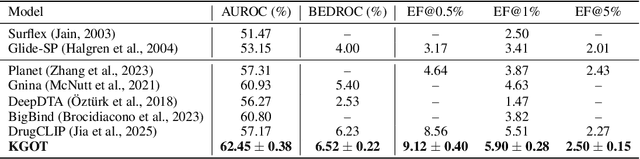
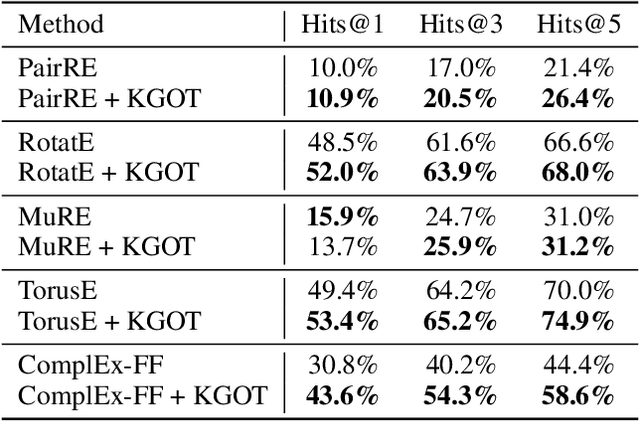
Predicting molecule-protein interactions (MPIs) is a fundamental task in computational biology, with crucial applications in drug discovery and molecular function annotation. However, existing MPI models face two major challenges. First, the scarcity of labeled molecule-protein pairs significantly limits model performance, as available datasets capture only a small fraction of biological relevant interactions. Second, most methods rely solely on molecular and protein features, ignoring broader biological context such as genes, metabolic pathways, and functional annotations that could provide essential complementary information. To address these limitations, our framework first aggregates diverse biological datasets, including molecular, protein, genes and pathway-level interactions, and then develop an optimal transport-based approach to generate high-quality pseudo-labels for unlabeled molecule-protein pairs, leveraging the underlying distribution of known interactions to guide label assignment. By treating pseudo-labeling as a mechanism for bridging disparate biological modalities, our approach enables the effective use of heterogeneous data to enhance MPI prediction. We evaluate our framework on multiple MPI datasets including virtual screening tasks and protein retrieval tasks, demonstrating substantial improvements over state-of-the-art methods in prediction accuracies and zero shot ability across unseen interactions. Beyond MPI prediction, our approach provides a new paradigm for leveraging diverse biological data sources to tackle problems traditionally constrained by single- or bi-modal learning, paving the way for future advances in computational biology and drug discovery.