 Add to Chrome
 Add to Firefox
 Add to Edge
Integrating national forest inventory, airborne lidar, and satellite imagery for wall-to-wall mapping of forest structure with computer vision
Jun 18, 2026
Remote sensing is increasingly relied upon to deliver actionable science for forest and wildfire risk management across large landscapes. Wall-to-wall, annually updated maps are a persistent need for effective forest management. Many planning systems and data collections combine disparate data sources with different purposes, vintages, and prediction quality, which leads to confounding behavior in operational planning systems. We introduce the VibrantForests framework, developed and applied to map forest attributes and provide a coherent foundation for effective forest and wildfire planning. VibrantForests includes a satellite-based forest structure model trained on lidar-derived samples and applied across the contiguous United States to concurrently generate estimates of canopy cover, canopy height, aboveground live tree biomass, basal area, and quadratic mean diameter at 10-meter resolution. We demonstrate predictive capability spanning the full spectrum of forest conditions ranging from sparse-canopy/low-biomass to dense-canopy/high-biomass. Results show that our model extends the range at which saturation is commonly encountered in comparable passive-sensor models, and reduces regression-to-mean behavior that commonly produces overestimation of forest attributes in small/sparse conditions and underestimation in large/dense conditions. The VibrantForests framework addresses a key limitation in large-area forest and wildfire planning by delivering coherent wall-to-wall estimates of management-relevant attributes at annual cadence and 10m resolution.

VibrantSR: Sub-Meter Canopy Height Models from Sentinel-2 Using Generative Flow Matching
Jan 14, 2026We present VibrantSR (Vibrant Super-Resolution), a generative super-resolution framework for estimating 0.5 meter canopy height models (CHMs) from 10 meter Sentinel-2 imagery. Unlike approaches based on aerial imagery that are constrained by infrequent and irregular acquisition schedules, VibrantSR leverages globally available Sentinel-2 seasonal composites, enabling consistent monitoring at a seasonal-to-annual cadence. Evaluated across 22 EPA Level 3 eco-regions in the western United States using spatially disjoint validation splits, VibrantSR achieves a Mean Absolute Error of 4.39 meters for canopy heights >= 2 m, outperforming Meta (4.83 m), LANDFIRE (5.96 m), and ETH (7.05 m) satellite-based benchmarks. While aerial-based VibrantVS (2.71 m MAE) retains an accuracy advantage, VibrantSR enables operational forest monitoring and carbon accounting at continental scales without reliance on costly and temporally infrequent aerial acquisitions.
VibrantVS: A high-resolution multi-task transformer for forest canopy height estimation
Dec 13, 2024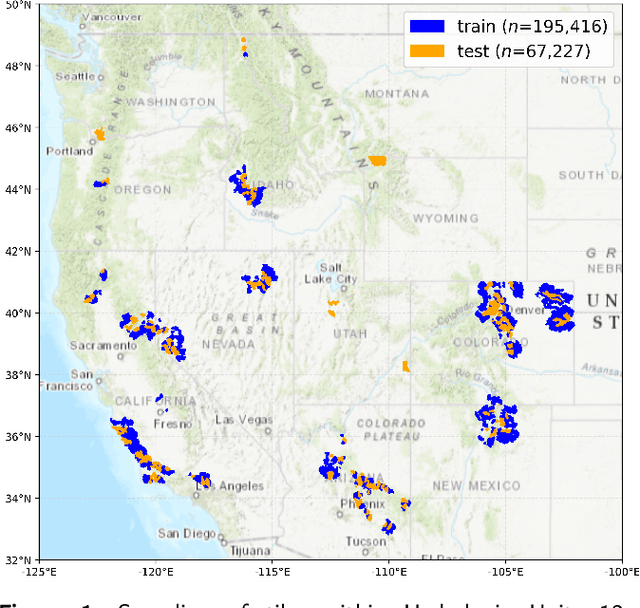
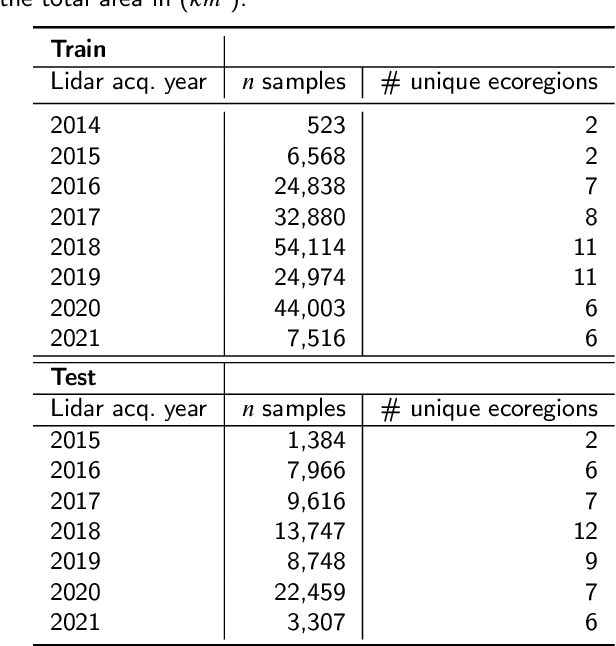
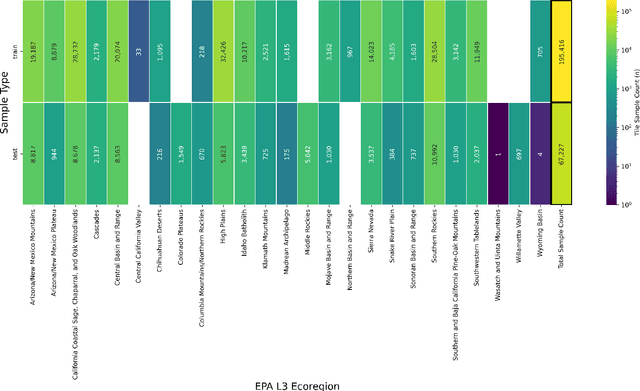
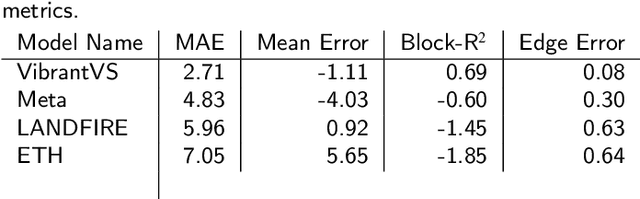
This paper explores the application of a novel multi-task vision transformer (ViT) model for the estimation of canopy height models (CHMs) using 4-band National Agriculture Imagery Program (NAIP) imagery across the western United States. We compare the effectiveness of this model in terms of accuracy and precision aggregated across ecoregions and class heights versus three other benchmark peer-reviewed models. Key findings suggest that, while other benchmark models can provide high precision in localized areas, the VibrantVS model has substantial advantages across a broad reach of ecoregions in the western United States with higher accuracy, higher precision, the ability to generate updated inference at a cadence of three years or less, and high spatial resolution. The VibrantVS model provides significant value for ecological monitoring and land management decisions for wildfire mitigation.