 Add to Chrome
 Add to Firefox
 Add to Edge
KathDB: Explainable Multimodal Database Management System with Human-AI Collaboration
Dec 11, 2025
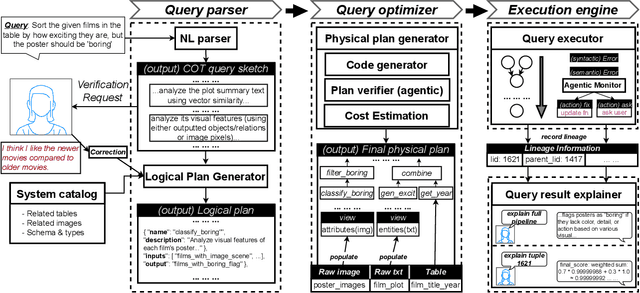
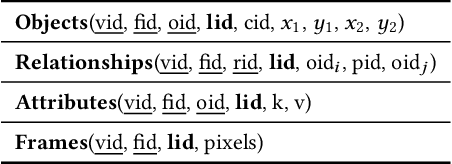
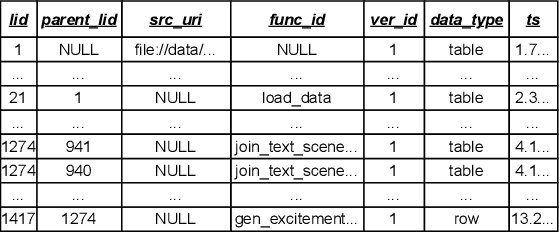
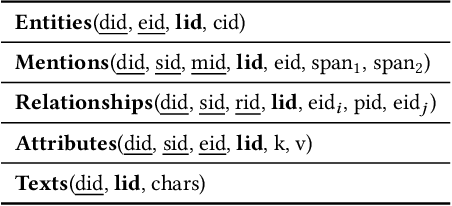
Traditional DBMSs execute user- or application-provided SQL queries over relational data with strong semantic guarantees and advanced query optimization, but writing complex SQL is hard and focuses only on structured tables. Contemporary multimodal systems (which operate over relations but also text, images, and even videos) either expose low-level controls that force users to use (and possibly create) machine learning UDFs manually within SQL or offload execution entirely to black-box LLMs, sacrificing usability or explainability. We propose KathDB, a new system that combines relational semantics with the reasoning power of foundation models over multimodal data. Furthermore, KathDB includes human-AI interaction channels during query parsing, execution, and result explanation, such that users can iteratively obtain explainable answers across data modalities.

RACOON: An LLM-based Framework for Retrieval-Augmented Column Type Annotation with a Knowledge Graph
Sep 22, 2024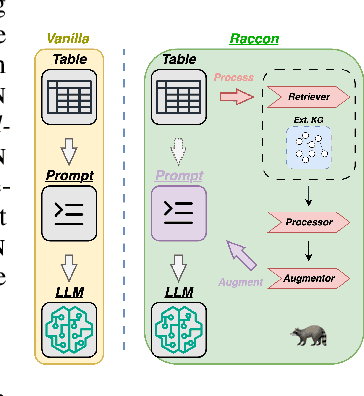

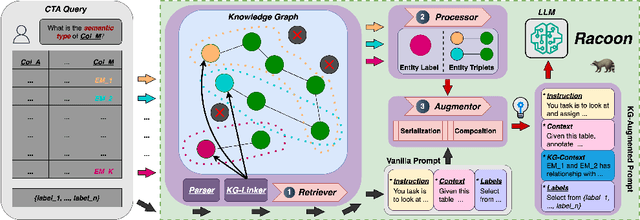
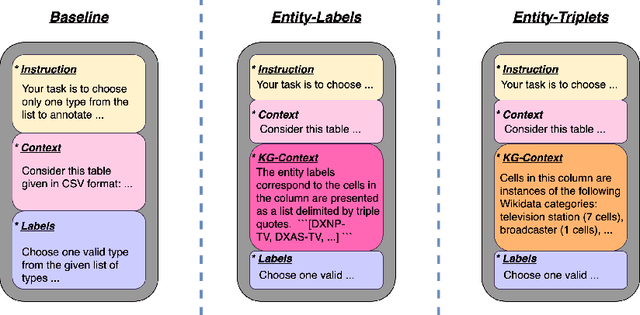
As an important component of data exploration and integration, Column Type Annotation (CTA) aims to label columns of a table with one or more semantic types. With the recent development of Large Language Models (LLMs), researchers have started to explore the possibility of using LLMs for CTA, leveraging their strong zero-shot capabilities. In this paper, we build on this promising work and improve on LLM-based methods for CTA by showing how to use a Knowledge Graph (KG) to augment the context information provided to the LLM. Our approach, called RACOON, combines both pre-trained parametric and non-parametric knowledge during generation to improve LLMs' performance on CTA. Our experiments show that RACOON achieves up to a 0.21 micro F-1 improvement compared against vanilla LLM inference.