 Add to Chrome
 Add to Firefox
 Add to Edge
Verification-Gated Agentic Mission-State Governance for Intelligent Industrial Multi-Robot Systems
Jun 30, 2026
Agentic artificial intelligence is increasingly used to decompose industrial tasks, propose robot actions, and adapt execution plans in dynamic cyber-physical environments. However, autonomous proposal generation alone does not guarantee that multi-robot industrial systems preserve task dependencies, resource ownership, safety holds, or repair boundaries during long-horizon execution. This paper introduces a verification-gated agentic mission-state governance framework for intelligent industrial multi-robot systems. The framework maintains two synchronized state objects: an evolving task forest for persistent hierarchy, delayed grounding, and repairable substructures; and a governed blackboard for online execution state, robot traces, resource locks, world beliefs, proposals, verification records, and scene-temporary constraints. From each forest--blackboard snapshot, a derived execution coupling topology exposes cross-branch dependencies for proposal verification, parallel-commit eligibility, and bounded repair. Candidate assignments, repairs, deferrals, and constraint updates may be generated by heuristic, optimization, or agentic reasoning modules, but they can update the committed mission state only after deterministic verification and atomic commit. We evaluate the framework in an indoor factory multi-robot scenario, 30-seed remote-construction stress benchmarks, structural ablations, and scalability probes. The results show improved verified and safety-audited mission-state progress with fewer invalid commitments, lock conflicts, duplicate assignments, abandoned nodes, and disruptive repairs under modeled mission predicates. The study positions agentic AI as a proposal-generating layer governed by inspectable mission-state verification rather than as an unchecked execution authority.

VLM-DEWM: Dynamic External World Model for Verifiable and Resilient Vision-Language Planning in Manufacturing
Feb 17, 2026Vision-language model (VLM) shows promise for high-level planning in smart manufacturing, yet their deployment in dynamic workcells faces two critical challenges: (1) stateless operation, they cannot persistently track out-of-view states, causing world-state drift; and (2) opaque reasoning, failures are difficult to diagnose, leading to costly blind retries. This paper presents VLM-DEWM, a cognitive architecture that decouples VLM reasoning from world-state management through a persistent, queryable Dynamic External World Model (DEWM). Each VLM decision is structured into an Externalizable Reasoning Trace (ERT), comprising action proposal, world belief, and causal assumption, which is validated against DEWM before execution. When failures occur, discrepancy analysis between predicted and observed states enables targeted recovery instead of global replanning. We evaluate VLM-DEWM on multi-station assembly, large-scale facility exploration, and real-robot recovery under induced failures. Compared to baseline memory-augmented VLM systems, VLM DEWM improves state-tracking accuracy from 56% to 93%, increases recovery success rate from below 5% to 95%, and significantly reduces computational overhead through structured memory. These results establish VLM-DEWM as a verifiable and resilient solution for long-horizon robotic operations in dynamic manufacturing environments.
Perceiving, Reasoning, Adapting: A Dual-Layer Framework for VLM-Guided Precision Robotic Manipulation
Mar 07, 2025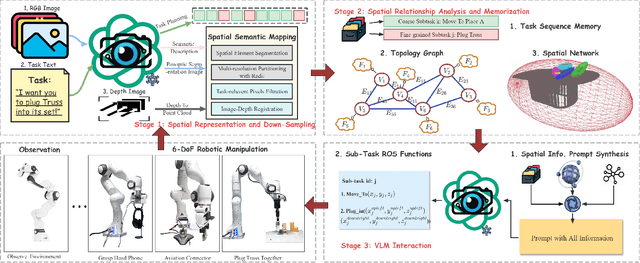
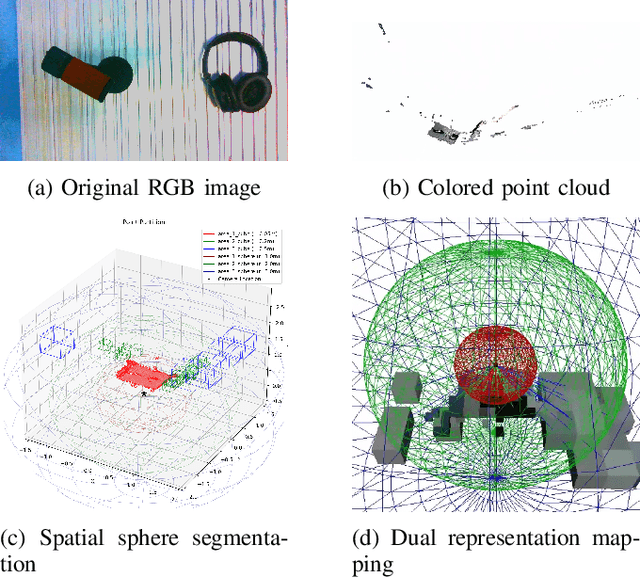
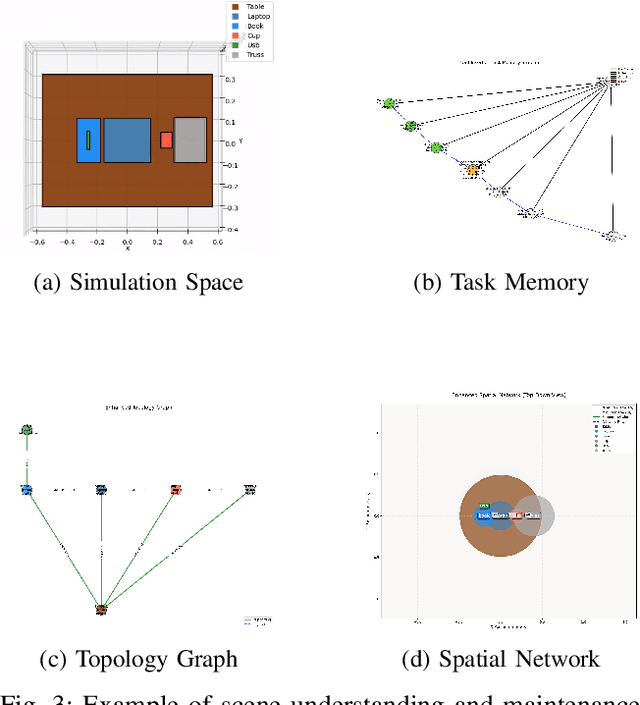
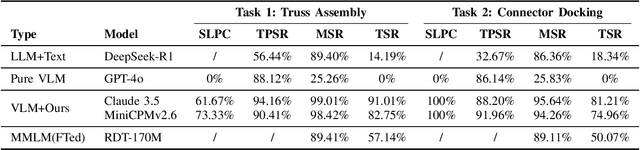
Vision-Language Models (VLMs) demonstrate remarkable potential in robotic manipulation, yet challenges persist in executing complex fine manipulation tasks with high speed and precision. While excelling at high-level planning, existing VLM methods struggle to guide robots through precise sequences of fine motor actions. To address this limitation, we introduce a progressive VLM planning algorithm that empowers robots to perform fast, precise, and error-correctable fine manipulation. Our method decomposes complex tasks into sub-actions and maintains three key data structures: task memory structure, 2D topology graphs, and 3D spatial networks, achieving high-precision spatial-semantic fusion. These three components collectively accumulate and store critical information throughout task execution, providing rich context for our task-oriented VLM interaction mechanism. This enables VLMs to dynamically adjust guidance based on real-time feedback, generating precise action plans and facilitating step-wise error correction. Experimental validation on complex assembly tasks demonstrates that our algorithm effectively guides robots to rapidly and precisely accomplish fine manipulation in challenging scenarios, significantly advancing robot intelligence for precision tasks.
3D-Grounded Vision-Language Framework for Robotic Task Planning: Automated Prompt Synthesis and Supervised Reasoning
Feb 13, 2025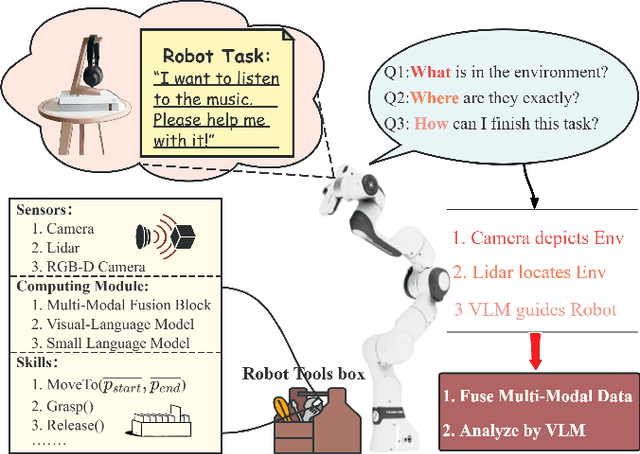
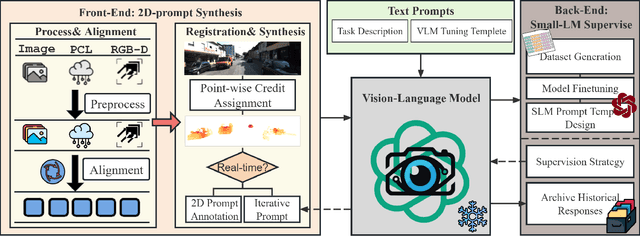
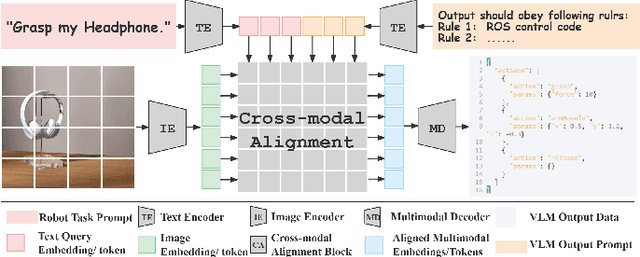
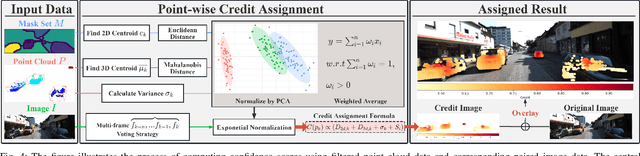
Vision-language models (VLMs) have achieved remarkable success in scene understanding and perception tasks, enabling robots to plan and execute actions adaptively in dynamic environments. However, most multimodal large language models lack robust 3D scene localization capabilities, limiting their effectiveness in fine-grained robotic operations. Additionally, challenges such as low recognition accuracy, inefficiency, poor transferability, and reliability hinder their use in precision tasks. To address these limitations, we propose a novel framework that integrates a 2D prompt synthesis module by mapping 2D images to point clouds, and incorporates a small language model (SLM) for supervising VLM outputs. The 2D prompt synthesis module enables VLMs, trained on 2D images and text, to autonomously extract precise 3D spatial information without manual intervention, significantly enhancing 3D scene understanding. Meanwhile, the SLM supervises VLM outputs, mitigating hallucinations and ensuring reliable, executable robotic control code generation. Our framework eliminates the need for retraining in new environments, thereby improving cost efficiency and operational robustness. Experimental results that the proposed framework achieved a 96.0\% Task Success Rate (TSR), outperforming other methods. Ablation studies demonstrated the critical role of both the 2D prompt synthesis module and the output supervision module (which, when removed, caused a 67\% TSR drop). These findings validate the framework's effectiveness in improving 3D recognition, task planning, and robotic task execution.