 Add to Chrome
 Add to Firefox
 Add to Edge
Graph-based Point Cloud Surface Reconstruction using B-Splines
Sep 19, 2025
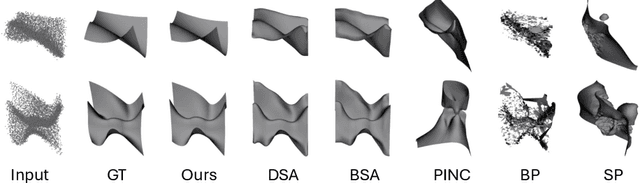
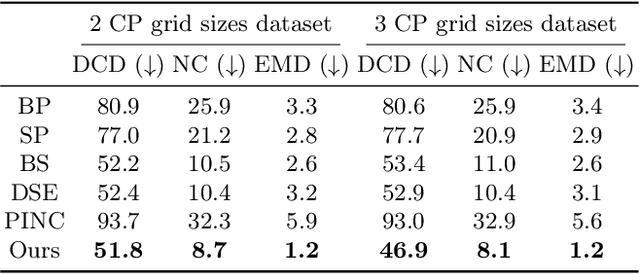
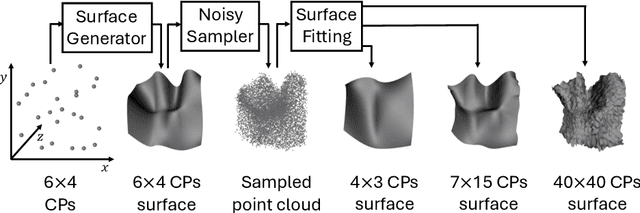

Generating continuous surfaces from discrete point cloud data is a fundamental task in several 3D vision applications. Real-world point clouds are inherently noisy due to various technical and environmental factors. Existing data-driven surface reconstruction algorithms rely heavily on ground truth normals or compute approximate normals as an intermediate step. This dependency makes them extremely unreliable for noisy point cloud datasets, even if the availability of ground truth training data is ensured, which is not always the case. B-spline reconstruction techniques provide compact surface representations of point clouds and are especially known for their smoothening properties. However, the complexity of the surfaces approximated using B-splines is directly influenced by the number and location of the spline control points. Existing spline-based modeling methods predict the locations of a fixed number of control points for a given point cloud, which makes it very difficult to match the complexity of its underlying surface. In this work, we develop a Dictionary-Guided Graph Convolutional Network-based surface reconstruction strategy where we simultaneously predict both the location and the number of control points for noisy point cloud data to generate smooth surfaces without the use of any point normals. We compare our reconstruction method with several well-known as well as recent baselines by employing widely-used evaluation metrics, and demonstrate that our method outperforms all of them both qualitatively and quantitatively.

Revisiting Point Cloud Completion: Are We Ready For The Real-World?
Nov 26, 2024Point clouds acquired in constrained and challenging real-world settings are incomplete, non-uniformly sparse, or both. These obstacles present acute challenges for a vital task - point cloud completion. Using tools from Algebraic Topology and Persistent Homology ($\mathcal{PH}$), we demonstrate that current benchmark synthetic point clouds lack rich topological features that are important constituents of point clouds captured in realistic settings. To facilitate research in this direction, we contribute the first real-world industrial point cloud dataset for point cloud completion, RealPC - a diverse set of rich and varied point clouds, consisting of $\sim$ 40,000 pairs across 21 categories of industrial structures in railway establishments. Our benchmark results on several strong baselines reveal a striking observation - the existing methods are tailored for synthetic datasets and fail miserably in real-world settings. Building on our observation that RealPC consists of several 0 and 1-dimensional $\mathcal{PH}$-based topological features, we demonstrate the potential of integrating Homology-based topological priors into existing works. More specifically, we present how 0-dimensional $\mathcal{PH}$ priors, which extract the global topology of a complete shape in the form of a 3-D skeleton, can assist a model in generating topologically-consistent complete shapes.
A Multisensor Hyperspectral Benchmark Dataset For Unmixing of Intimate Mixtures
Aug 30, 2023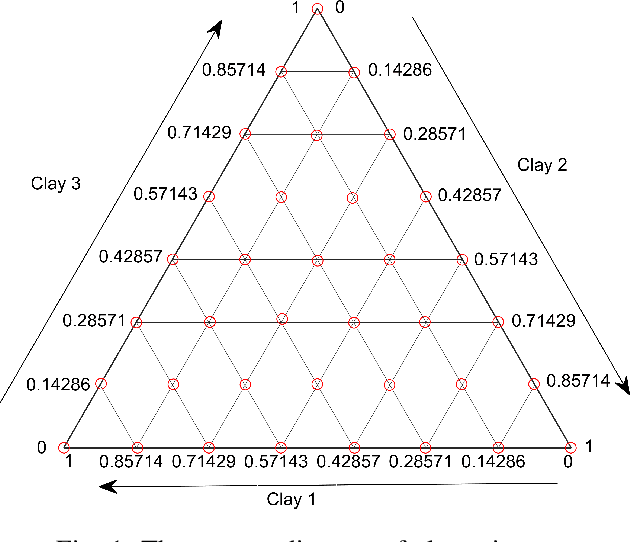
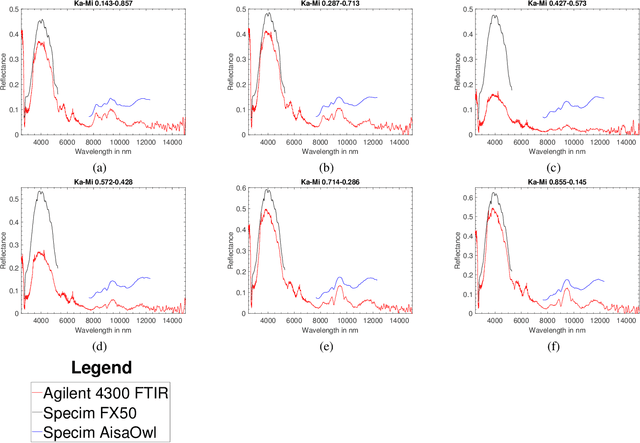
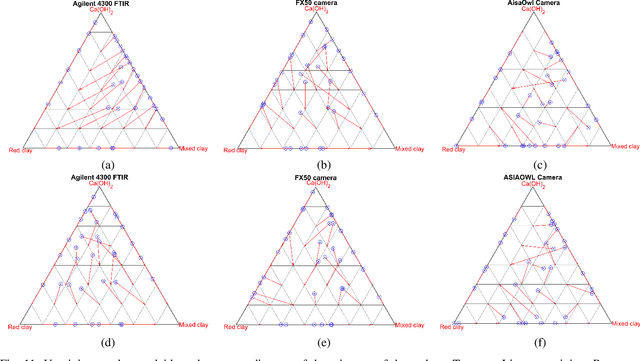
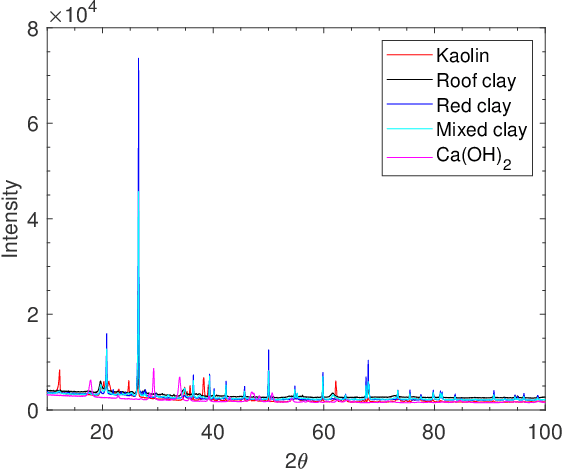
Optical hyperspectral cameras capture the spectral reflectance of materials. Since many materials behave as heterogeneous intimate mixtures with which each photon interacts differently, the relationship between spectral reflectance and material composition is very complex. Quantitative validation of spectral unmixing algorithms requires high-quality ground truth fractional abundance data, which are very difficult to obtain. In this work, we generated a comprehensive laboratory ground truth dataset of intimately mixed mineral powders. For this, five clay powders (Kaolin, Roof clay, Red clay, mixed clay, and Calcium hydroxide) were mixed homogeneously to prepare 325 samples of 60 binary, 150 ternary, 100 quaternary, and 15 quinary mixtures. Thirteen different hyperspectral sensors have been used to acquire the reflectance spectra of these mixtures in the visible, near, short, mid, and long-wavelength infrared regions (350-15385) nm. {\color{black} Overlaps in wavelength regions due to the operational ranges of each sensor} and variations in acquisition conditions {\color{black} resulted in} a large amount of spectral variability. Ground truth composition is given by construction, but to verify that the generated samples are sufficiently homogeneous, XRD and XRF elemental analysis is performed. We believe these data will be beneficial for validating advanced methods for nonlinear unmixing and material composition estimation, including studying spectral variability and training supervised unmixing approaches. The datasets can be downloaded from the following link: https://github.com/VisionlabUA/Multisensor_datasets.