 Add to Chrome
 Add to Firefox
 Add to Edge
Color encoding in Latent Space of Stable Diffusion Models
Dec 10, 2025

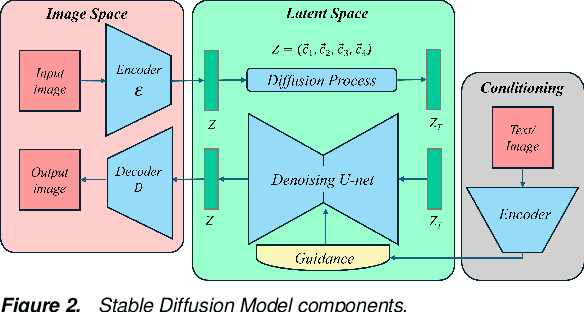
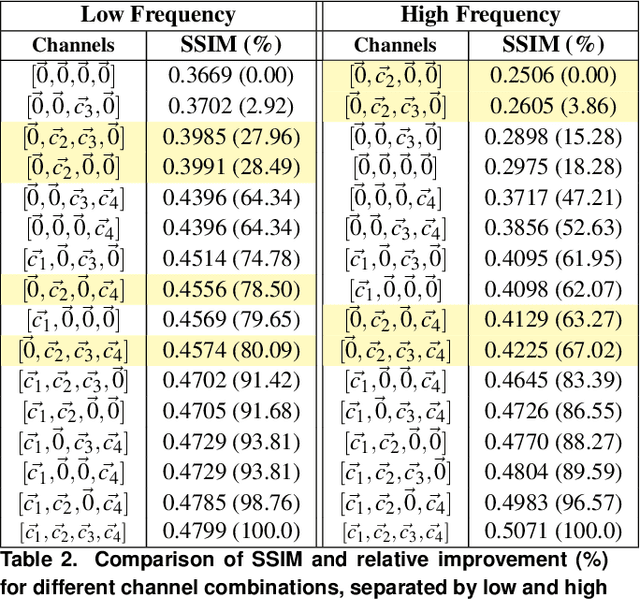
Recent advances in diffusion-based generative models have achieved remarkable visual fidelity, yet a detailed understanding of how specific perceptual attributes - such as color and shape - are internally represented remains limited. This work explores how color is encoded in a generative model through a systematic analysis of the latent representations in Stable Diffusion. Through controlled synthetic datasets, principal component analysis (PCA) and similarity metrics, we reveal that color information is encoded along circular, opponent axes predominantly captured in latent channels c_3 and c_4, whereas intensity and shape are primarily represented in channels c_1 and c_2. Our findings indicate that the latent space of Stable Diffusion exhibits an interpretable structure aligned with a efficient coding representation. These insights provide a foundation for future work in model understanding, editing applications, and the design of more disentangled generative frameworks.

Color in Visual-Language Models: CLIP deficiencies
Feb 06, 2025This work explores how color is encoded in CLIP (Contrastive Language-Image Pre-training) which is currently the most influential VML (Visual Language model) in Artificial Intelligence. After performing different experiments on synthetic datasets created for this task, we conclude that CLIP is able to attribute correct color labels to colored visual stimulus, but, we come across two main deficiencies: (a) a clear bias on achromatic stimuli that are poorly related to the color concept, thus white, gray and black are rarely assigned as color labels; and (b) the tendency to prioritize text over other visual information. Here we prove it is highly significant in color labelling through an exhaustive Stroop-effect test. With the aim to find the causes of these color deficiencies, we analyse the internal representation at the neuron level. We conclude that CLIP presents an important amount of neurons selective to text, specially in deepest layers of the network, and a smaller amount of multi-modal color neurons which could be the key of understanding the concept of color properly. Our investigation underscores the necessity of refining color representation mechanisms in neural networks to foster a more comprehensive comprehension of colors as humans understand them, thereby advancing the efficacy and versatility of multimodal models like CLIP in real-world scenarios.
* 6 pages, 10 figures, conference, Artificial Intelligence