 Add to Chrome
 Add to Firefox
 Add to Edge
Order Matters: LVLMs as Judges for Temporal Reasoning in Image Sequences
Aug 11, 2026
As generative multimedia evolves from static image synthesis to complex, interleaved visual narratives, a foundational bottleneck has emerged: the judgment crisis. While human perception naturally synthesizes the temporal and logical flow of a story, automated evaluation systems remain largely "blind" to sequential continuity, often failing to distinguish between a coherent narrative and a semantically shuffled or contradictory sequence. This work identifies a critical structural gap in current multimodal evaluation paradigms, arguing that the reliance on Large Vision-Language Models (LVLMs) as judges is fundamentally limited by architectural biases. Our analysis reveals a profound performance dichotomy: while models may appear competent in isolated pointwise scoring, they suffer a catastrophic collapse when required to perform pairwise discrimination of temporal order. We demonstrate that this is not merely a data-scarcity issue but a structural one. Through a series of diagnostic probes, we uncover systematic positional asymmetries, specifically primacy and recency effects, where a model's judgment of a story is significantly influenced by the placement of a frame, often more than by its semantic consistency. These biases, potentially rooted in causal masking and rotary embeddings, suggest that current transformer-based judges are inherently ill-equipped for long-form visual reasoning. By exposing these blind spots, we challenge the multimedia community to move beyond snapshot-centric metrics and instead pioneer Temporally-Aware Evaluation paradigms that treat visual sequences as unified logical structures rather than unordered collections of frames.

Latent Beam Diffusion Models for Decoding Image Sequences
Mar 26, 2025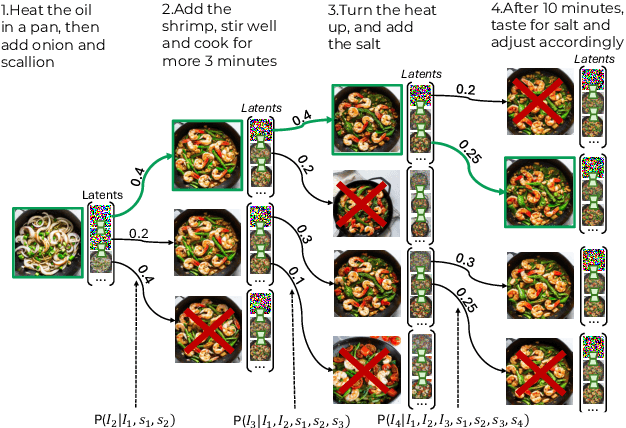
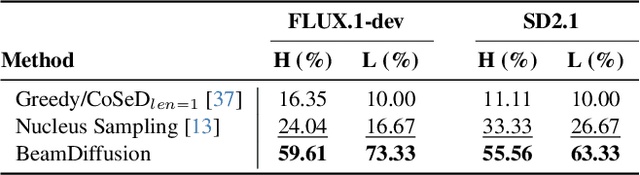
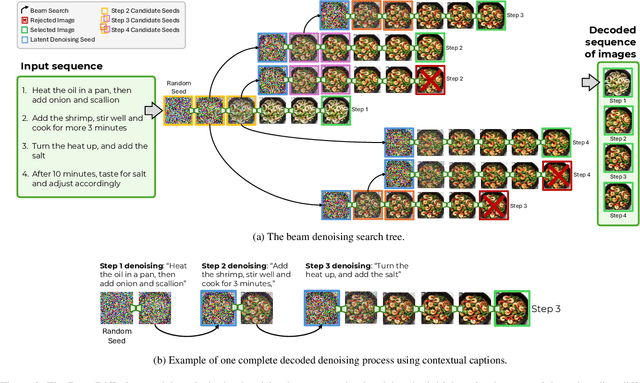
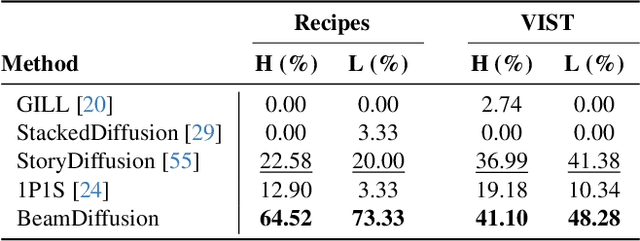
While diffusion models excel at generating high-quality images from text prompts, they struggle with visual consistency in image sequences. Existing methods generate each image independently, leading to disjointed narratives - a challenge further exacerbated in non-linear storytelling, where scenes must connect beyond adjacent frames. We introduce a novel beam search strategy for latent space exploration, enabling conditional generation of full image sequences with beam search decoding. Unlike prior approaches that use fixed latent priors, our method dynamically searches for an optimal sequence of latent representations, ensuring coherent visual transitions. To address beam search's quadratic complexity, we integrate a cross-attention mechanism that efficiently scores search paths and enables pruning, prioritizing alignment with both textual prompts and visual context. Human evaluations confirm that our approach outperforms baseline methods, producing full sequences with superior coherence, visual continuity, and textual alignment. By bridging advances in search optimization and latent space refinement, this work sets a new standard for structured image sequence generation.