 Add to Chrome
 Add to Firefox
 Add to Edge
Intelligent Navigation and Obstacle-Aware Fabrication for Mobile Additive Manufacturing Systems
Mar 26, 2026
As the demand for mass customization increases, manufacturing systems must become more flexible and adaptable to produce personalized products efficiently. Additive manufacturing (AM) enhances production adaptability by enabling on-demand fabrication of customized components directly from digital models, but its flexibility remains constrained by fixed equipment layouts. Integrating mobile robots addresses this limitation by allowing manufacturing resources to move and adapt to changing production requirements. Mobile AM Robots (MAMbots) combine AM with mobile robotics to produce and transport components within dynamic manufacturing environments. However, the dynamic manufacturing environments introduce challenges for MAMbots. Disturbances such as obstacles and uneven terrain can disrupt navigation stability, which in turn affects printing accuracy and surface quality. This work proposes a universal mobile printing-and-delivery platform that couples navigation and material deposition, addressing the limitations of earlier frameworks that treated these processes separately. A real-time control framework is developed to plan and control the robot's navigation, ensuring safe motion, obstacle avoidance, and path stability while maintaining print quality. The closed-loop integration of sensing, mobility, and manufacturing provides real-time feedback for motion and process control, enabling MAMbots to make autonomous decisions in dynamic environments. The framework is validated through simulations and real-world experiments that test its adaptability to trajectory variations and external disturbances. Coupled navigation and printing together enable MAMbots to plan safe, adaptive trajectories, improving flexibility and adaptability in manufacturing.

A Mobile Additive Manufacturing Robot Framework for Smart Manufacturing Systems
Apr 19, 2024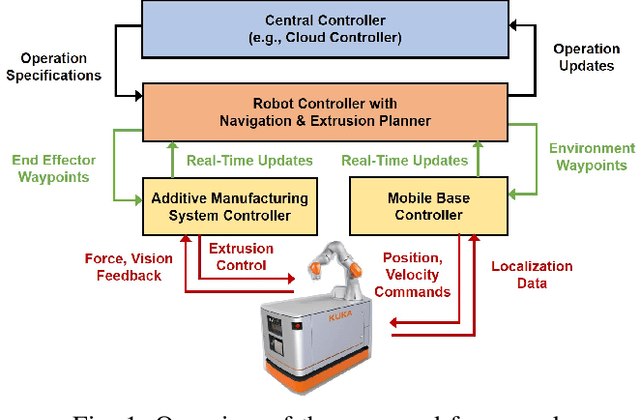
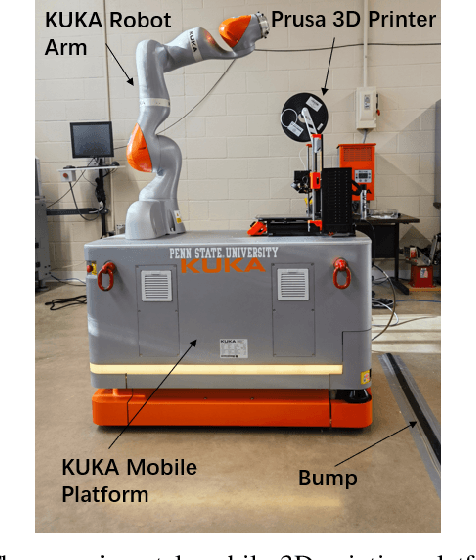
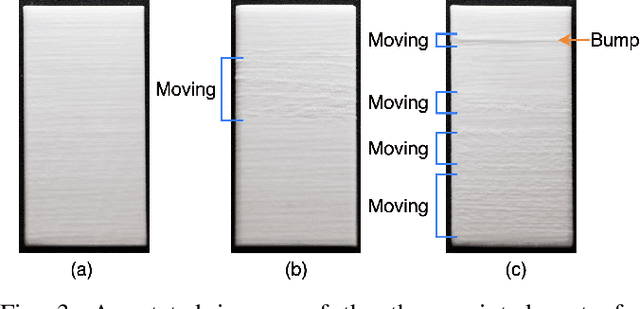
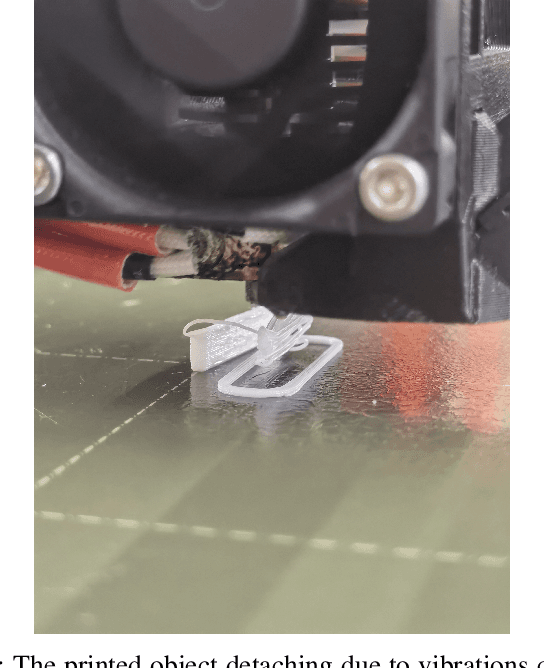
Recent technological innovations in the areas of additive manufacturing and collaborative robotics have paved the way toward realizing the concept of on-demand, personalized production on the shop floor. Additive manufacturing process can provide the capability of printing highly customized parts based on various customer requirements. Autonomous, mobile systems provide the flexibility to move custom parts around the shop floor to various manufacturing operations, as needed by product requirements. In this work, we proposed a mobile additive manufacturing robot framework for merging an additive manufacturing process system with an autonomous mobile base. Two case studies showcase the potential benefits of the proposed mobile additive manufacturing framework. The first case study overviews the effect that a mobile system can have on a fused deposition modeling process. The second case study showcases how integrating a mobile additive manufacturing machine can improve the throughput of the manufacturing system. The major findings of this study are that the proposed mobile robotic AM has increased throughput by taking advantage of the travel time between operations/processing sites. It is particularly suited to perform intermittent operations (e.g., preparing feedstock) during the travel time of the robotic AM. One major implication of this study is its application in manufacturing structural components (e.g., concrete construction, and feedstock preparation during reconnaissance missions) in remote or extreme terrains with on-site or on-demand feedstocks.