 Add to Chrome
 Add to Firefox
 Add to Edge
Unified Number-Free Text-to-Motion Generation Via Flow Matching
Mar 27, 2026
Generative models excel at motion synthesis for a fixed number of agents but struggle to generalize with variable agents. Based on limited, domain-specific data, existing methods employ autoregressive models to generate motion recursively, which suffer from inefficiency and error accumulation. We propose Unified Motion Flow (UMF), which consists of Pyramid Motion Flow (P-Flow) and Semi-Noise Motion Flow (S-Flow). UMF decomposes the number-free motion generation into a single-pass motion prior generation stage and multi-pass reaction generation stages. Specifically, UMF utilizes a unified latent space to bridge the distribution gap between heterogeneous motion datasets, enabling effective unified training. For motion prior generation, P-Flow operates on hierarchical resolutions conditioned on different noise levels, thereby mitigating computational overheads. For reaction generation, S-Flow learns a joint probabilistic path that adaptively performs reaction transformation and context reconstruction, alleviating error accumulation. Extensive results and user studies demonstrate UMF' s effectiveness as a generalist model for multi-person motion generation from text. Project page: https://githubhgh.github.io/umf/.

Efficient Continual Adaptation of Pretrained Robotic Policy with Online Meta-Learned Adapters
Mar 27, 2025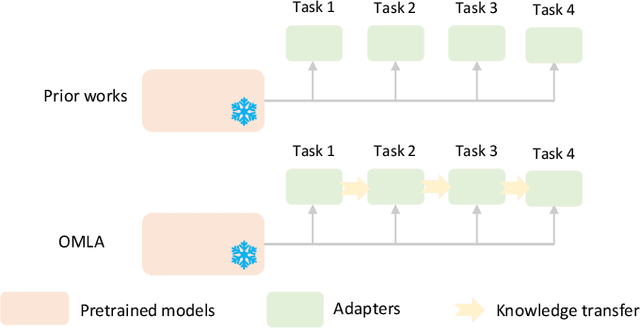

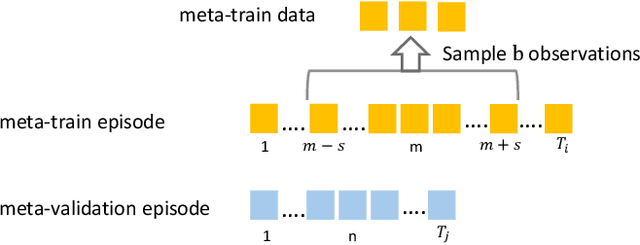
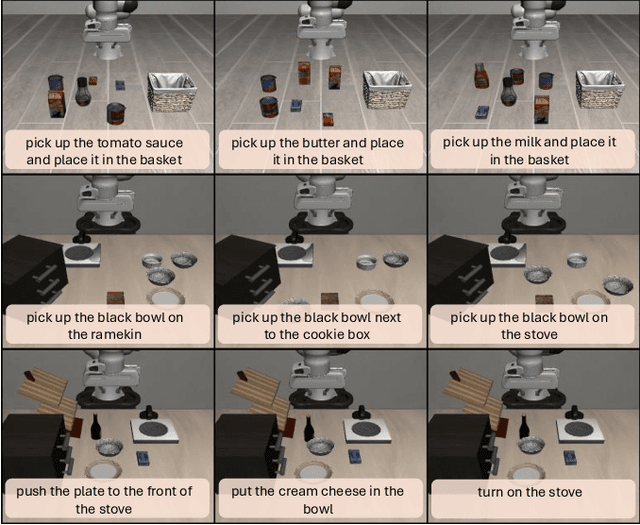
Continual adaptation is essential for general autonomous agents. For example, a household robot pretrained with a repertoire of skills must still adapt to unseen tasks specific to each household. Motivated by this, building upon parameter-efficient fine-tuning in language models, prior works have explored lightweight adapters to adapt pretrained policies, which can preserve learned features from the pretraining phase and demonstrate good adaptation performances. However, these approaches treat task learning separately, limiting knowledge transfer between tasks. In this paper, we propose Online Meta-Learned adapters (OMLA). Instead of applying adapters directly, OMLA can facilitate knowledge transfer from previously learned tasks to current learning tasks through a novel meta-learning objective. Extensive experiments in both simulated and real-world environments demonstrate that OMLA can lead to better adaptation performances compared to the baseline methods. The project link: https://ricky-zhu.github.io/OMLA/.