 Add to Chrome
 Add to Firefox
 Add to Edge
Graph-RHO: Critical-path-aware Heterogeneous Graph Network for Long-Horizon Flexible Job-Shop Scheduling
Apr 11, 2026
Long-horizon Flexible Job-Shop Scheduling~(FJSP) presents a formidable combinatorial challenge due to complex, interdependent decisions spanning extended time horizons. While learning-based Rolling Horizon Optimization~(RHO) has emerged as a promising paradigm to accelerate solving by identifying and fixing invariant operations, its effectiveness is hindered by the structural complexity of FJSP. Existing methods often fail to capture intricate graph-structured dependencies and ignore the asymmetric costs of prediction errors, in which misclassifying critical-path operations is significantly more detrimental than misclassifying non-critical ones. Furthermore, dynamic shifts in predictive confidence during the rolling process make static pruning thresholds inadequate. To address these limitations, we propose Graph-RHO, a novel critical-path-aware graph-based RHO framework. First, we introduce a topology-aware heterogeneous graph network that encodes subproblems as operation-machine graphs with multi-relational edges, leveraging edge-feature-aware message passing to predict operation stability. Second, we incorporate a critical-path-aware mechanism that injects inductive biases during training to distinguish highly sensitive bottleneck operations from robust ones. Third, we devise an adaptive thresholding strategy that dynamically calibrates decision boundaries based on online uncertainty estimation to align model predictions with the solver's search space. Extensive experiments on standard benchmarks demonstrate that \mbox{Graph-RHO} establishes a new state of the art in solution quality and computational efficiency. Remarkably, it exhibits exceptional zero-shot generalization, reducing solve time by over 30\% on large-scale instances (2000 operations) while achieving superior solution quality. Our code is available \href{https://github.com/IntelliSensing/Graph-RHO}{here}.

UniRS: Unifying Multi-temporal Remote Sensing Tasks through Vision Language Models
Dec 30, 2024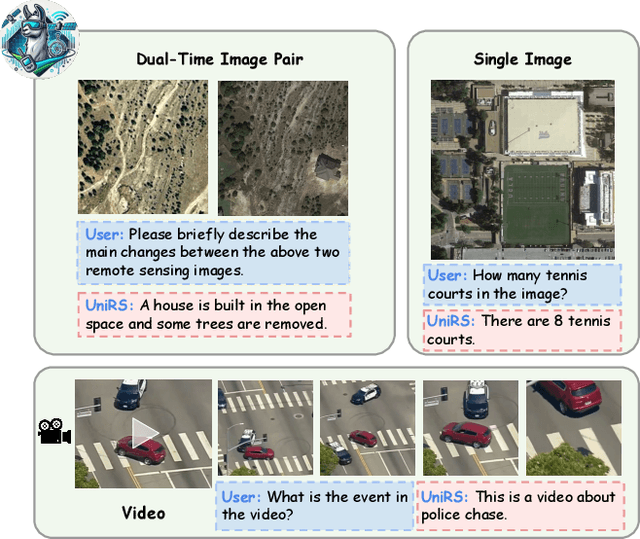
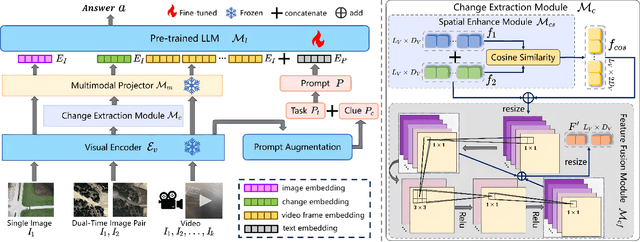
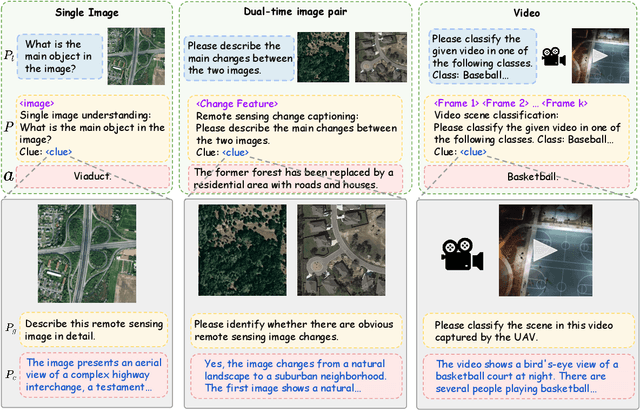
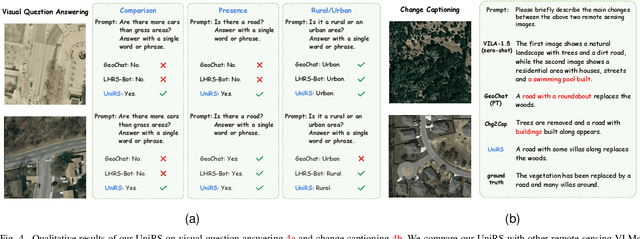
The domain gap between remote sensing imagery and natural images has recently received widespread attention and Vision-Language Models (VLMs) have demonstrated excellent generalization performance in remote sensing multimodal tasks. However, current research is still limited in exploring how remote sensing VLMs handle different types of visual inputs. To bridge this gap, we introduce \textbf{UniRS}, the first vision-language model \textbf{uni}fying multi-temporal \textbf{r}emote \textbf{s}ensing tasks across various types of visual input. UniRS supports single images, dual-time image pairs, and videos as input, enabling comprehensive remote sensing temporal analysis within a unified framework. We adopt a unified visual representation approach, enabling the model to accept various visual inputs. For dual-time image pair tasks, we customize a change extraction module to further enhance the extraction of spatiotemporal features. Additionally, we design a prompt augmentation mechanism tailored to the model's reasoning process, utilizing the prior knowledge of the general-purpose VLM to provide clues for UniRS. To promote multi-task knowledge sharing, the model is jointly fine-tuned on a mixed dataset. Experimental results show that UniRS achieves state-of-the-art performance across diverse tasks, including visual question answering, change captioning, and video scene classification, highlighting its versatility and effectiveness in unifying these multi-temporal remote sensing tasks. Our code and dataset will be released soon.