 Add to Chrome
 Add to Firefox
 Add to Edge
Multi-kernel spectral clustering: Entrywise eigenvector perturbation bounds and exact recovery
Aug 09, 2026
Kernel spectral clustering with a single bandwidth can be inadequate for data exhibiting multiple characteristic pairwise-distance scales, a problem particularly prevalent in the high-dimensional regime. We address this issue through a multi-kernel formulation that aggregates kernels with different bandwidths. The bandwidths are selected as prescribed empirical quantiles of the pairwise squared distances, thereby capturing the relevant distance scales without requiring prior population-scale information. We develop a rigorous theoretical analysis of the resulting method under a general high-dimensional, multi-scale mixture model with heterogeneous cluster centers and covariance geometries. We construct a blockwise constant, low-rank informative approximation to the empirical multi-kernel matrix and establish row-wise $\ell_{2,\infty}$ perturbation bounds for its leading spectral components, as well as for the associated normalized Laplacian matrix. These bounds yield observation-level control of the spectral embedding, which is more informative than conventional global eigenspace perturbation estimates. Under suitable eigen-gap and cluster-separation conditions, we show that approximate $K$-means applied to the multi-kernel spectral embedding achieves exact recovery with high probability.

Spectral Machine Learning for Pancreatic Mass Imaging Classification
May 03, 2021
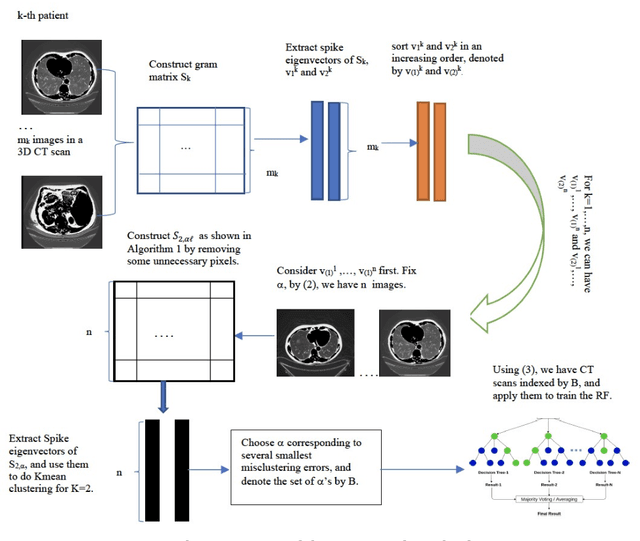
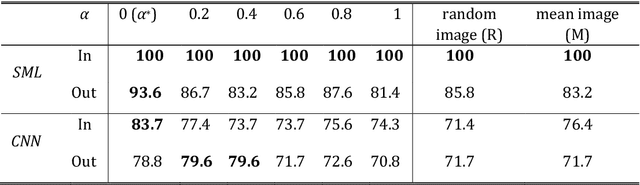
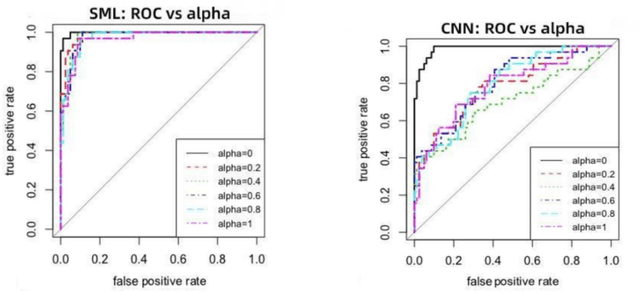
We present a novel spectral machine learning (SML) method in screening for pancreatic mass using CT imaging. Our algorithm is trained with approximately 30,000 images from 250 patients (50 patients with normal pancreas and 200 patients with abnormal pancreas findings) based on public data sources. A test accuracy of 94.6 percents was achieved in the out-of-sample diagnosis classification based on a total of approximately 15,000 images from 113 patients, whereby 26 out of 32 patients with normal pancreas and all 81 patients with abnormal pancreas findings were correctly diagnosed. SML is able to automatically choose fundamental images (on average 5 or 9 images for each patient) in the diagnosis classification and achieve the above mentioned accuracy. The computational time is 75 seconds for diagnosing 113 patients in a laptop with standard CPU running environment. Factors that influenced high performance of a well-designed integration of spectral learning and machine learning included: 1) use of eigenvectors corresponding to several of the largest eigenvalues of sample covariance matrix (spike eigenvectors) to choose input attributes in classification training, taking into account only the fundamental information of the raw images with less noise; 2) removal of irrelevant pixels based on mean-level spectral test to lower the challenges of memory capacity and enhance computational efficiency while maintaining superior classification accuracy; 3) adoption of state-of-the-art machine learning classification, gradient boosting and random forest. Our methodology showcases practical utility and improved accuracy of image diagnosis in pancreatic mass screening in the era of AI.