 Add to Chrome
 Add to Firefox
 Add to Edge
ARC Prize 2025: Technical Report
Jan 15, 2026
The ARC-AGI benchmark series serves as a critical measure of few-shot generalization on novel tasks, a core aspect of intelligence. The ARC Prize 2025 global competition targeted the newly released ARC-AGI-2 dataset, which features greater task complexity compared to its predecessor. The Kaggle competition attracted 1,455 teams and 15,154 entries, with the top score reaching 24% on the ARC-AGI-2 private evaluation set. Paper submissions nearly doubled year-over-year to 90 entries, reflecting the growing research interest in fluid intelligence and abstract reasoning. The defining theme of 2025 is the emergence of the refinement loop -- a per-task iterative program optimization loop guided by a feedback signal. Refinement loops come in a variety of forms, in particular evolutionary program synthesis approaches and application-layer refinements to commercial AI systems. Such refinement loops are also possible in weight space, as evidenced by zero-pretraining deep learning methods which are now achieving competitive performance with remarkably small networks (7M parameters). In parallel, four frontier AI labs (Anthropic, Google DeepMind, OpenAI, and xAI) reported ARC-AGI performance in public model cards in 2025, establishing ARC-AGI as an industry standard benchmark for AI reasoning. However, our analysis indicates that current frontier AI reasoning performance remains fundamentally constrained to knowledge coverage, giving rise to new forms of benchmark contamination. In this paper, we survey the top-performing methods, examine the role of refinement loops in AGI progress, discuss knowledge-dependent overfitting, and preview ARC-AGI-3, which introduces interactive reasoning challenges that require exploration, planning, memory, goal acquisition, and alignment capabilities.

ARC-AGI-2: A New Challenge for Frontier AI Reasoning Systems
May 17, 2025The Abstraction and Reasoning Corpus for Artificial General Intelligence (ARC-AGI), introduced in 2019, established a challenging benchmark for evaluating the general fluid intelligence of artificial systems via a set of unique, novel tasks only requiring minimal prior knowledge. While ARC-AGI has spurred significant research activity over the past five years, recent AI progress calls for benchmarks capable of finer-grained evaluation at higher levels of cognitive complexity. We introduce ARC-AGI-2, an upgraded version of the benchmark. ARC-AGI-2 preserves the input-output pair task format of its predecessor, ensuring continuity for researchers. It incorporates a newly curated and expanded set of tasks specifically designed to provide a more granular signal to assess abstract reasoning and problem-solving abilities at higher levels of fluid intelligence. To contextualize the difficulty and characteristics of ARC-AGI-2, we present extensive results from human testing, providing a robust baseline that highlights the benchmark's accessibility to human intelligence, yet difficulty for current AI systems. ARC-AGI-2 aims to serve as a next-generation tool for rigorously measuring progress towards more general and human-like AI capabilities.
ARC Prize 2024: Technical Report
Dec 05, 2024
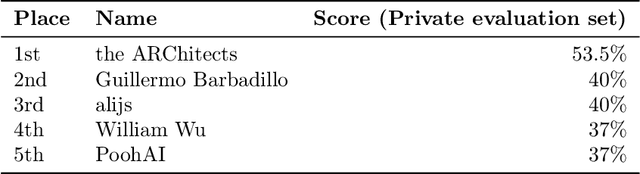
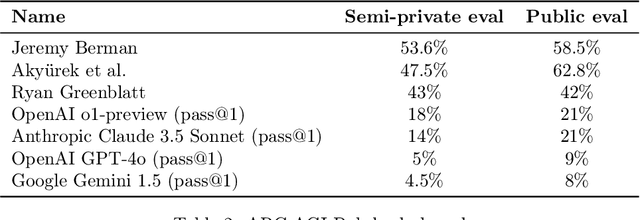

As of December 2024, the ARC-AGI benchmark is five years old and remains unbeaten. We believe it is currently the most important unsolved AI benchmark in the world because it seeks to measure generalization on novel tasks -- the essence of intelligence -- as opposed to skill at tasks that can be prepared for in advance. This year, we launched ARC Prize, a global competition to inspire new ideas and drive open progress towards AGI by reaching a target benchmark score of 85\%. As a result, the state-of-the-art score on the ARC-AGI private evaluation set increased from 33\% to 55.5\%, propelled by several frontier AGI reasoning techniques including deep learning-guided program synthesis and test-time training. In this paper, we survey top approaches, review new open-source implementations, discuss the limitations of the ARC-AGI-1 dataset, and share key insights gained from the competition.