 Add to Chrome
 Add to Firefox
 Add to Edge
OLR-WA: Online Weighted Average Linear Regression in Multivariate Data Streams
Dec 16, 2025

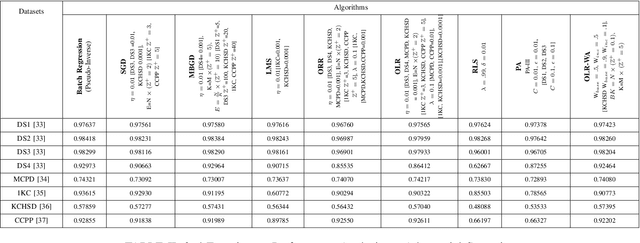
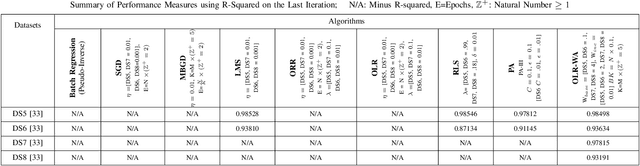
Online learning updates models incrementally with new data, avoiding large storage requirements and costly model recalculations. In this paper, we introduce "OLR-WA; OnLine Regression with Weighted Average", a novel and versatile multivariate online linear regression model. We also investigate scenarios involving drift, where the underlying patterns in the data evolve over time, conduct convergence analysis, and compare our approach with existing online regression models. The results of OLR-WA demonstrate its ability to achieve performance comparable to the batch regression, while also showcasing comparable or superior performance when compared with other state-of-the-art online models, thus establishing its effectiveness. Moreover, OLR-WA exhibits exceptional performance in terms of rapid convergence, surpassing other online models with consistently achieving high r2 values as a performance measure from the first iteration to the last iteration, even when initialized with minimal amount of data points, as little as 1% to 10% of the total data points. In addition to its ability to handle time-based (temporal drift) scenarios, remarkably, OLR-WA stands out as the only model capable of effectively managing confidence-based challenging scenarios. It achieves this by adopting a conservative approach in its updates, giving priority to older data points with higher confidence levels. In summary, OLR-WA's performance further solidifies its versatility and utility across different contexts, making it a valuable solution for online linear regression tasks.

OLR-WA Online Regression with Weighted Average
Jul 06, 2023Machine Learning requires a large amount of training data in order to build accurate models. Sometimes the data arrives over time, requiring significant storage space and recalculating the model to account for the new data. On-line learning addresses these issues by incrementally modifying the model as data is encountered, and then discarding the data. In this study we introduce a new online linear regression approach. Our approach combines newly arriving data with a previously existing model to create a new model. The introduced model, named OLR-WA (OnLine Regression with Weighted Average) uses user-defined weights to provide flexibility in the face of changing data to bias the results in favor of old or new data. We have conducted 2-D and 3-D experiments comparing OLR-WA to a static model using the entire data set. The results show that for consistent data, OLR-WA and the static batch model perform similarly and for varying data, the user can set the OLR-WA to adapt more quickly or to resist change.