 Add to Chrome
 Add to Firefox
 Add to Edge
The Confounder Trap: Treatment-Encoding Representations in Causal Inference with Text
Jul 28, 2026
Estimating causal effects of linguistic properties from observational text is difficult because the same document can contain both the treatment of interest and the non-treatment textual attributes needed for adjustment. Existing approaches often learn representations from the full text to capture latent confounding, but when treatment status is itself encoded by words in the text, these representations can directly encode treatment. This creates a confounder trap: richer representations can make treated and control documents separable, inducing overlap violations even when the underlying causal problem satisfies overlap. We study latent text treatments that are encoded through lexicons or other treatment-defining lexical information, and propose masking-based adjustment representations that remove this lexical treatment signal before representation learning. We formalize representation-induced overlap failure, prove that deletion masking preserves overlap for bag-of-words/topic-model representations, and characterize replacement masking as a natural relaxation for large language models that hides treatment-defining tokens while preserving word order and context. Across simulations, masking improves overlap diagnostics, stabilizes treatment effect estimates, and reduces bias relative to adjustment methods that learn from the unmasked text.

Author Clustering and Topic Estimation for Short Texts
Jun 15, 2021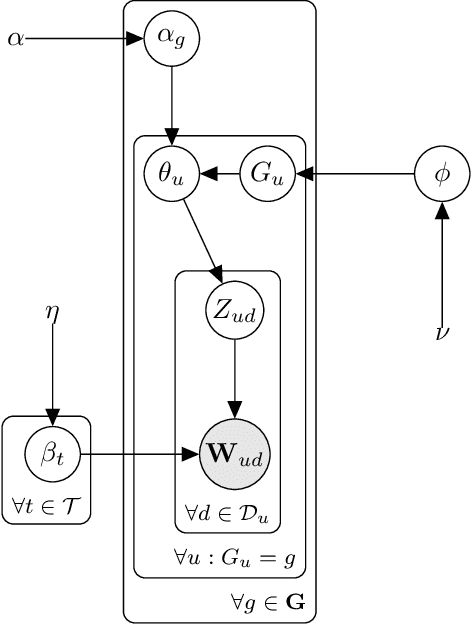
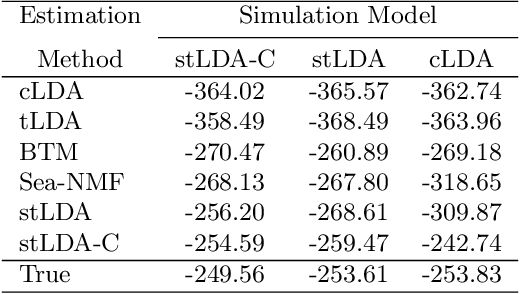
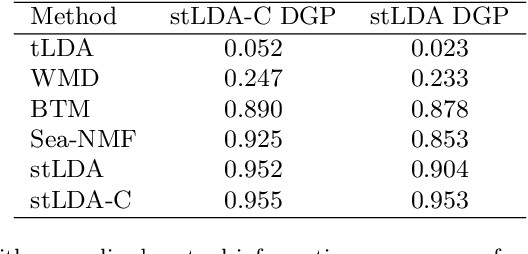
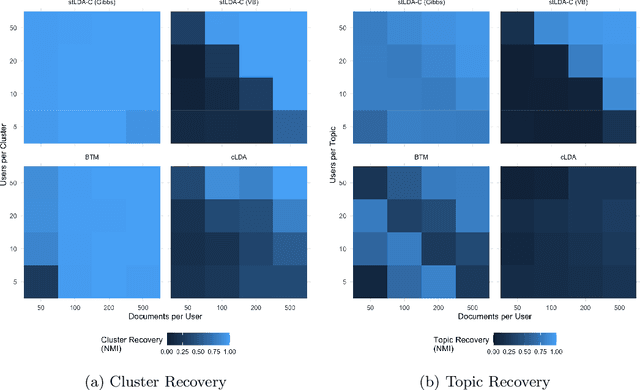
Analysis of short text, such as social media posts, is extremely difficult because it relies on observing many document-level word co-occurrence pairs. Beyond topic distributions, a common downstream task of the modeling is grouping the authors of these documents for subsequent analyses. Traditional models estimate the document groupings and identify user clusters with an independent procedure. We propose a novel model that expands on the Latent Dirichlet Allocation by modeling strong dependence among the words in the same document, with user-level topic distributions. We also simultaneously cluster users, removing the need for post-hoc cluster estimation and improving topic estimation by shrinking noisy user-level topic distributions towards typical values. Our method performs as well as -- or better -- than traditional approaches to problems arising in short text, and we demonstrate its usefulness on a dataset of tweets from United States Senators, recovering both meaningful topics and clusters that reflect partisan ideology.