 Add to Chrome
 Add to Firefox
 Add to Edge
Reducing cross-sample prediction churn in scientific machine learning
May 13, 2026
Scientific machine learning reports predictive performance. It does not report whether the same prediction would survive a different draw of training data. Across $9$ chemistry benchmarks, two classifiers trained on independent bootstraps of the same training set agree on aggregate accuracy to within $1.3\text{--}4.2$ percentage points but disagree on the class label of $8.0\text{--}21.8\%$ of test molecules. We call this gap \emph{cross-sample prediction churn}. The standard parameter-side techniques (deep ensembles, MC dropout, stochastic weight averaging) do not reduce this gap; two data-side methods do. The first is $K$-bootstrap bagging, which cuts the rate $40\text{--}54\%$ on every dataset at no accuracy cost ($K{\times}$-ERM compute). The second is \emph{twin-bootstrap}, our proposal: two networks trained jointly on independent bootstraps with a sym-KL consistency loss between their predictions, which at matched $2{\times}$-ERM compute reduces churn a further median $45\%$ beyond bagging-$K{=}2$. Cross-sample prediction churn deserves a column alongside predictive performance in scientific-ML benchmark reports, because without it the parameter-side and data-side methods are indistinguishable on the metric they actually differ on.

Beyond Learning on Molecules by Weakly Supervising on Molecules
Feb 04, 2026Molecular representations are inherently task-dependent, yet most pre-trained molecular encoders are not. Task conditioning promises representations that reorganize based on task descriptions, but existing approaches rely on expensive labeled data. We show that weak supervision on programmatically derived molecular motifs is sufficient. Our Adaptive Chemical Embedding Model (ACE-Mol) learns from hundreds of motifs paired with natural language descriptors that are cheap to compute, trivial to scale. Conventional encoders slowly search the embedding space for task-relevant structure, whereas ACE-Mol immediately aligns its representations with the task. ACE-Mol achieves state-of-the-art performance across molecular property prediction benchmarks with interpretable, chemically meaningful representations.
General purpose models for the chemical sciences
Jul 10, 2025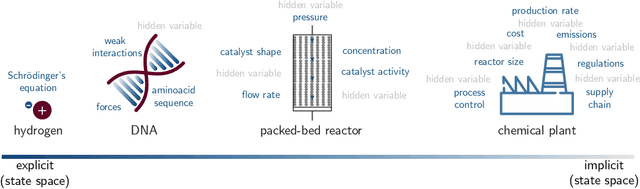
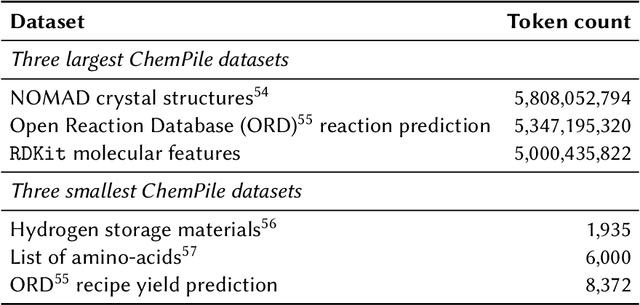
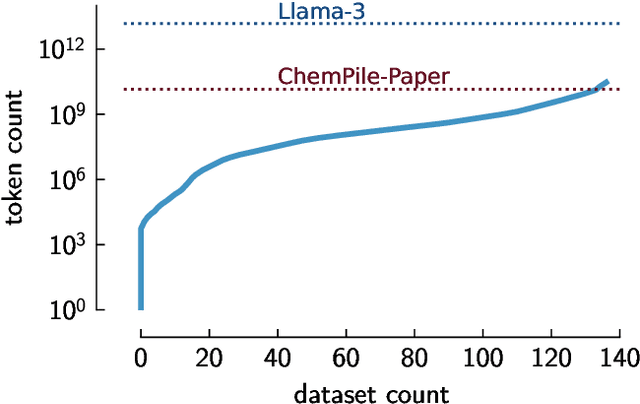
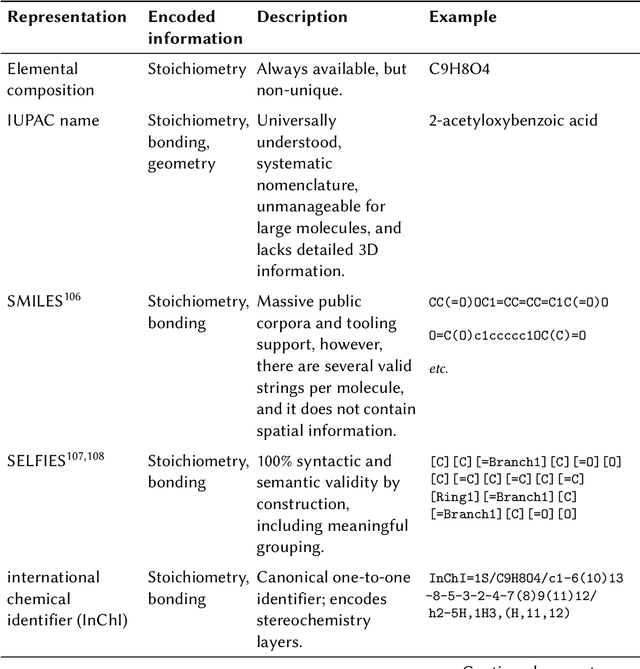
Data-driven techniques have a large potential to transform and accelerate the chemical sciences. However, chemical sciences also pose the unique challenge of very diverse, small, fuzzy datasets that are difficult to leverage in conventional machine learning approaches completely. A new class of models, general-purpose models (GPMs) such as large language models, have shown the ability to solve tasks they have not been directly trained on, and to flexibly operate with low amounts of data in different formats. In this review, we discuss fundamental building principles of GPMs and review recent applications of those models in the chemical sciences across the entire scientific process. While many of these applications are still in the prototype phase, we expect that the increasing interest in GPMs will make many of them mature in the coming years.